February, 2024
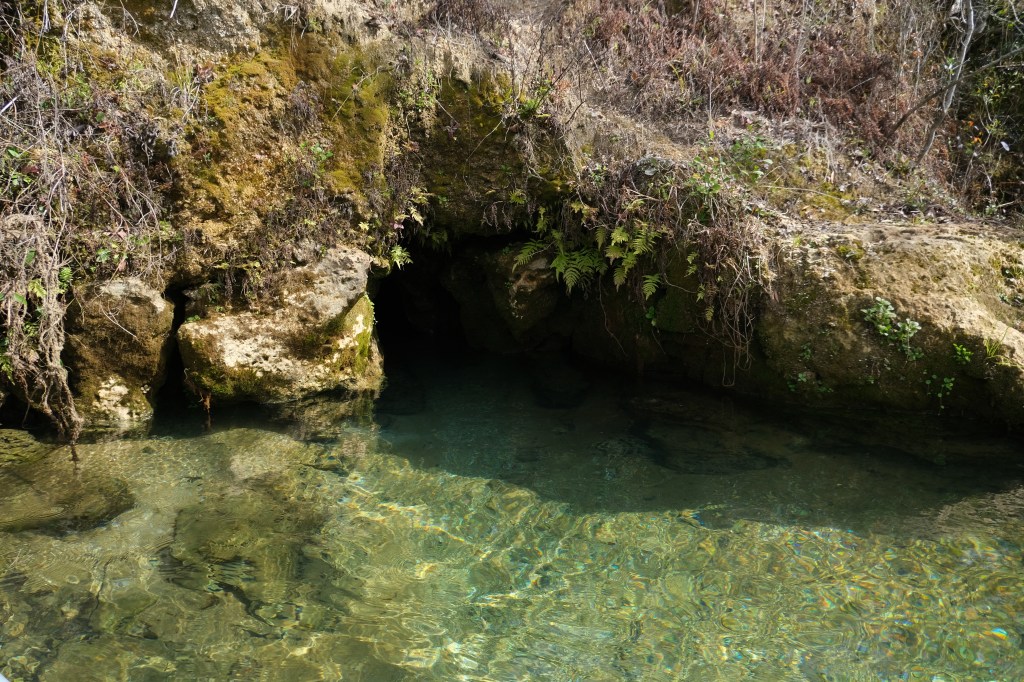
Some Florida springs seep from soil, some gush from giant underground gashes in the limestone, and some spurt from caves. Washington Blue Spring is of the latter type with the cool, clear water rushing out of two caves (each with multiple openings).
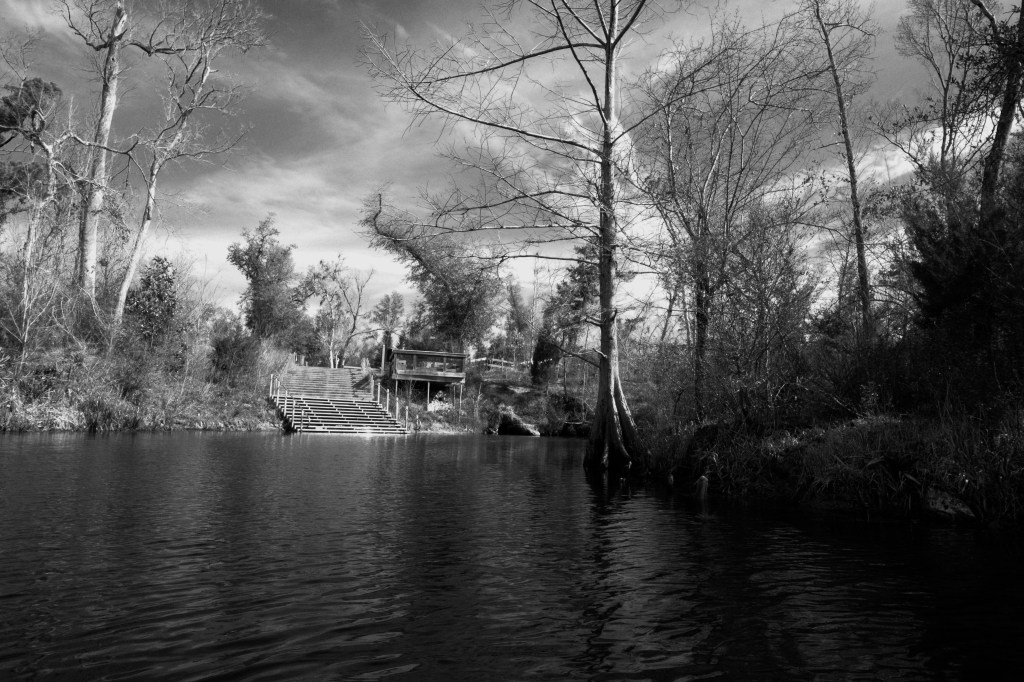

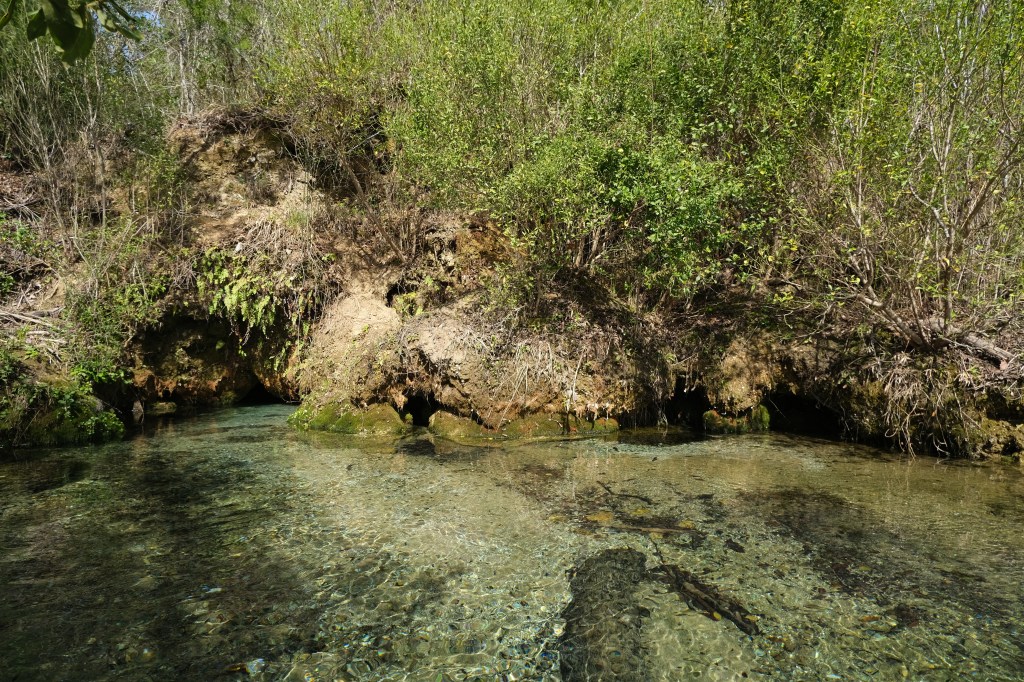
View of the entrance to the right-hand spring cave (the dark area off to the right of the platform, top) and of the left-hand spring cave (middle) with its multiple openings (bottom).
The water flow produced by the two caves produces a Y-shaped spring. There actually is a third arm (producing a trident?), although I may have missed a vent on that arm. The Washington Blue Spring system is just upstream of Gainer, Pitt, Sylvan, and Williford springs on Econofina Creek. Econfina Creek flows into Deerpoint Lake and eventually St. Andrews Bay at Panama City. The region is agricultural to the east, water management area to the west, and a mixture of both upstream.

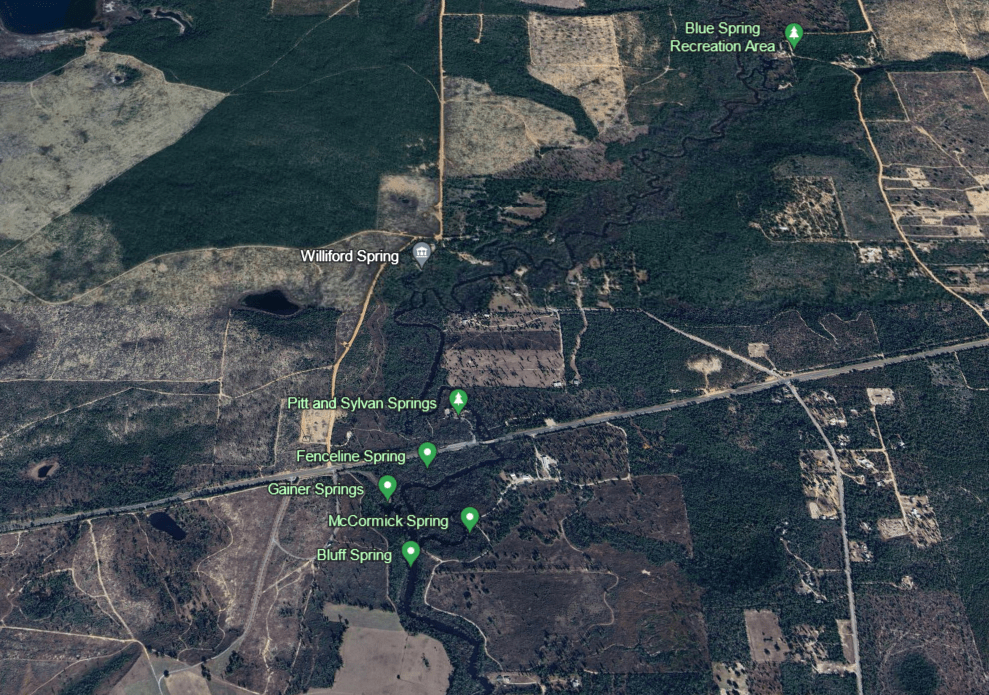
Maps showing the morphology of the spring (top) and the location relative to other springs surveyed.
Of the springs that I surveyed on Econfina Creek, this spring had a higher diversity of fish, my main goal in these visits, but also of human experiences. The human density at the park was low, but a few souls were enjoying their Friday morning outside. I heard discussions of the fish present, but also of bar dynamics, salads as healthy eating, and goats as pets. A friendly bear of a man on a paddle board shared his music, Meat Puppets “Backwater”, with the fish and me. Alas, I did not get a picture of the stinkin’ cute pet baby goat that was investigating the sand bar formed by the confluence of Washington Blue Spring with Econfina Creek.
Fish with a soundtrack. The ticking sounds in the background were of animal origin (crayfish?), but the Meat Puppets was being conducted through the water from a boombox and through a paddleboard. I got a big wave from the man on the paddleboard. The fish seem unaffected by the music or the clicking.
This spring was blanketed with a lot more live algae than the lower Econfina springs. Perhaps as a result, the springsnails (Elimia sp.) had really proliferated, especially on the limestone and sandy substrate near the caves.


A mixture of live and senescent algae at two sites along the Washington Blue Spring run. The brightest green algae was likely Vaucheria, a yellow-green species that resembles green hair.
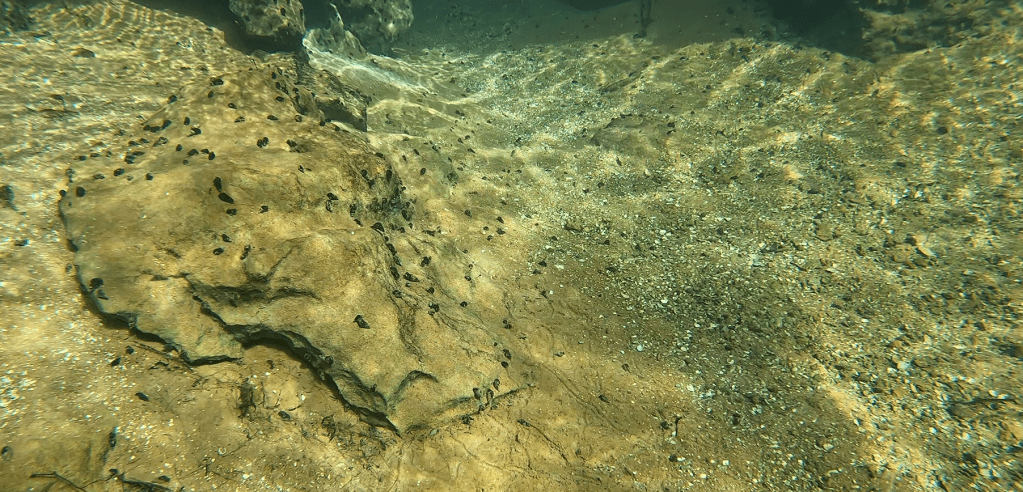
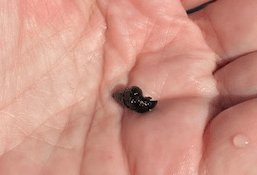
Spring snails on the limestone and sand (top) and a closeup of a snail on my hand (bottom).
I discovered that there were other snails crawling through the sediments when I sped up the film that I collected near the left cave system. Because they were buried in the sediments, I did not see a live one to pick up and identify.
Unidentified snails crawling at 2000x their normal speed.
Fish diversity and density was a bit higher in this spring than in the other springs the I visited on Econfina Creek in February. In addition to the shiners and sunfish that I saw at those other springs, I recorded more species of sunfish, more bass, more fundulids (killifish and topminnows), and some golden silversides (Labidesthes vanhyningi) at Washington Blue Spring. Spotted sunfish, which approached nearly every camera in central peninsula, were less abundant and more shy here. Instead, I got some footage of shiners attacking the camera.

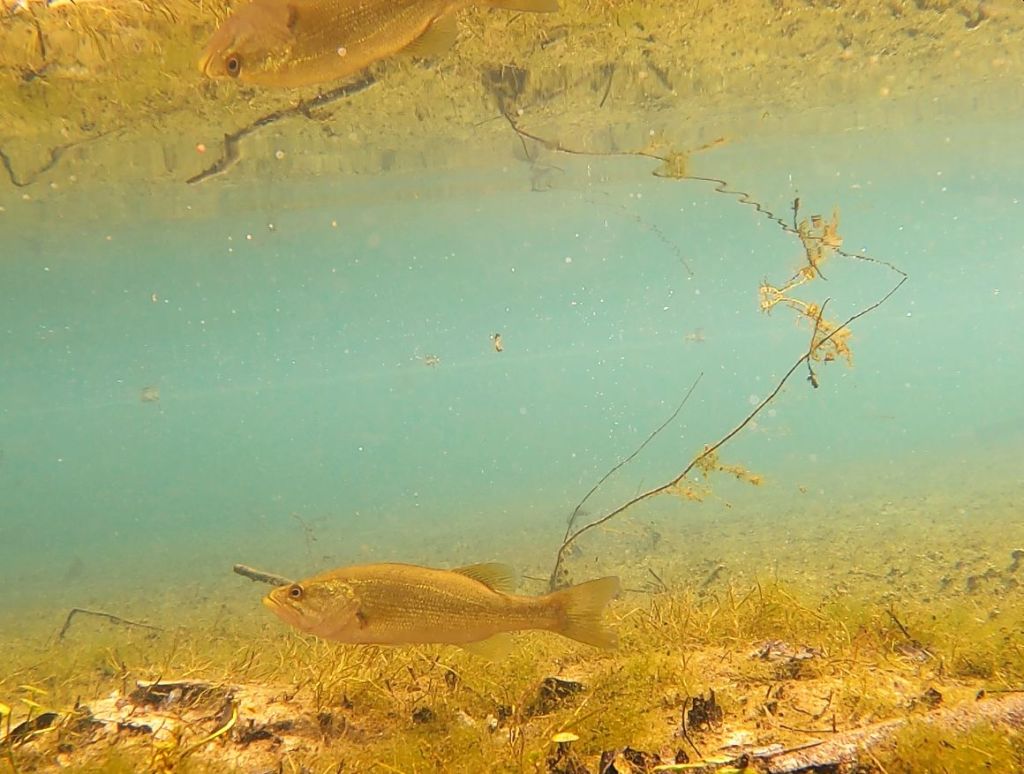
Pretty juvenile redbreast (Lepomis auritus) and redear sunfish (Lepomis microlophus) that are a little too close to the camera and moving to be sharp (top). A golden largemouth bass (Micropterus salmoides) matching the algal background (bottom).


A Russetfin topminnow (Fundulus escambiae) in the shallows near one of the caves (top) and a golden silverside and largemouth bass downstream (middle and bottom).
Shiners attacking the camera with human discussion traveling through the water in the background.
Given the high proportion of water management area land near Econfina Creek, nutrient concentrations were generally low for the period of 2009-2020 (https://protectingfloridatogether.gov/water-quality-status-dashboard). In that time period, most data points were near ~0.2 mg/L with periodic measurements up to 0.6 mg/L and a few high spikes up to 1.4+ mg/L (that would be considered quite high). Phosphorus has exhibited similar trends with most points quite low (~0.01 mg/L), virtually all points below 0.03 mg/L and just a few points in the 0.035-0.045 mg/L range. Interestingly, the oxygen concentrations were higher in the shallow left arm (3.8-9.9 mg/L) than on the deeper right arm (1.9-2.8 mg/L) of the spring, likely due to the abundant algae. Downstream, the oxygen concentrations were 6.3-7.1 mg/L. The conductivity was low 1280-1450 microS/cm for all samples.
 A Florida Spring Odyssey