May 2024
View of the Morrison Springs main pool, looking upstream from the vent.
I first tried to visit Morrison Springs in February, but the spring, like so many others in the panhandle, was still flooded from Hurricane Idalia that hit back in August 2023 and subsequent storms. Its large main pool was impossible to see as it was completely covered in brown water. Video is a lot more effective when you can see.
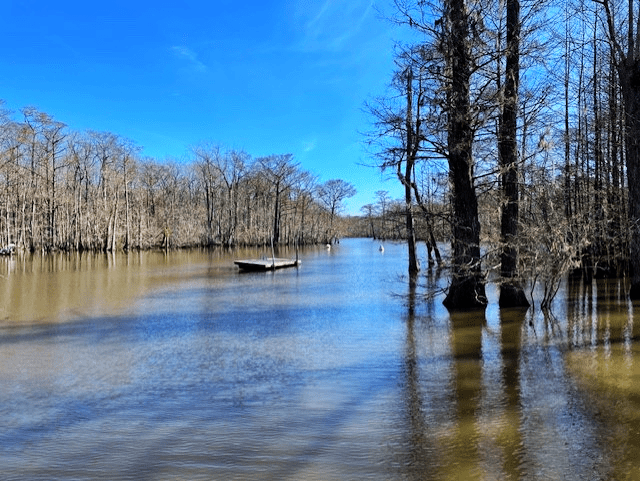

Morrison Springs in February (top) and May (bottom) 2024.
Morrison Springs is a large spring, with a 250-ft diameter main pool. This pool contains three cavities, one of which descends to 300 feet, that produce something on the order of 50 million gallons of water per day, so the spring is categorized as 2nd magnitude, despite its size. Located just south of the town of Ponce de Leon and downstream of Ponce de Leon Spring, Morrison flows down a broad and somewhat shallow run into the Choctawatchee River. The Choctawatchee River meanders down to the Choctawatchee Bay, which opens to the Gulf of Mexico at Destin.
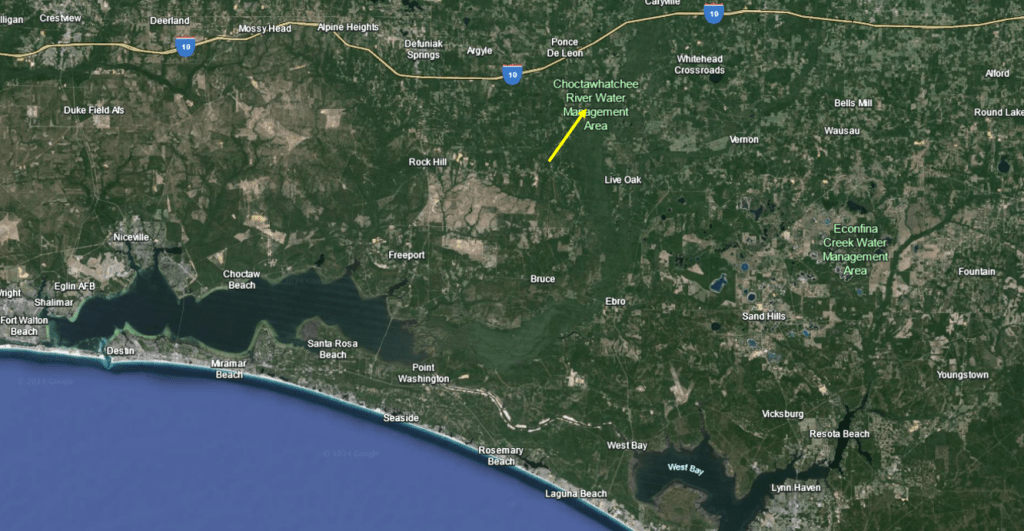
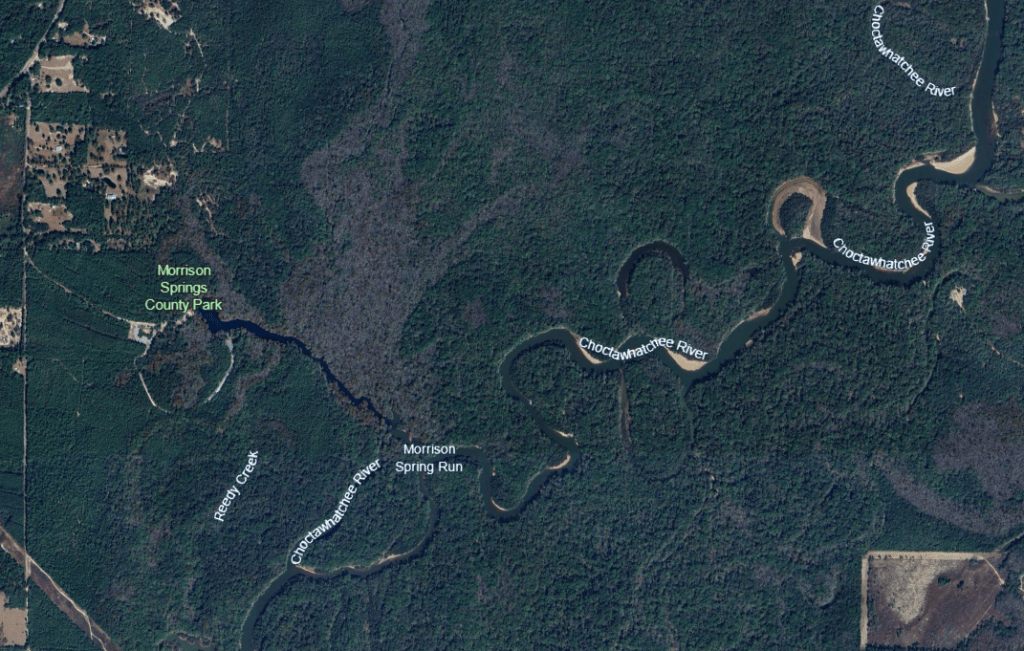
Google Earth images of the location of Morrison Springs on the Choctawatchee River (yellow arrow, top) and of the spring itself (bottom). The headspring appears almost as wide as the Choctawatchee River into which it flows.
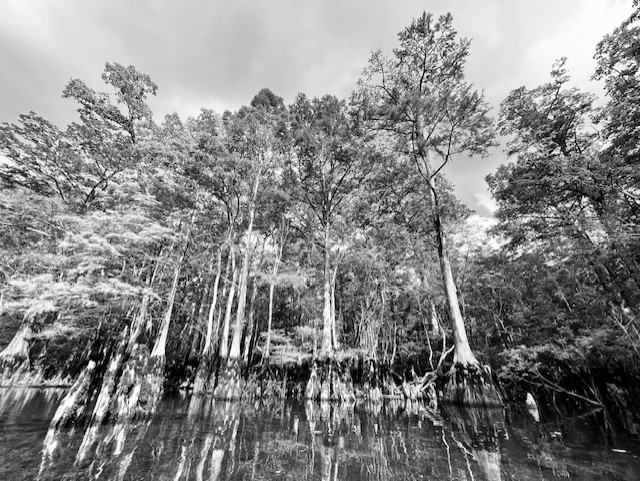
Upon my return to the spring months later, two characteristics struck me: 1) the thick and lovely cypress forest all along the banks and 2) the high water lines on the trees. There were two obvious lines, one about 1/2 meter and one about a meter above the surface of the water on the day that I visited. The prominence of these lines suggest that the spring run attains this stage (water height) often.
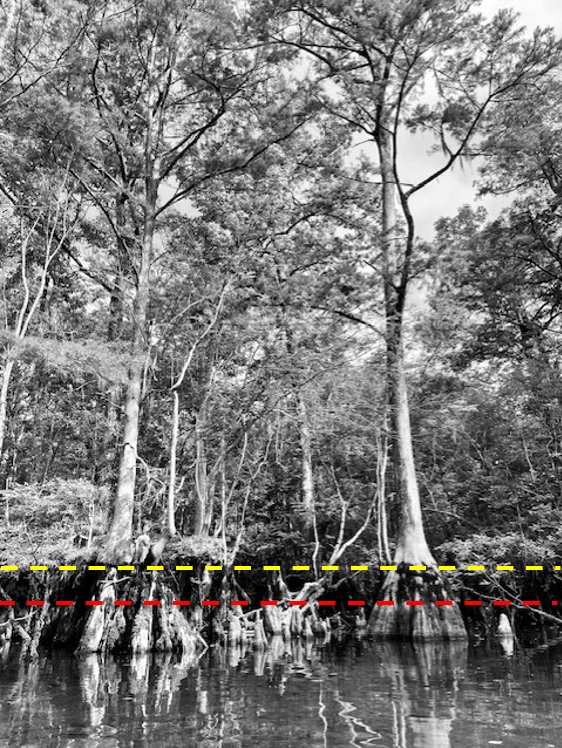
Closer view of some of the cypress trees with dotted lines representing their high water lines.
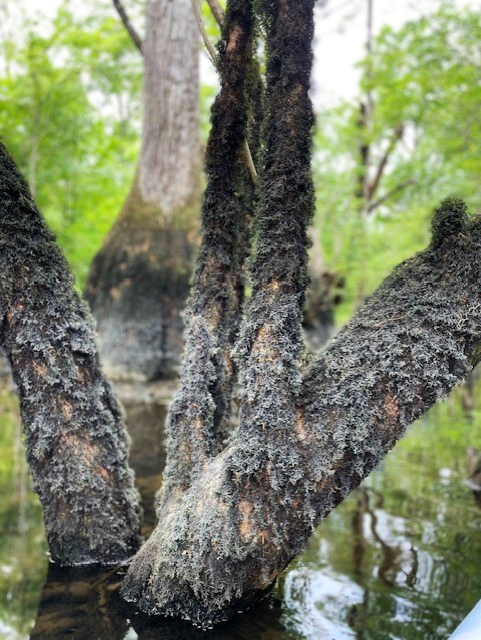
Up near these cypress trees, the water somewhat clear with a layer of suspended sediment near the surface. Happily, I could see both lots of fish and loads of snails. A shoal of shiners made way for largemouth bass (Micropterus salmoides) and spotted sunfish (Lepomis punctatus), which made way for an adult chain pickerel (Esox niger) on the right side of the main pool.
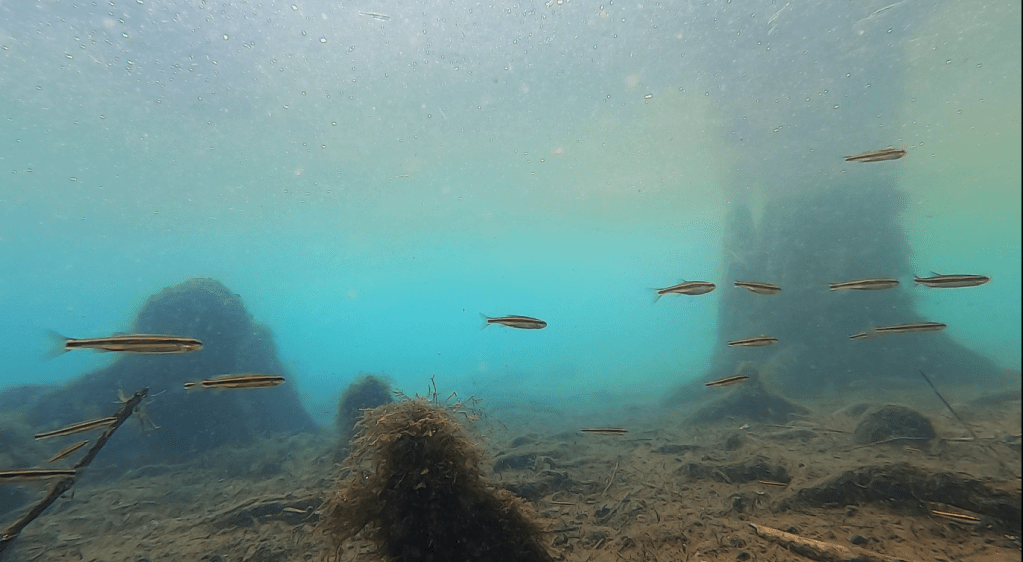

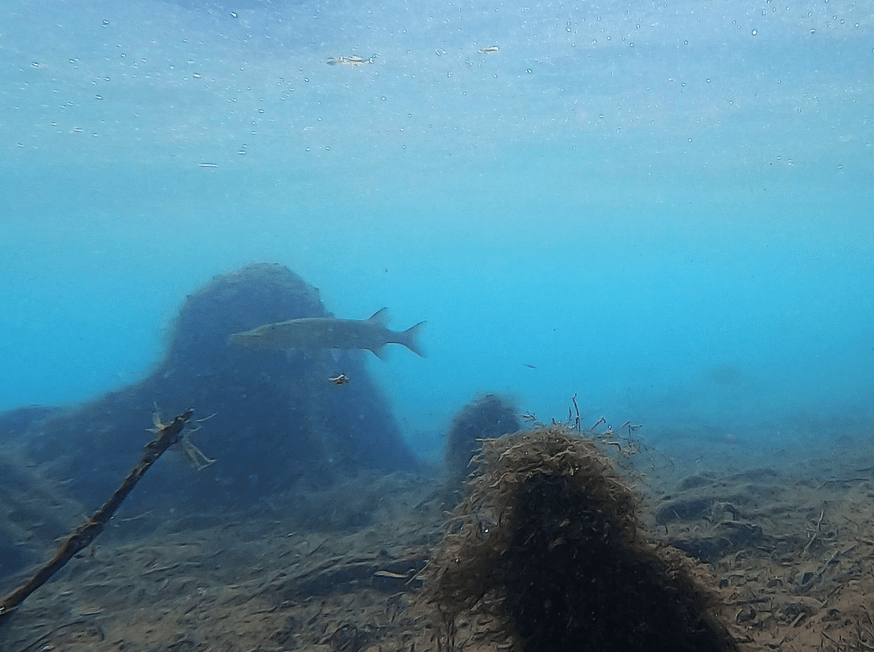
Shiners (top), largemouth bass and spotted sunfish (middle), and a chain pickerel (bottom).
The spring had flooded back into the trees, so I also filmed further back among the cypress trees and was rewarded with two juvenile chain pickerel.
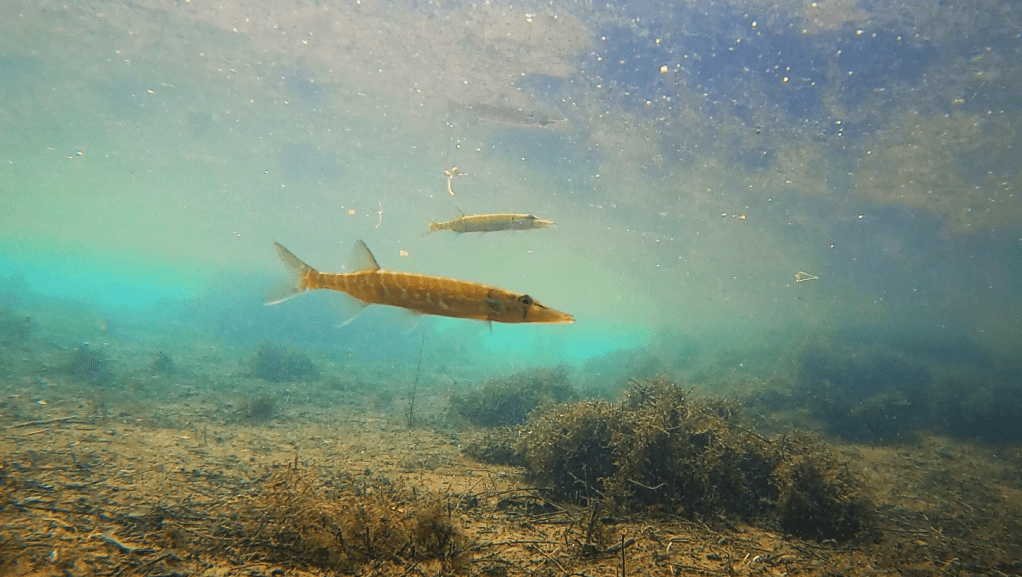
Two juvenile chain pickerel.
On the left side of the main pool, I discovered bizarre-o bluegill sunfish (Lepomis macrochirus) that had virtually no markings. I only recognized them by their diagnostic black dot on the dorsal fin. Typically, fish this large would have prominent dark bars running from top to bottom.
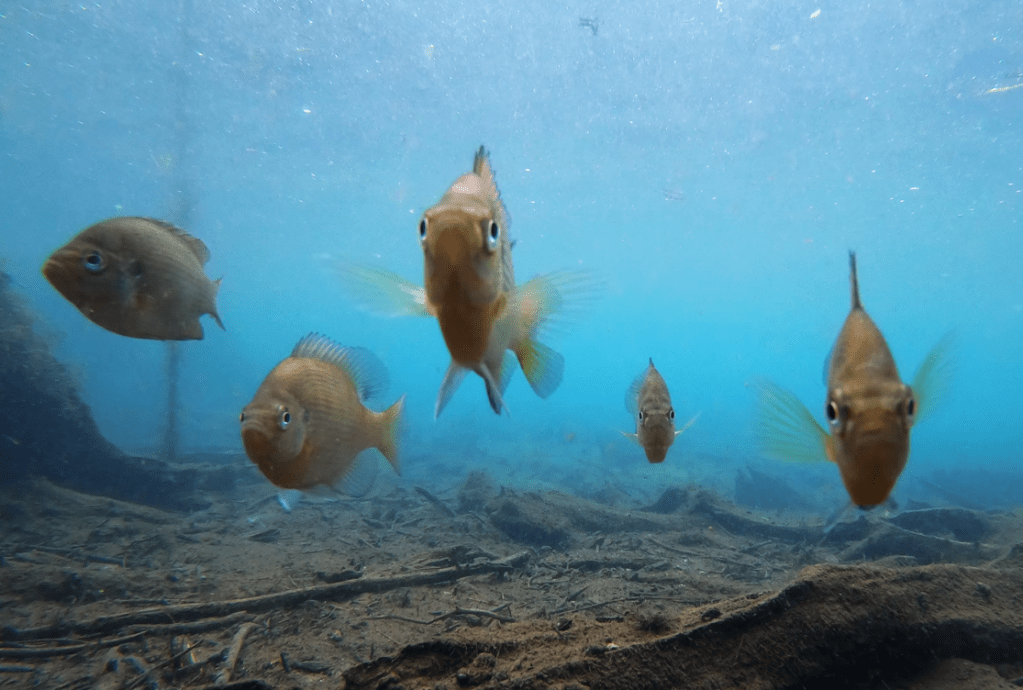
Bluegill sunfish (and one spotted) missing their typical bar patterns.
Alas, the water clarity declined once I left the headspring area. Despite the murkiness, I was able to film several different species of fish, including a bowfin (Amia calva), golden silversides fighting (Labidesthys vanhyningi), and the crown jewel: bluenose shiners (Pteronotropis welaka). I have been asked many times if I have seen them in my visits to springs and finally I can say yes. This species is categorized as a state-designated threatened species due to its isolated populations that are vulnerable to extirpation (local eradication).
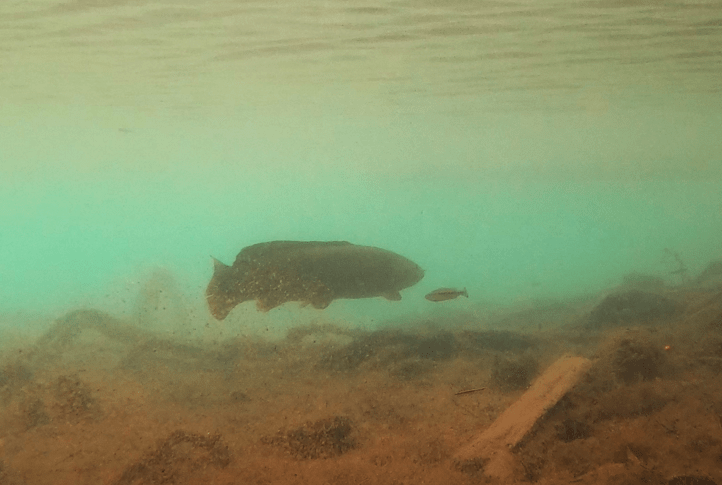
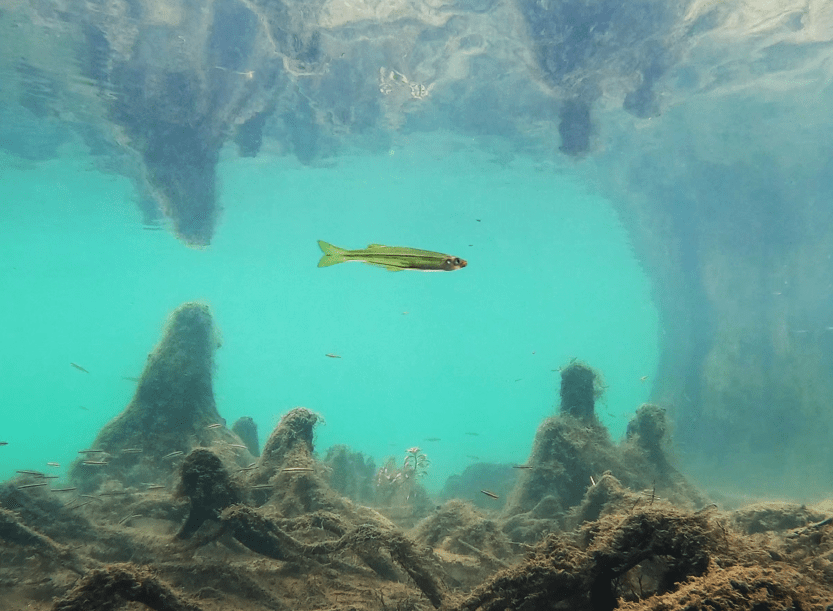
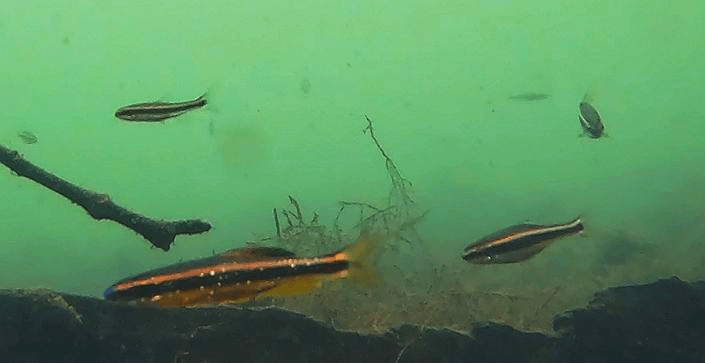
A bowfin looming over a juvenile largemouth bass (top), a golden silverside (middle), and bluenose shiners (bottom). Note the shiners’ bright blue snout and sparkles, which no other Florida shiner possesses. When breeding, the males get much darker and more blue and the dorsal and anal fins get very large and round.
Golden silversides fighting.
I wish that I had better video that could show off the vents of Morrison Spring (I have read that there are three), but the water clarity was too low to see much of anything from the GoPro on my kayak. However, the recording of bluenose shiners made the trip more than worth it. I will have to try again on some day like today (6/12/24) when the Walton County website (https://www.co.walton.fl.us/523/Morrison-Springs) lists water clarity as 1 (the clearest).
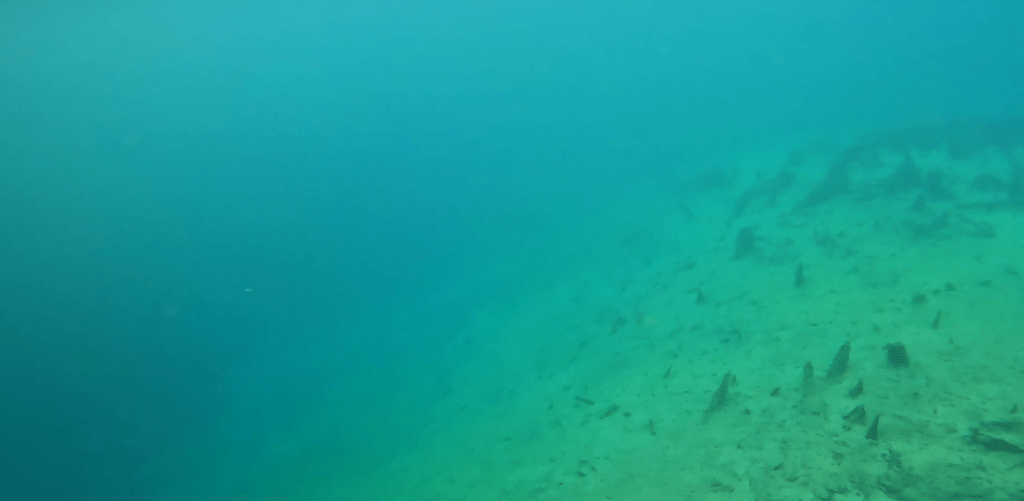
My best view of the vent area on the day of my visit in early May 2024. The view, although terrible, was still much better than in February.
I was unable to find much water quality data on Morrison Spring. About the best that I was able to find was four sets of USGS samples collected from 1969 to 1985 and a 2006 NWFWMD report entitled: Ground water chemical characterization of Morrison Spring, Florida (https://www.nwfwater.com/content/download/6674/48451/WRSR0602.pdf). This report seemed to describe data from wells near Morrison all the way up to the Alabama border. However, their data matched mine (what I collected) quite well, with relatively cold temperatures (NWFWMD = 20.7oC, my data = 20.8-21.5oC at the headspring, 22.7oC downstream), moderate dissolved oxygen (NWFWMD = 3.17 mg/L, my data = 3.02-3.74 mg/L at the headspring, 2.99-4.16 mg/L downstream), and low conductivity (NWFWMD = 226 microS/cm, my data ~230 microS/cm at the headspring, 220-230 microS/cm downstream). The nitrate data that they reported also were quite low (0.180 mg/L). Happily, these data were comparable to the data collected by USGS decades ago, suggesting that Morrison Springs may have been less impacted by human activity than many other springs. However, I did see reports that it was closed due to high bacterial counts in 2014 and I saw recent warnings about the large number of visitors in the warm seasons.
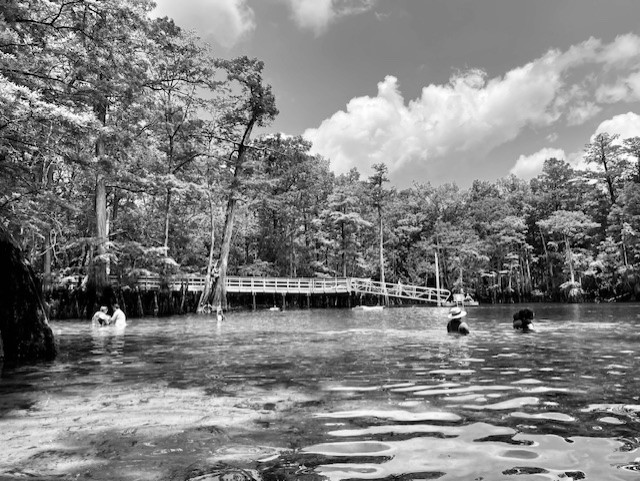
A few of the visitors at the Morrison Springs main pool in May 2024.
 A Florida Spring Odyssey