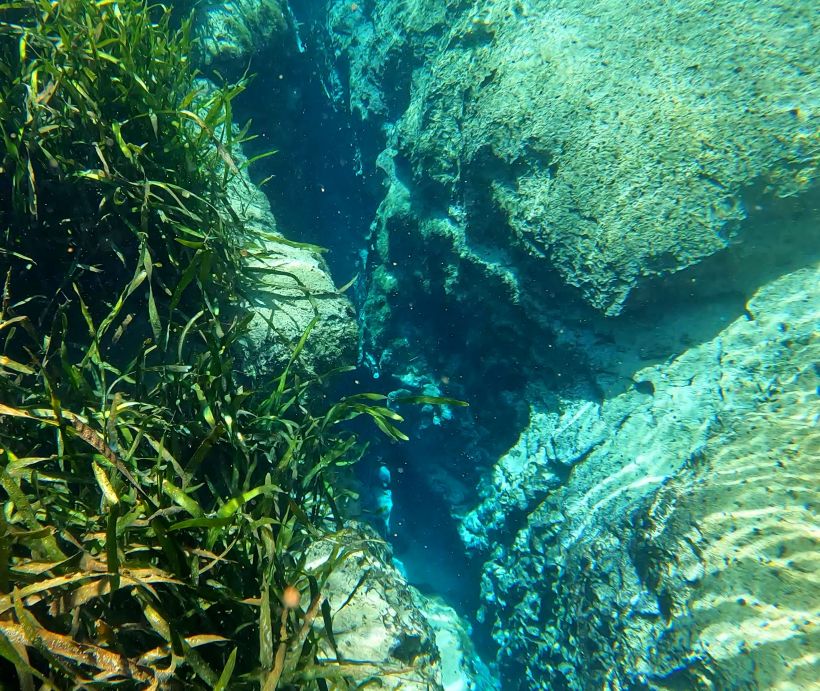
May 2024
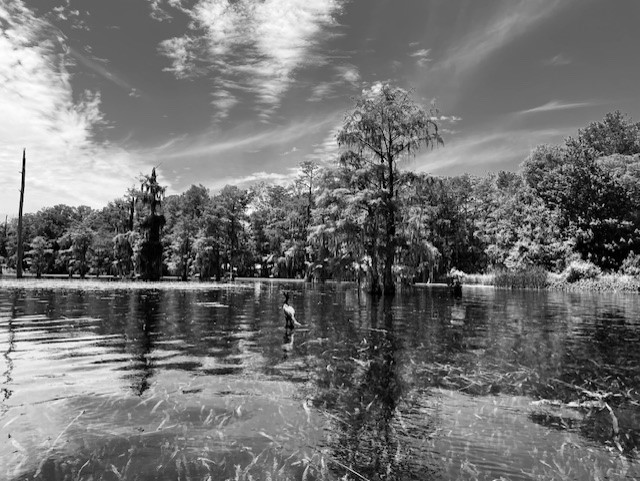
Jackson Blue was my last stop in the panhandle and my last big “Blue” to visit. Back in the day, a lot of springs must have been really blue because “Blue” appears to be the most common name for springs in Florida: Gilchrist Blue, Jackson Blue, Levy Blue, Madison Blue, Volusia Blue, etc. Now each “Blue” is distinguished from the others using the name of the county in which it occurs. Jackson and Volusia Blue are two of the 33 first magnitude springs in Florida.
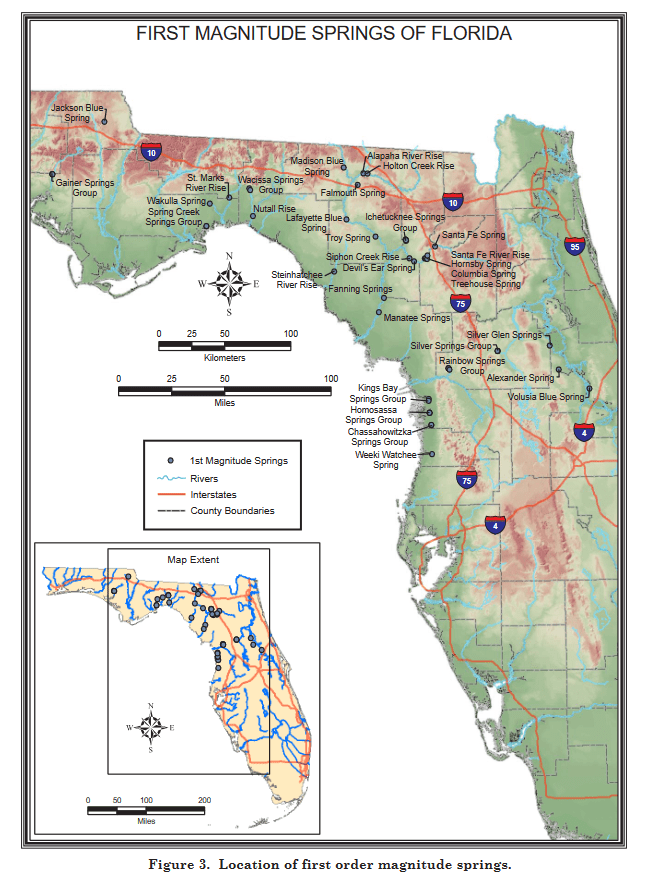
Figure from Scott et al. (2002) The Springs of Florida: https://lake.wateratlas.usf.edu/upload/documents/FirstMagnitudeSprings-OpenFileReport85-FGS.pdf. Jackson Blue is in the upper left corner.
Jackson Blue Spring is in a heavily agricultural area, just to the east of the town of Marianna, Florida Caverns State Park, and the Chipola River into which it flows. It is dammed downstream where it passes just south of Marianna. According to Jackson County, this dam produced a reservoir that is now a “nationally known fishing site” (https://jacksoncountyfl.gov/services/parks-recreation/blue-springs-recreation-area/). The run would be big without the dam, but it is especially wide along its length because of the dam. As an interesting aside, the park originally hosted a club for Graham Air Force Base officers.
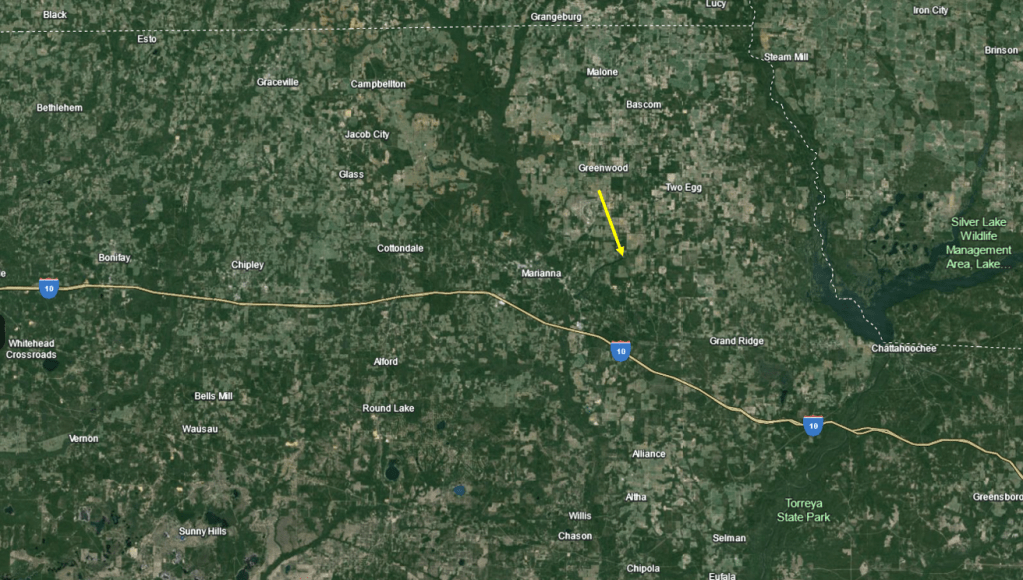

Google Earth images of the landscape around Jackson Blue Recreation Area (top) and of the dammed run (Merritts Mill Pond, bottom).

Locations of the springs in Jackson Blue Spring run (from: https://floridadep.gov/sites/default/files/JacksonBlue-MerritsMill-nutr-tmdl.pdf)
Jackson Blue Recreation Area (home to the headspring) is a medium-old Florida sort of place, with a dirt parking lot and a small ticket booth attended by a woman who was, perhaps, a high school student. The park is open only during the warm season and the swimming area is surrounded by a cement wall on the upstream end and a moveable wall on the downstream end.

The Jackson Blue swimming area.
On my visit, I put in below the swimming area, which already was starting to fill up with swimmers and divers when I arrived. As soon as I pushed off, I was in an eelgrass (Valisneria americana) wonderland all across the wide run.
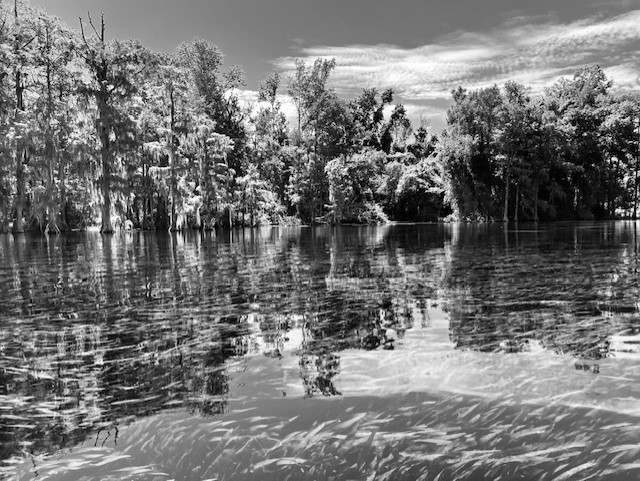
Thick beds of eelgrass blanket most of the bottom of the Jackson Blue run.
Much of the eelgrass and other plants were somewhat coated with algae, all of which was photosynthesizing rapidly in the clear water. The evidence for this process was the production of copious bubbles. When plants or algae photosynthesize faster than the water can absorb the oxygen, oxygen bubbles form, covering the producers or rising to the surface if they get too big or disturbed.
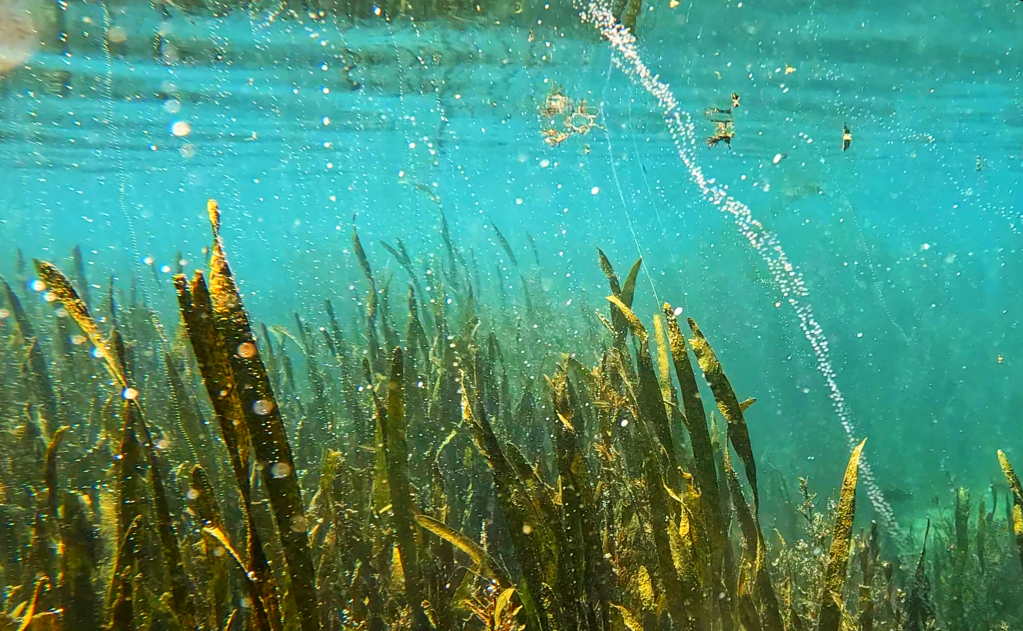
Bubbles of oxygen streaming off the eelgrass leaves (and algae).
Beyond the swimming area, lovely old cypress trees (Taxodium distichum) produced shade close to the banks.
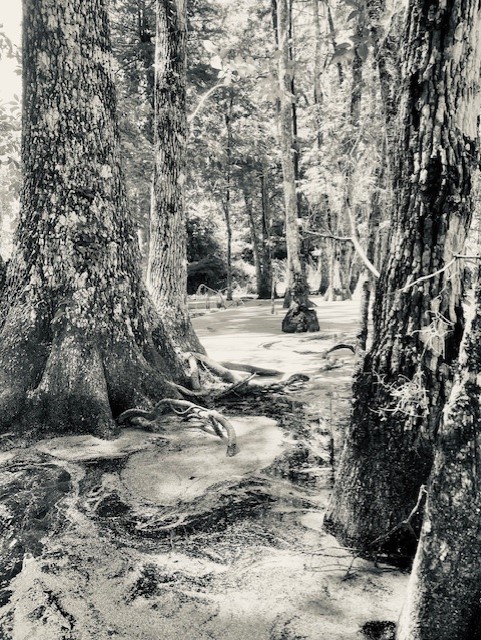
Cypress trees in the shallows of Jackson Blue Spring. Duckweed (Lemna sp.) covered the surface of the water in many areas.
Downstream of the headspring, several other springs dot the run. The most famous of these is Shangra-La Spring on northern bank of the run.
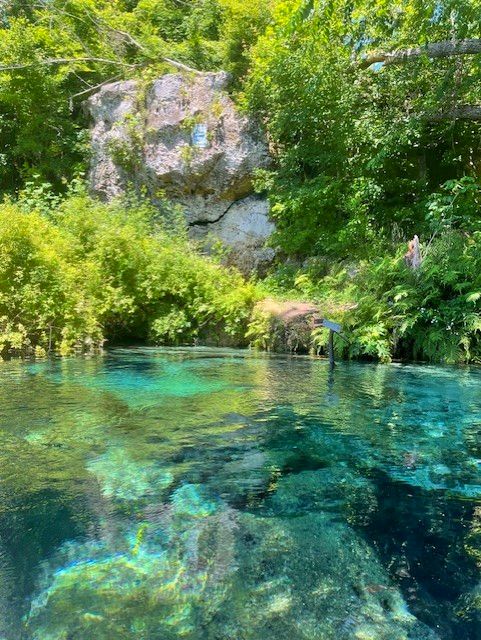

Shangri-La main spring above water (top) and underwater (bottom).
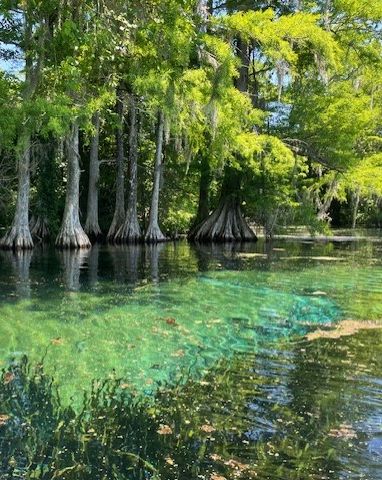
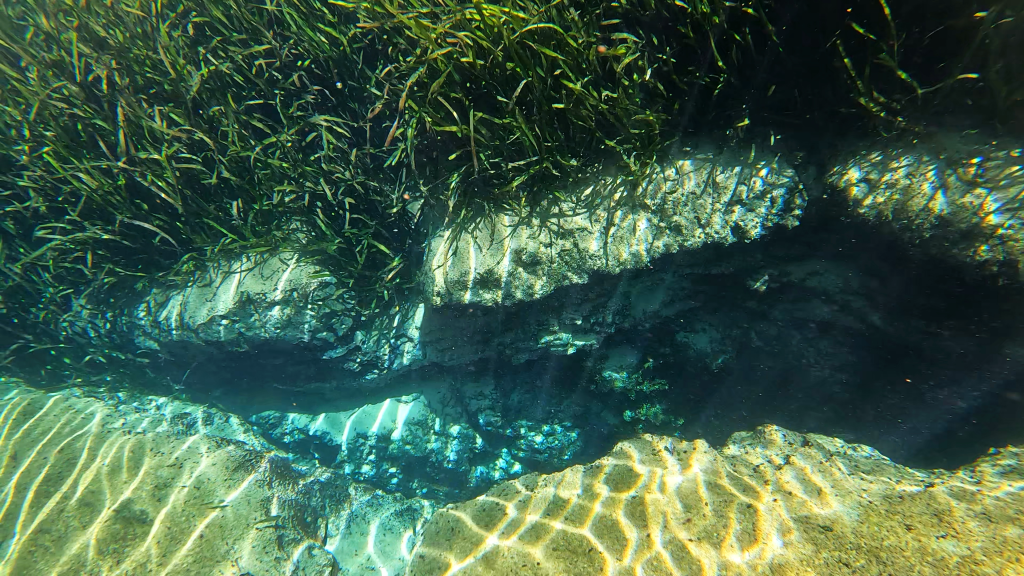
The Shangri-La second vent just off shore, photographed above the water (top) and underwater (bottom).
Twin Caves Spring is a little further downstream next to a swimming platform near the southern bank of the run.
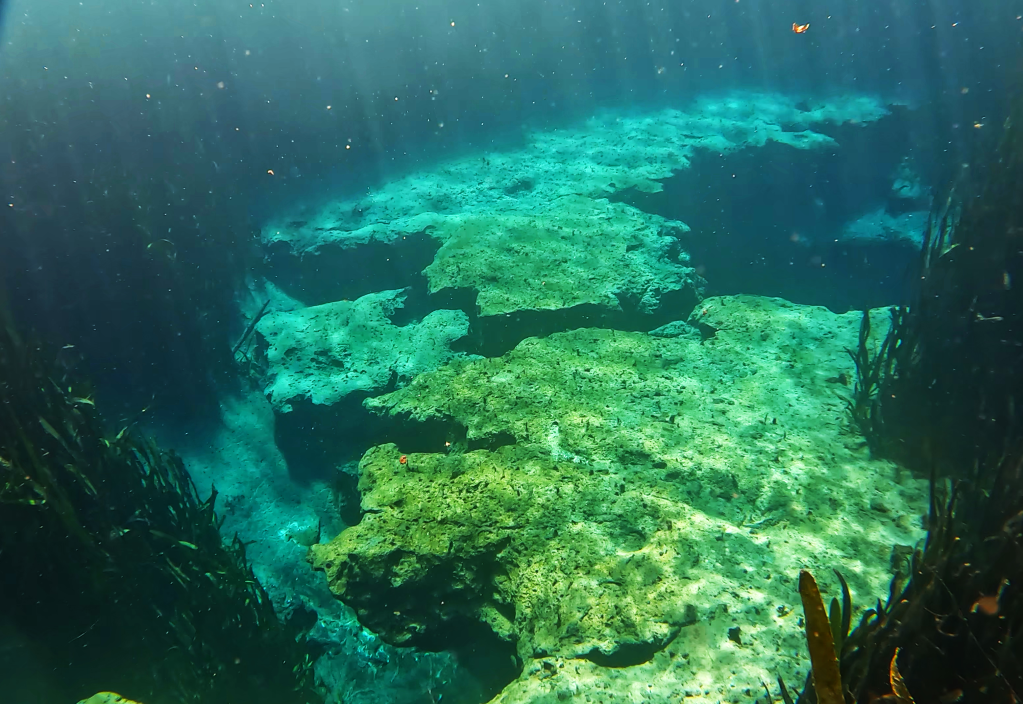
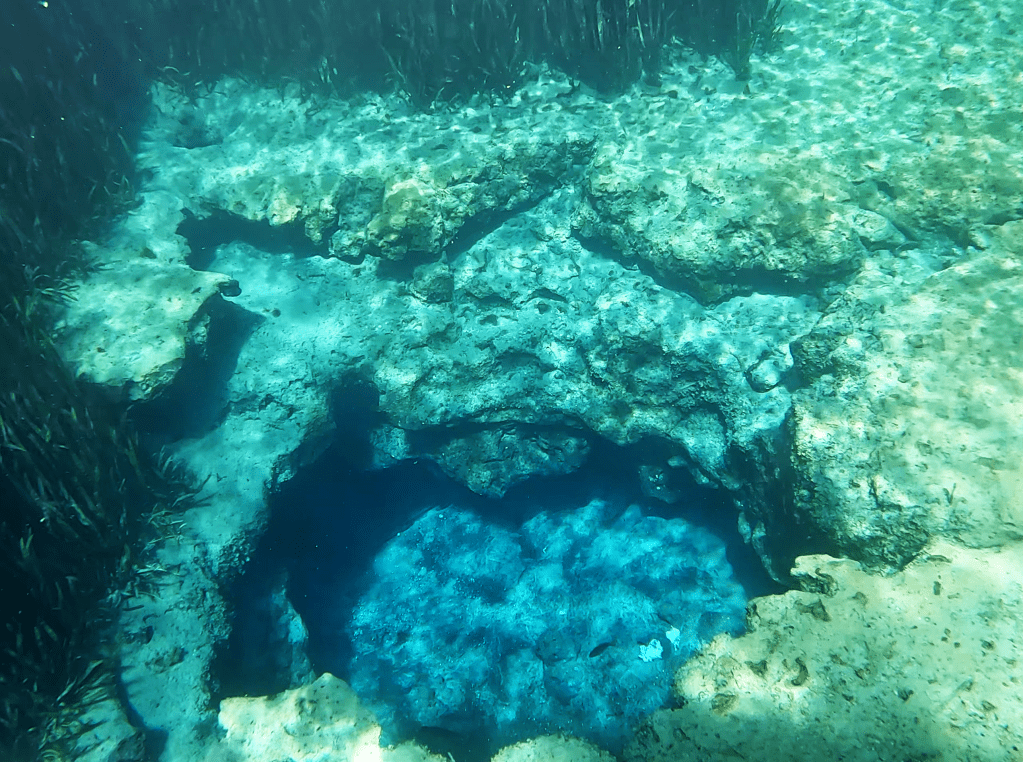
Two views of Twin Caves Spring.
Just below the swimming area, the algae was pretty thick, but back under the trees along the banks, the sandy substrate was more visible. In the shallows under the cypress trees, there were more juvenile largemouth bass (Micropterus salmoides) than I have ever seen in one place. And, of course, there were lots of sunfish, especially spotted sunfish (Lepomis punctatus), all over the run.
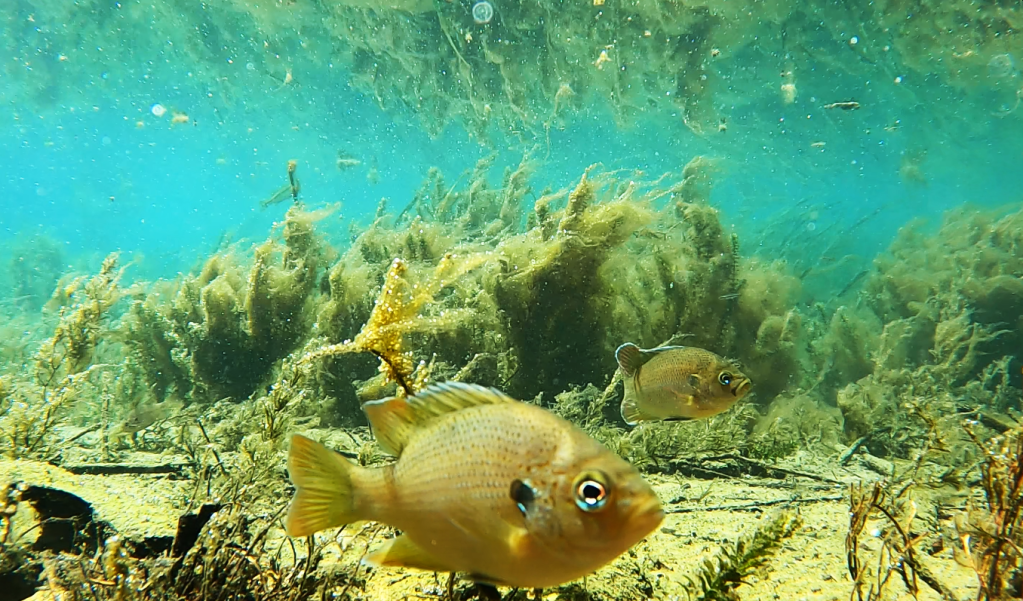
Thick algae with spotted sunfish just downstream from the canoe launch.
Several juvenile largemouth bass passing through as two bluefin killifish (Lucania goodei) flared bright blue dorsal fins in a territorial display.
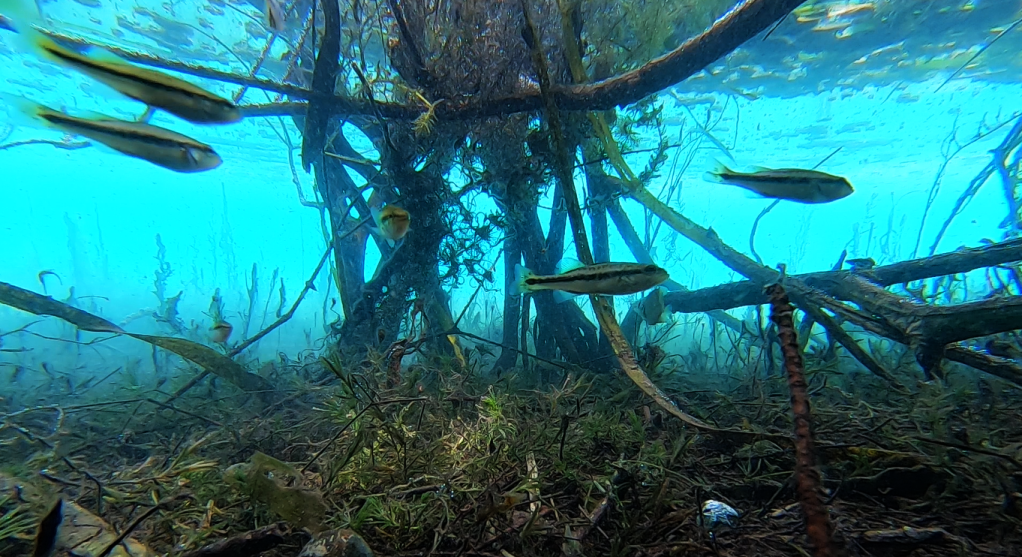
Still more juvenile largemouth bass downstream.
In addition to the large sunfish and largemouth bass populations, the turtle populations also seemed to be healthy.
A turtle passing by two spotted sunfish.
A tiny loggerhead musk turtle (Sternotherus minor) climbing over the rocks in this view from Shangri-La Spring out toward the center of the run (below).
Like most other springs in Florida, the available data for Jackson Blue Spring is a bit spotty. The discharge time series reported by USGS (https://waterdata.usgs.gov/nwis) and DEP (https://floridadep.gov/sites/default/files/JacksonBlue-MerritsMill-nutr-tmdl.pdf) only ranged from 2005 to 2010. Over that period of time, Jackson Blue discharge ranged from 38 to 219 cfs, a massive 576% difference in magnitude from the lowest to highest discharge. The temperatures at the headspring were comparatively cool (USGS data from 1972-2023: 20.5-21oC; 21.1-22.3oC for me). The dissolved oxygen concentrations were high for a spring (USGS: 7-10.3 mg/L at the headspring; 7.05-9.17 mg/L for me). The high values for the headspring suggest that the water issuing from the spring is not underground long. High dissolved oxygen downstream also would have been related to the large producer (plants and algae) populations. The conductivity was low, as expected given the spring’s distance from the Gulf: 197-287 microS/cm for USGS and 280-310 microS/cm for me.
For many of the biggest springs in Florida, the state developed MFL (Minimum flow and level) plans to maintain spring discharges and TMDL (Total Maximum Daily Load) plans to restore nutrient concentrations. I could not find an MFL plan for Jackson Blue, but the TMDL plan reported nitrate concentrations that ranged from 3.1-3.4 mg/L in recent years, an order of magnitude higher than the concentration in 1960 and than the background concentration of 0.35 mg/L used for many springs across the state. DEP examined the isotopic ratios of the nitrogen (14N vs 15N) in Jackson Blue and came to the conclusion that most of the nitrate emerging from the springs was from fertilizers. As organisms process nitrate, they use the lighter 14N before the heavier 15N, so their waste tends to have a low ratio of 14N:15N. The reported phosphorus concentrations, happily, all were low, about 0.02 mg/L.

Figure from: https://floridadep.gov/sites/default/files/JacksonBlue-MerritsMill-nutr-tmdl.pdf
 A Florida Spring Odyssey