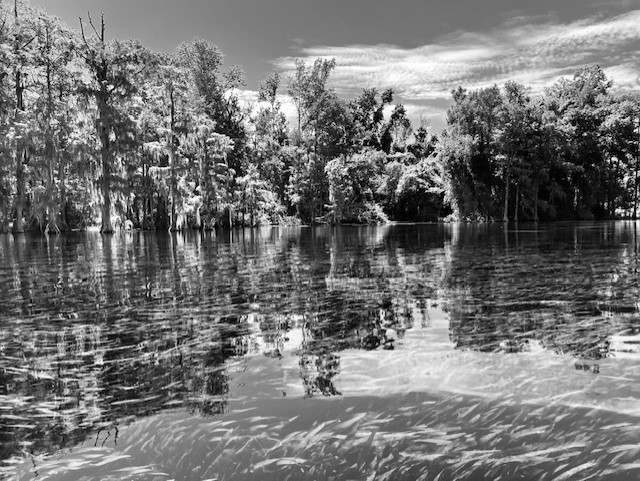
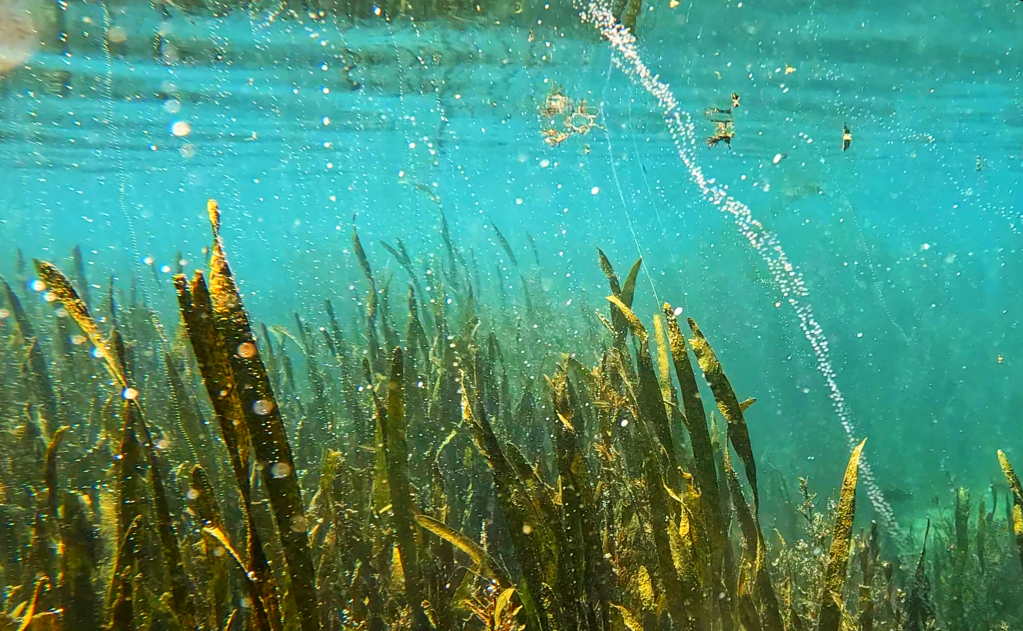
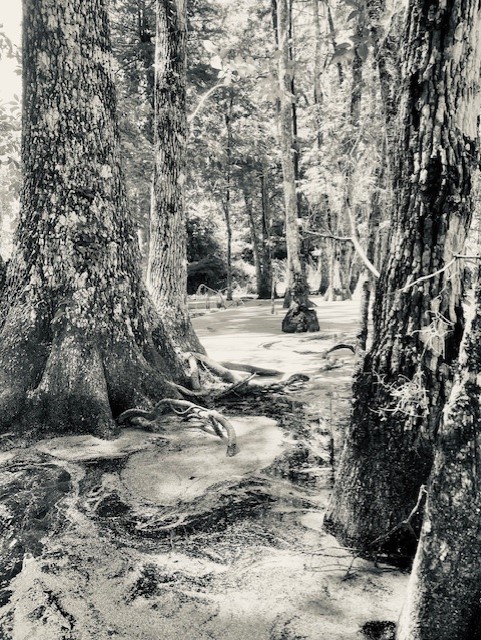
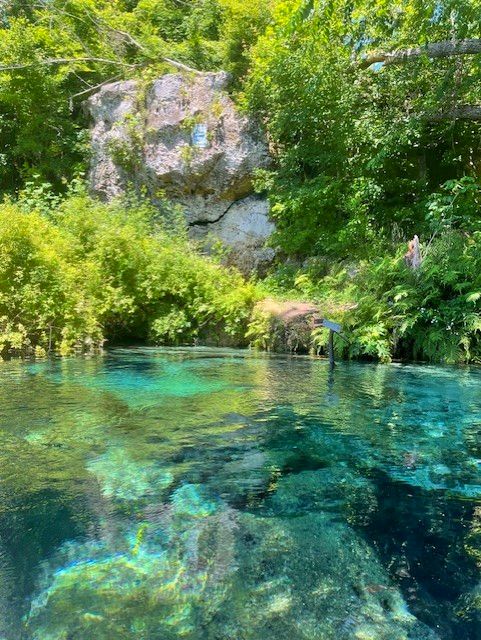
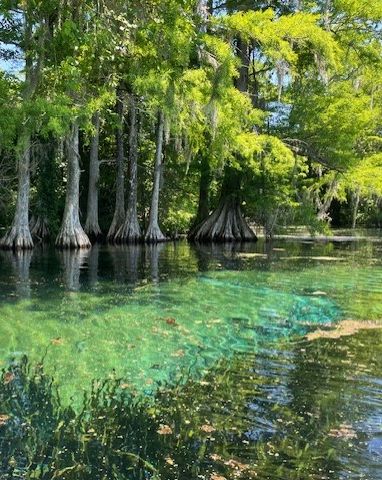
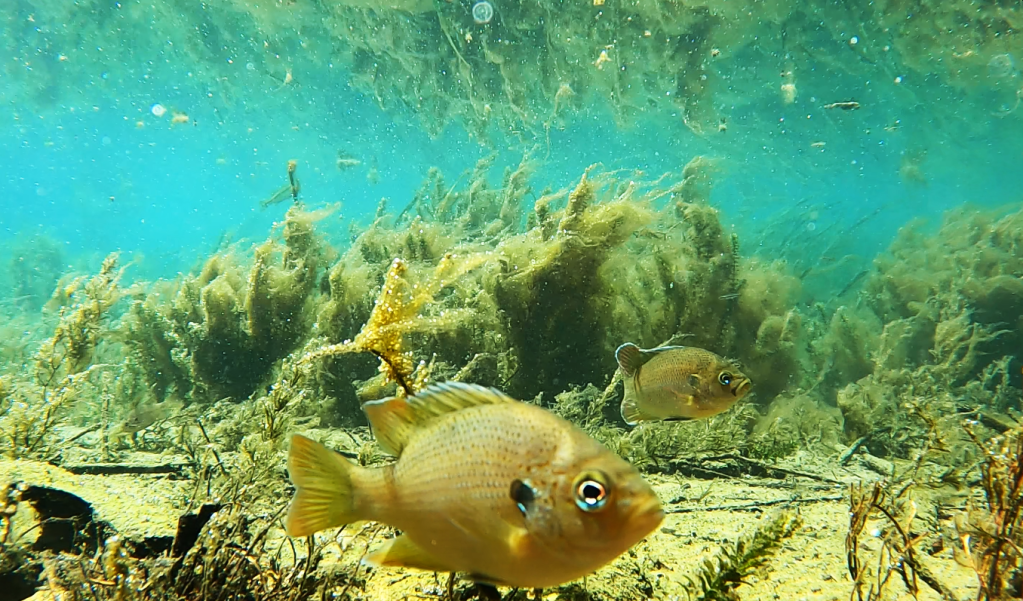
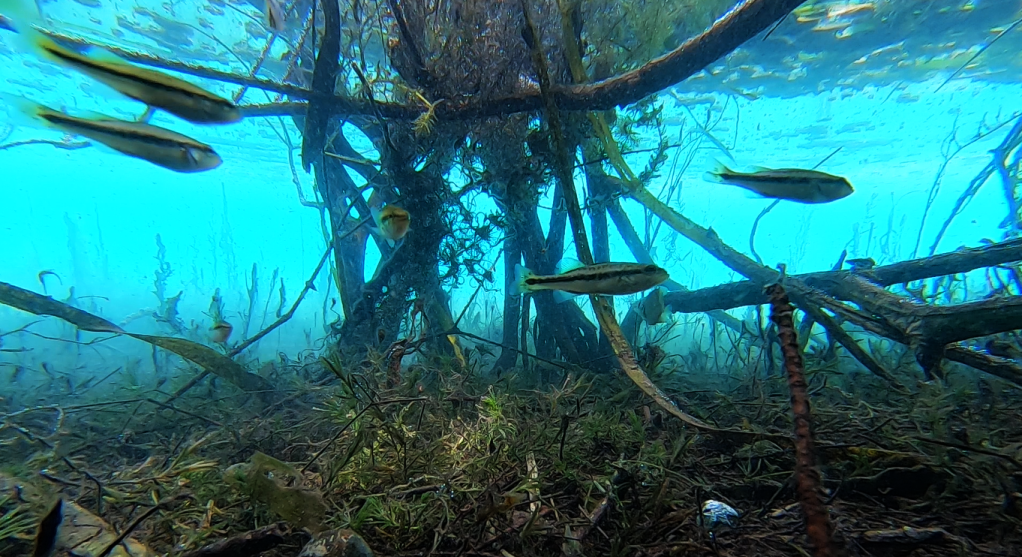
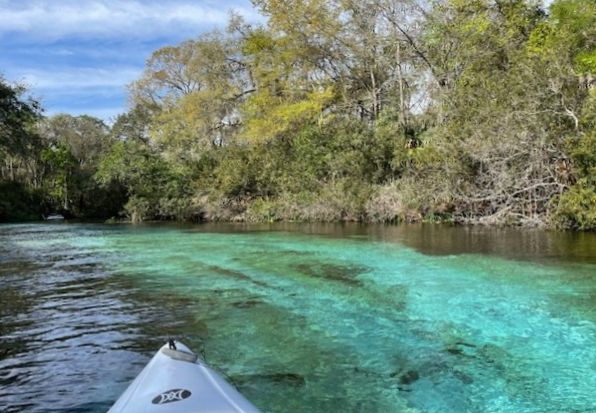
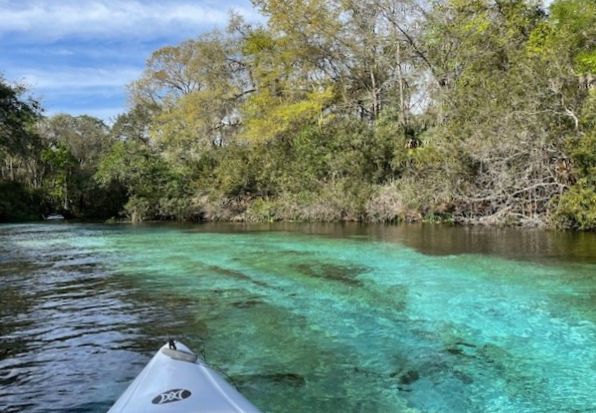
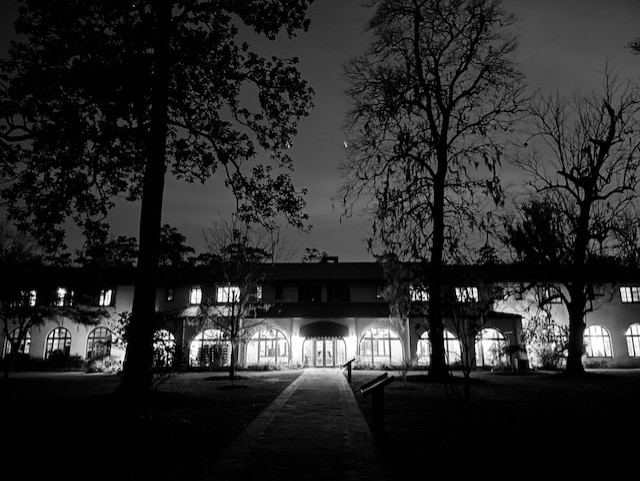
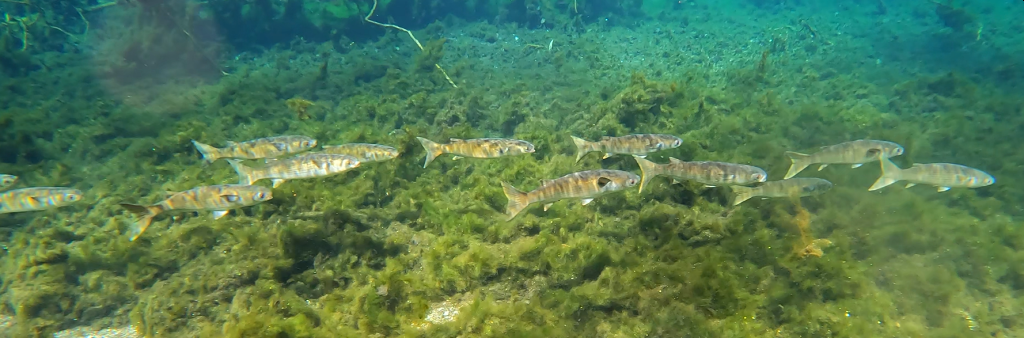
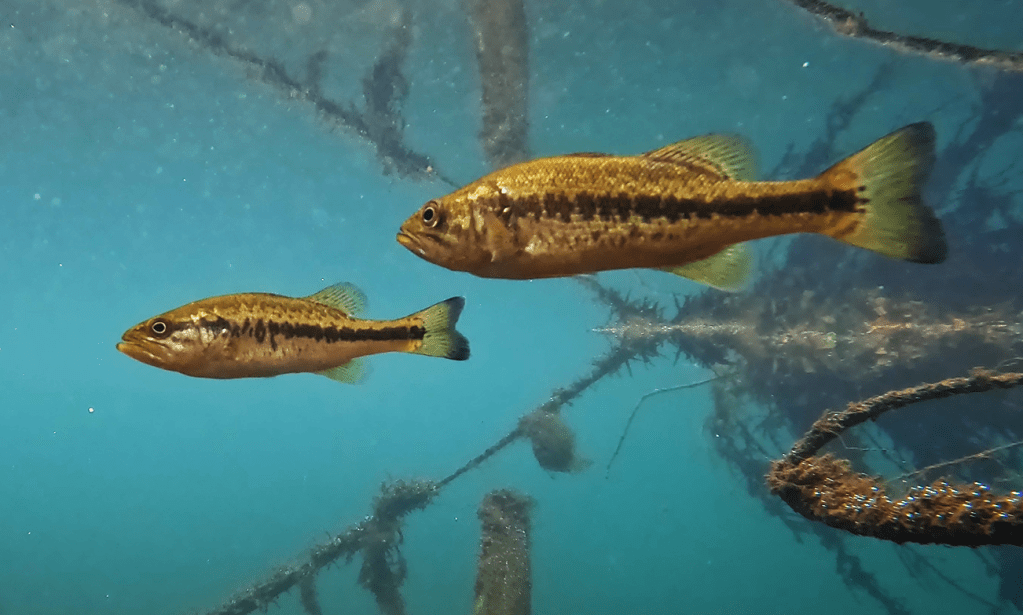
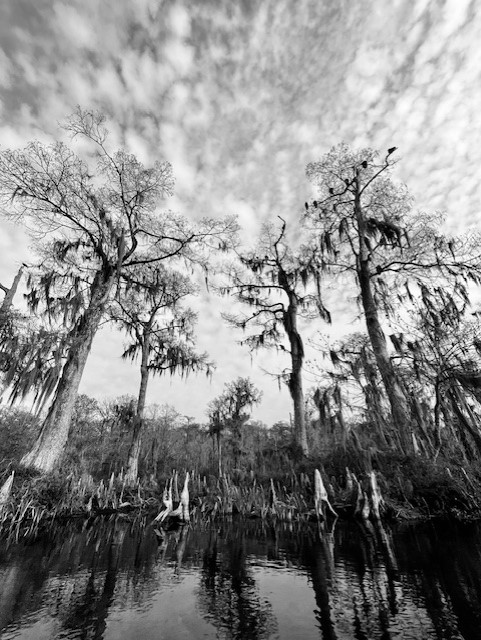
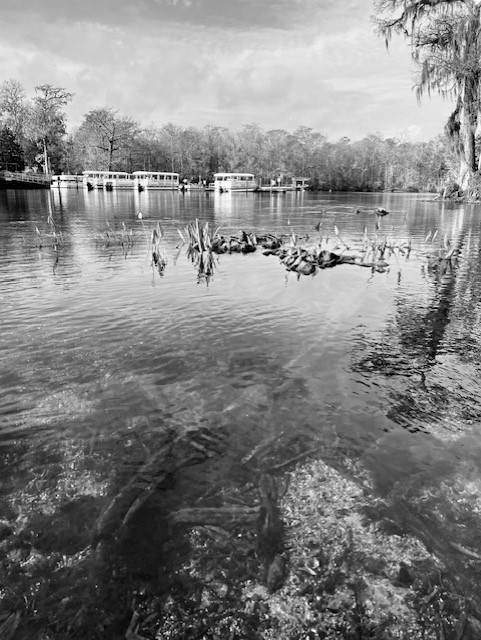
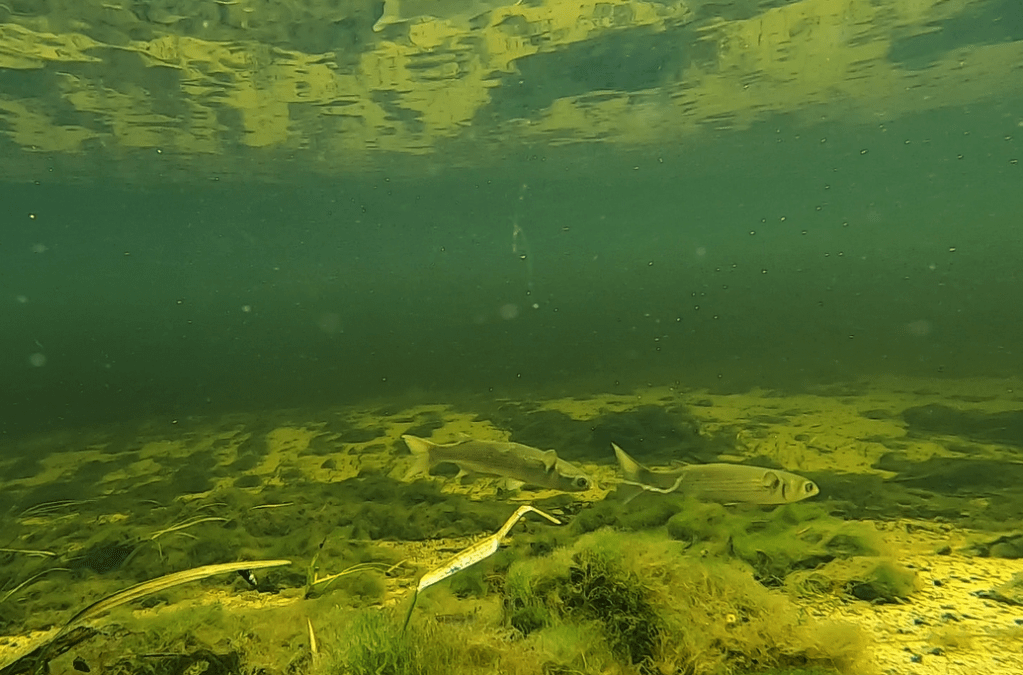
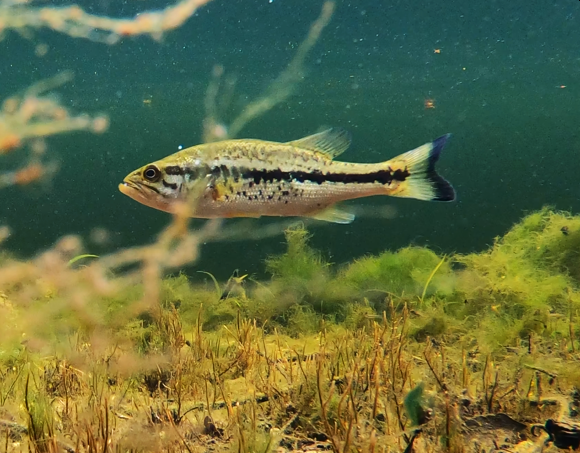
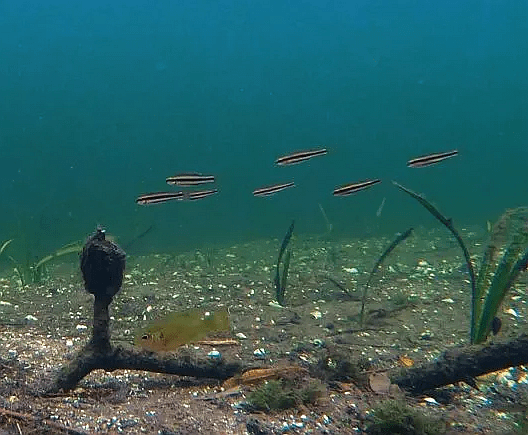
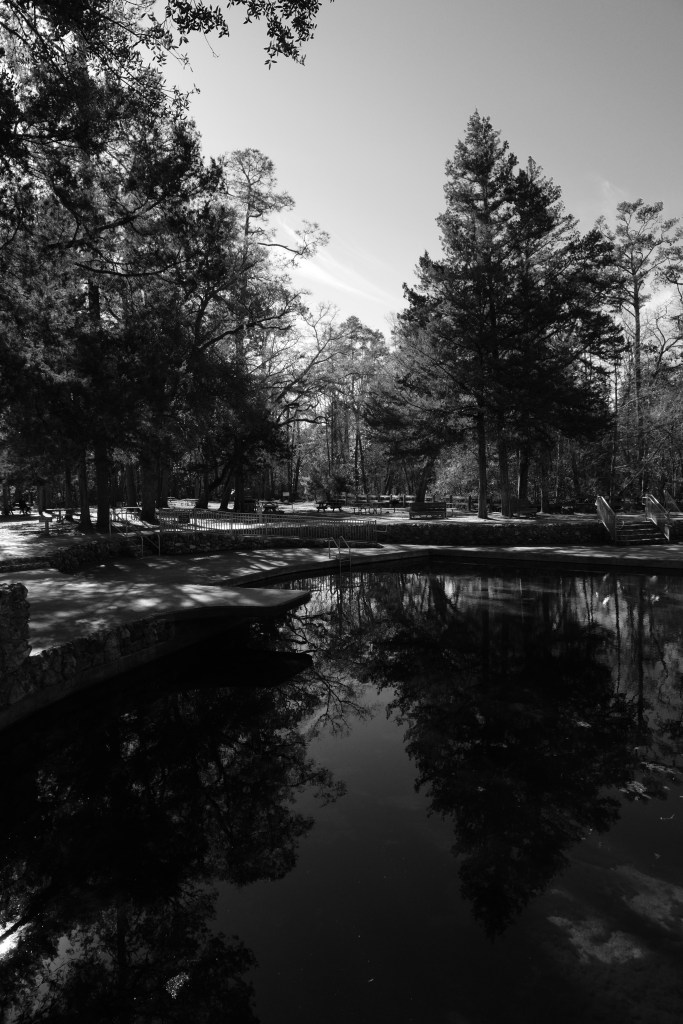
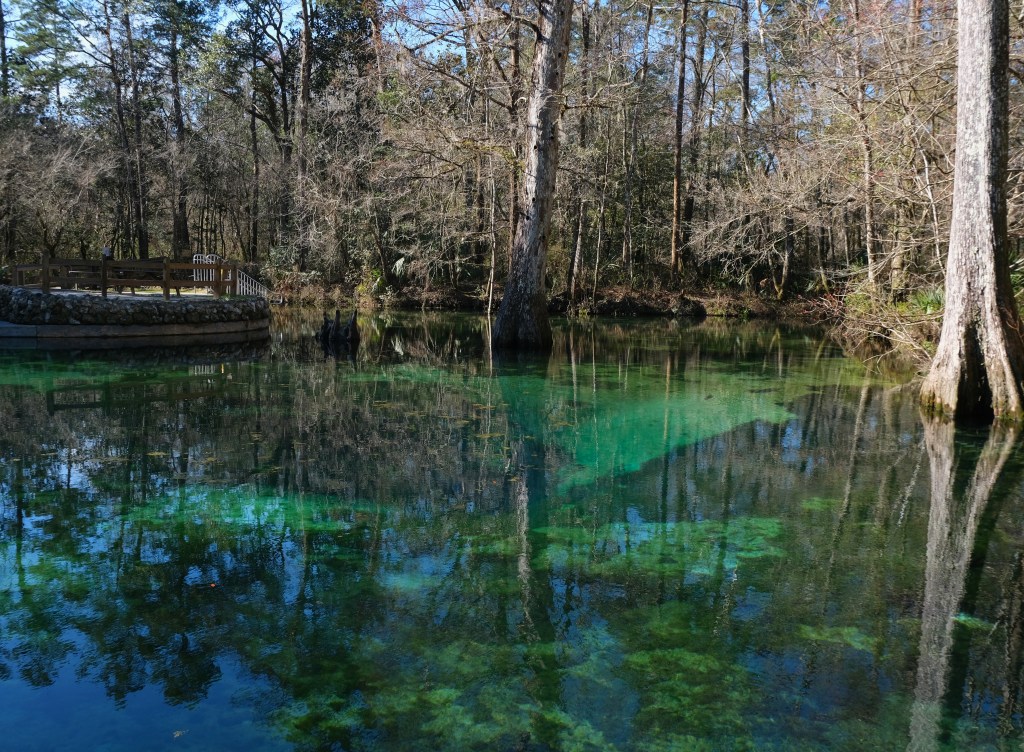
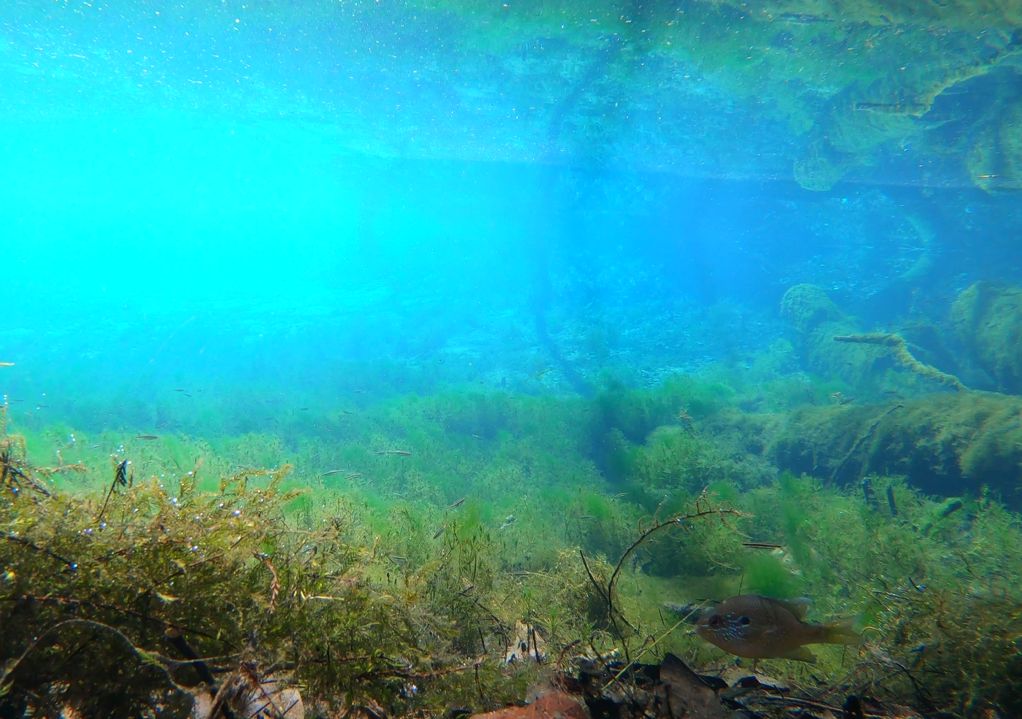
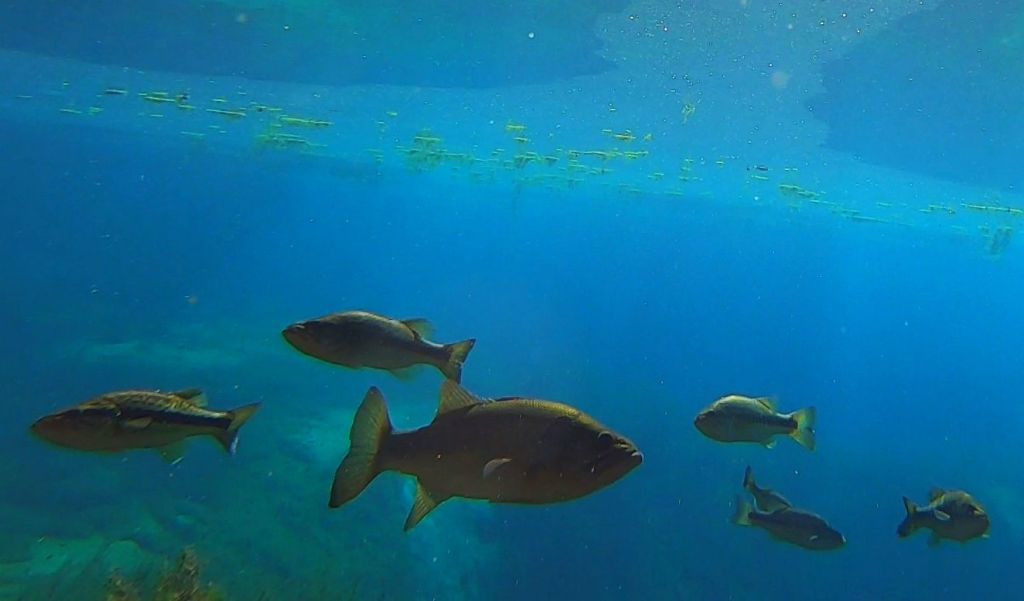
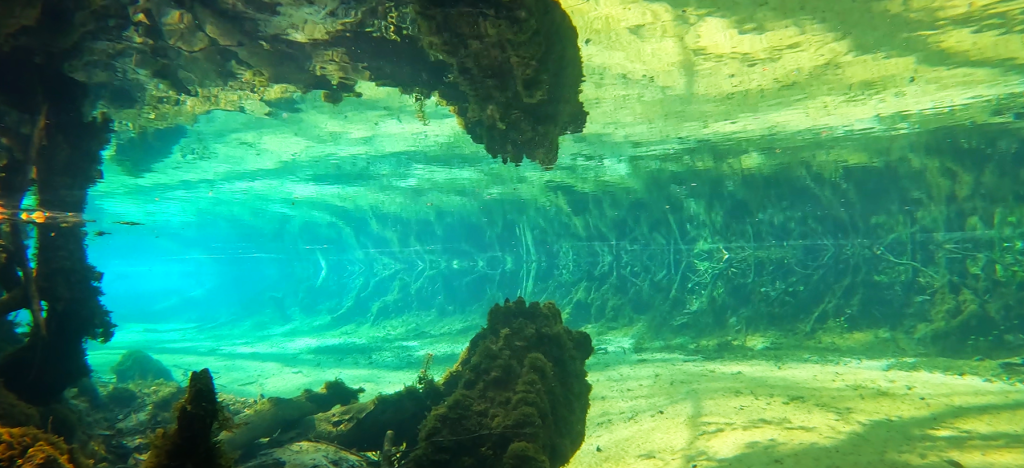
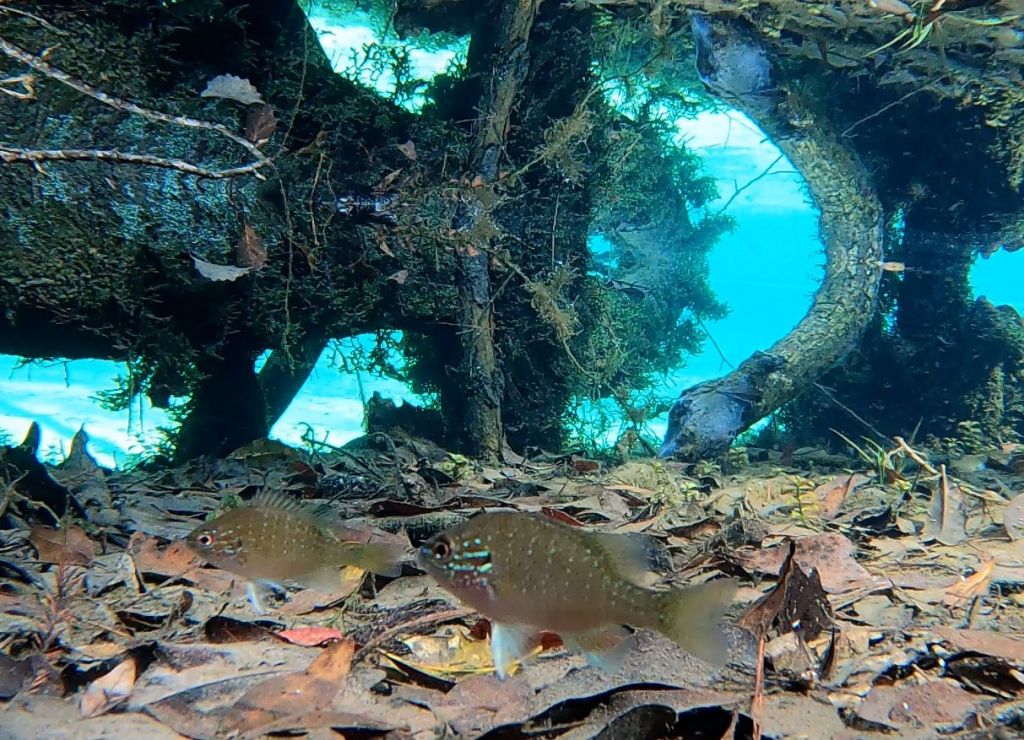
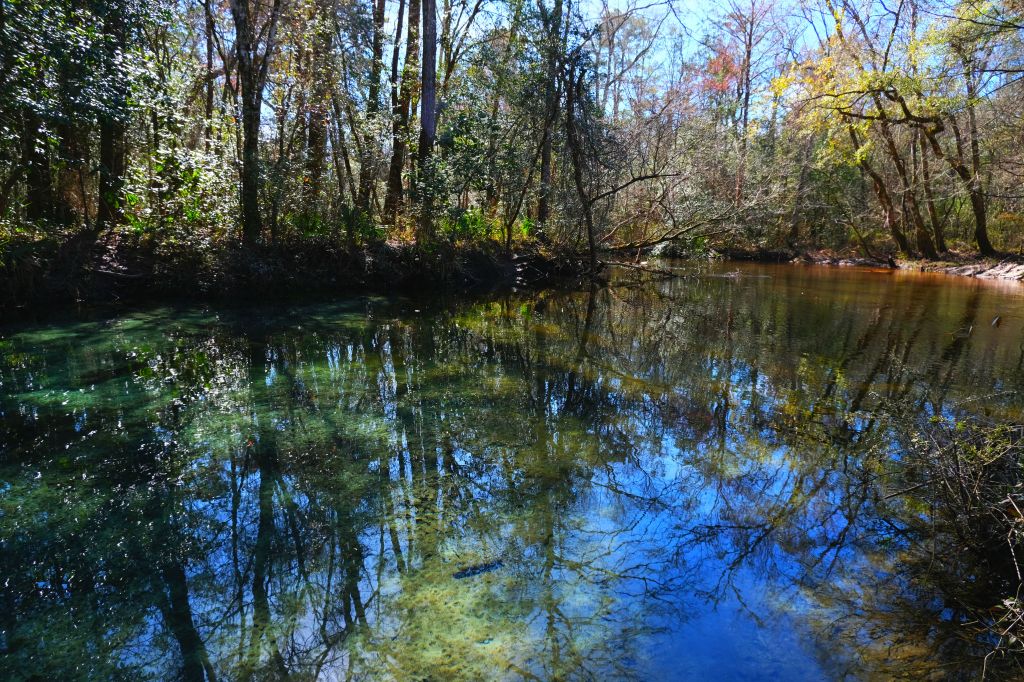
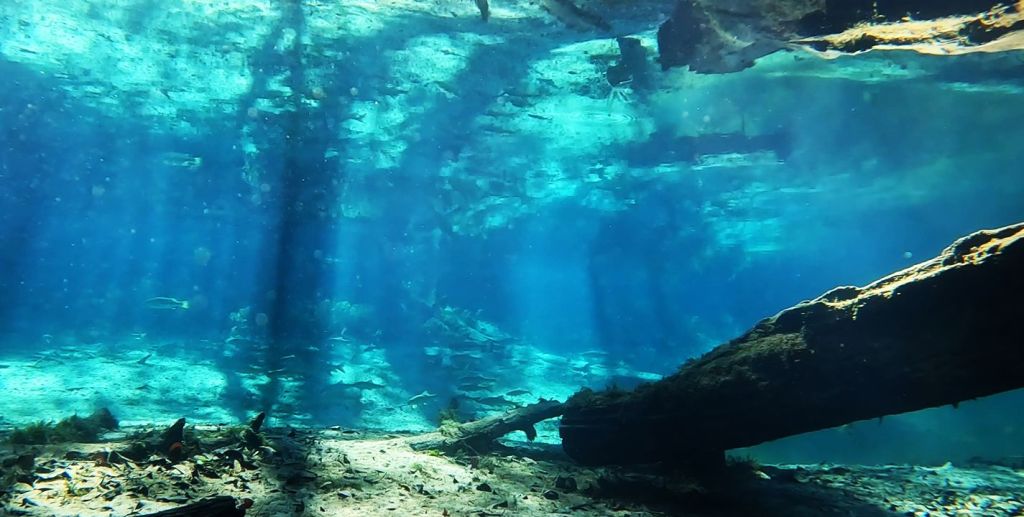
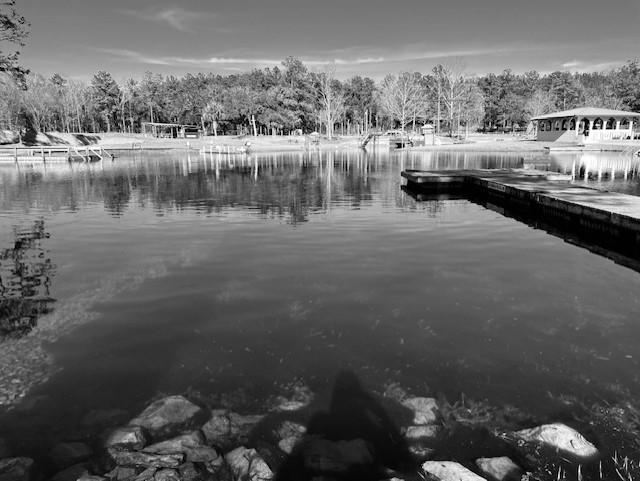
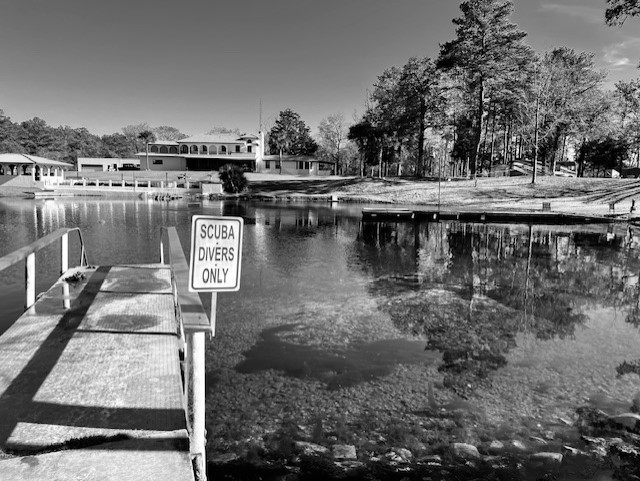
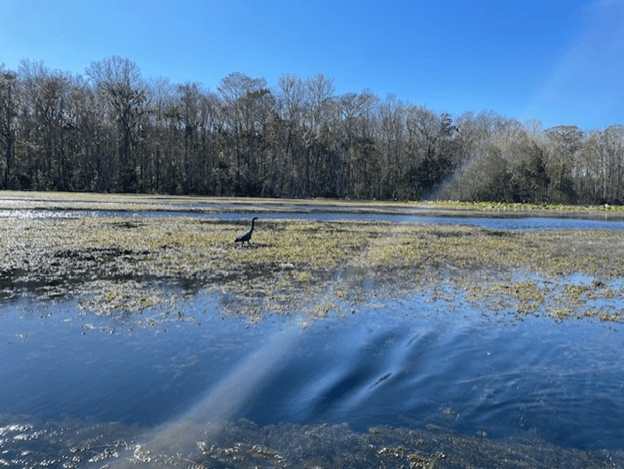
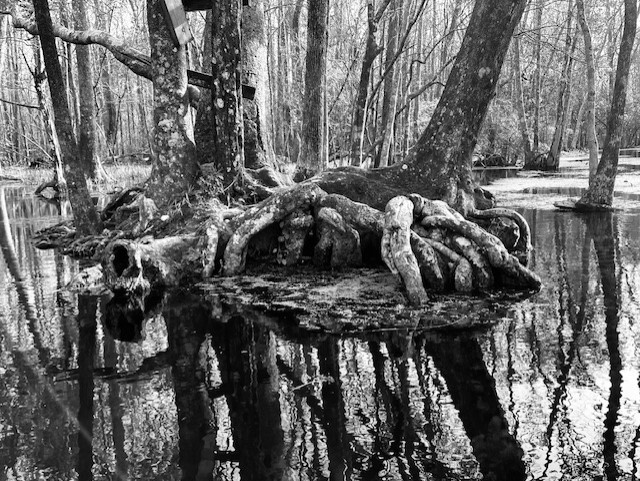
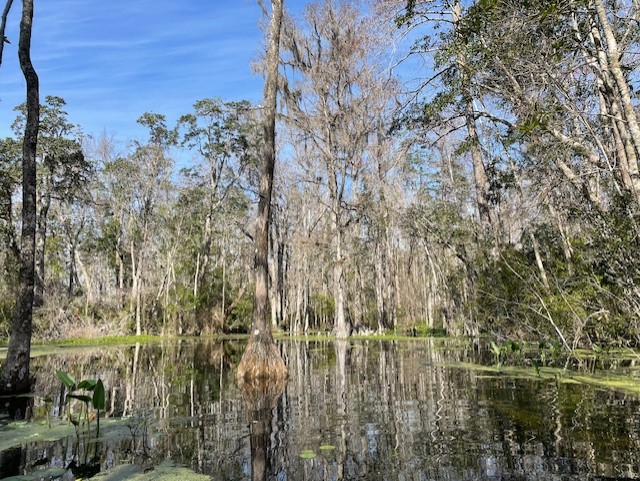
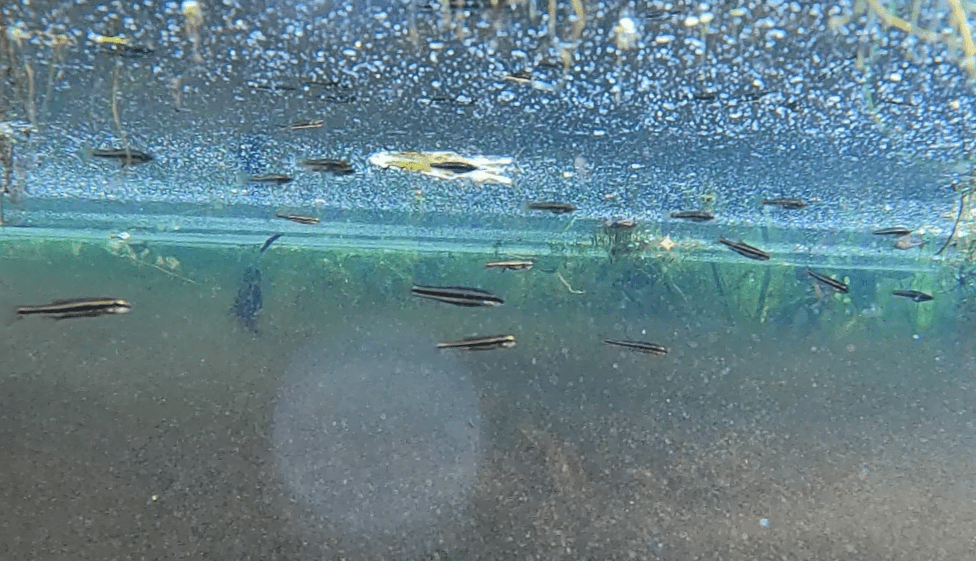
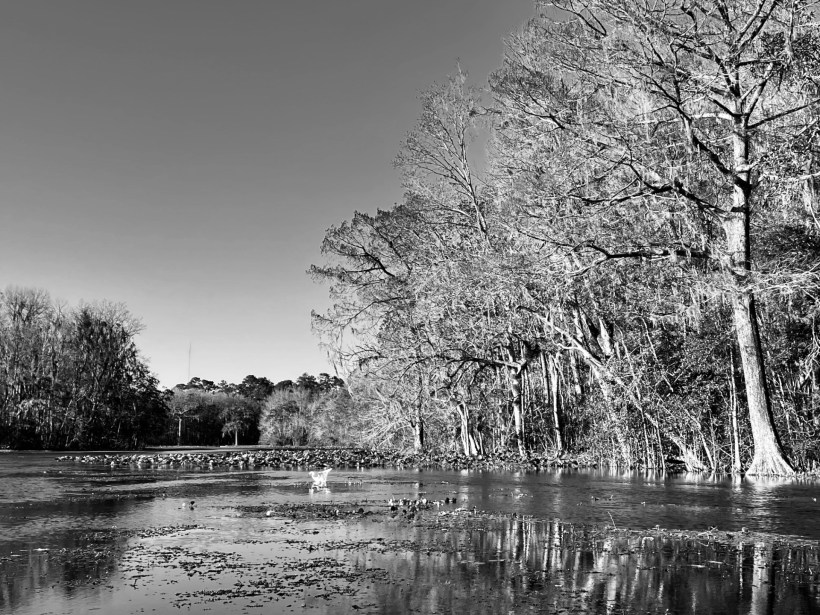
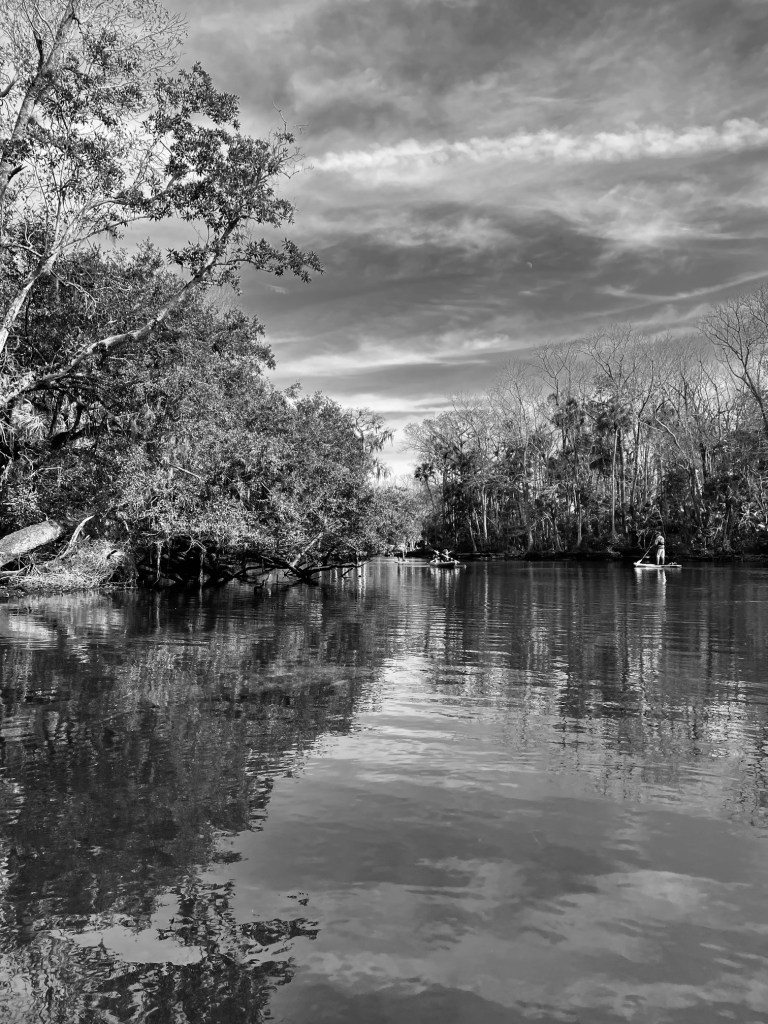
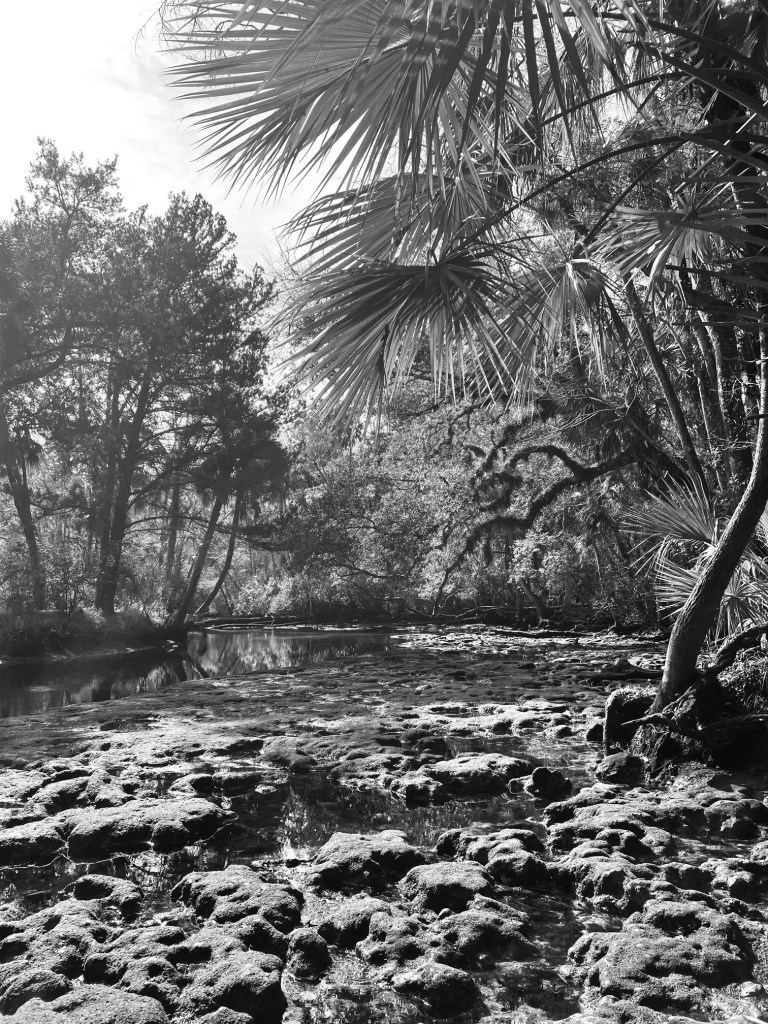
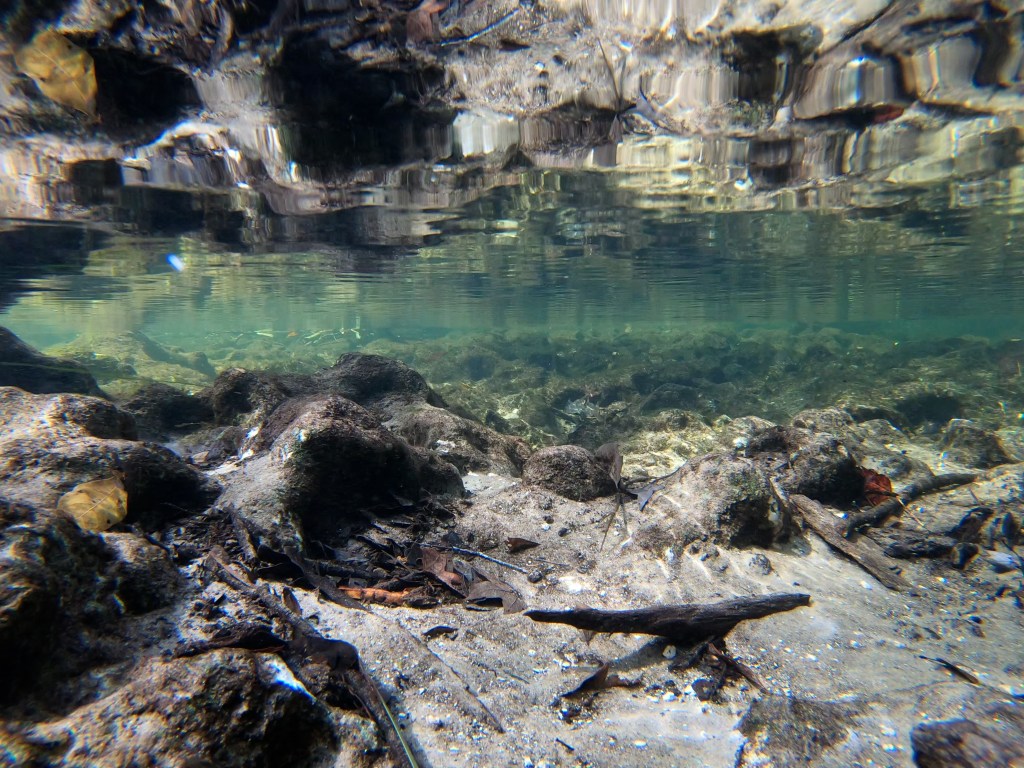
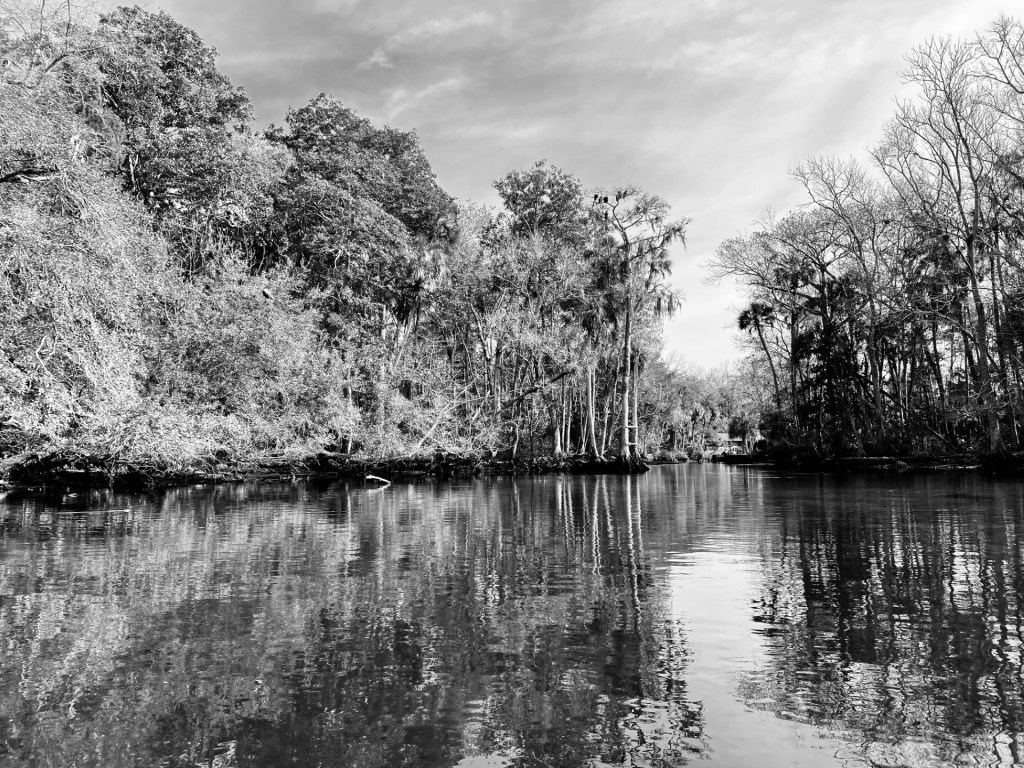
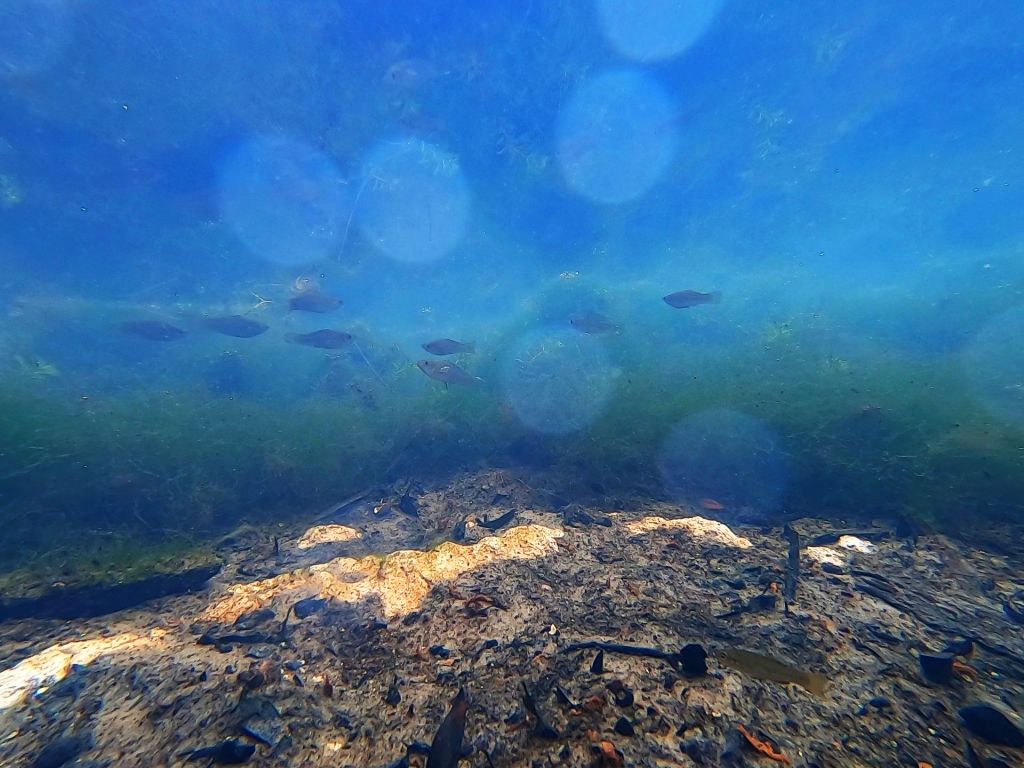
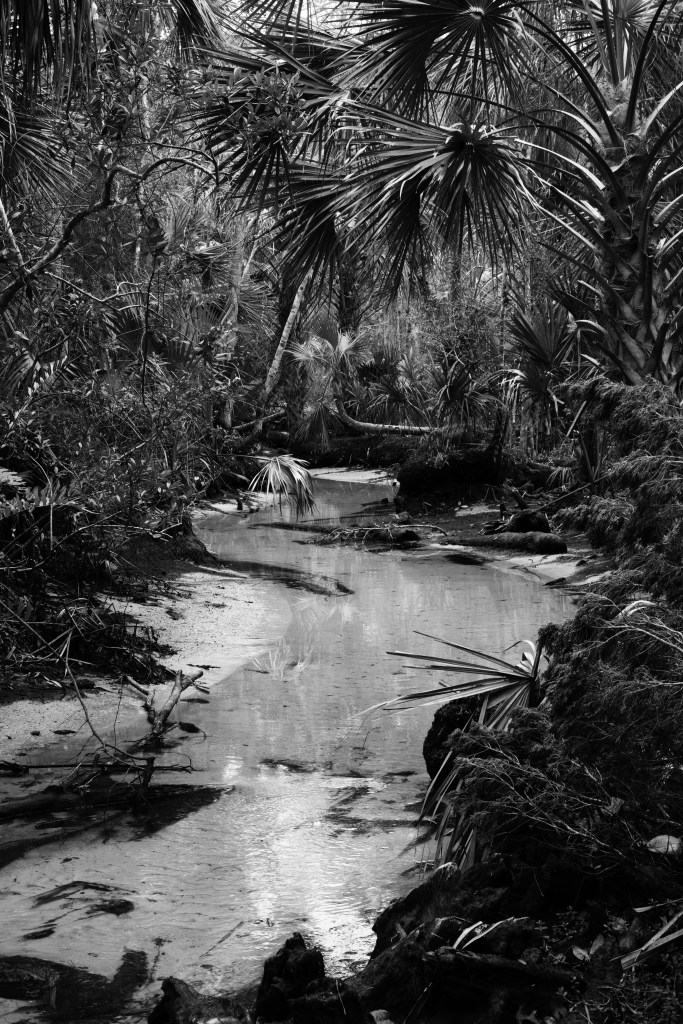
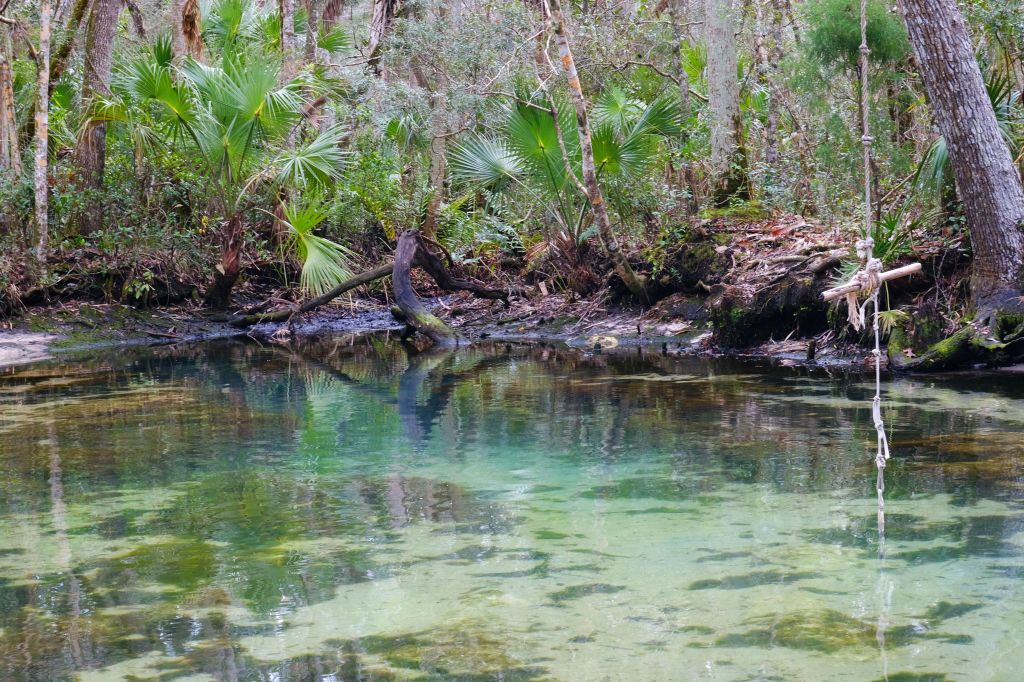
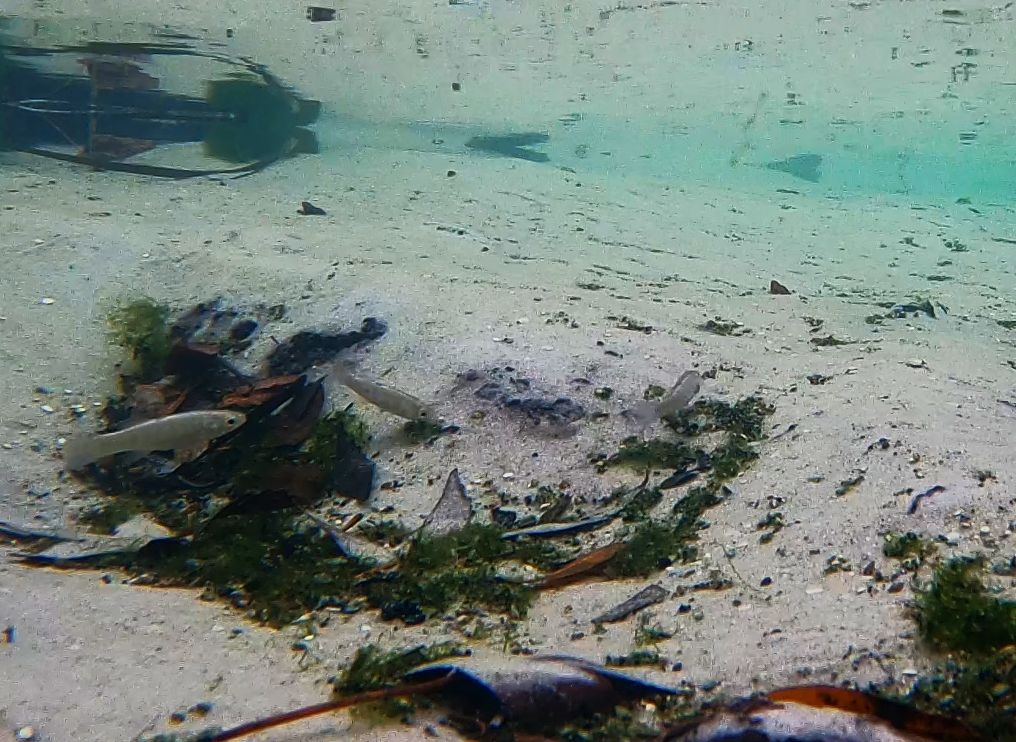
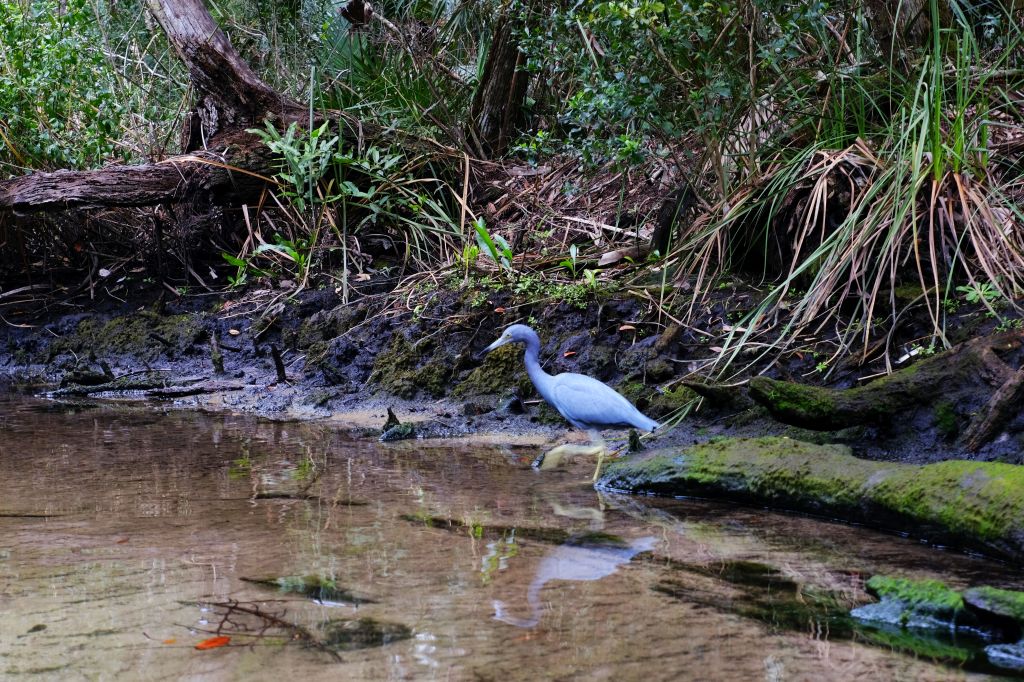
Gum Slough, the spring that flows into Withlacoochee River (south)

January and March 2024

Apparently, Floridians like their Gum trees. Gum trees include sweetgum (Liquidambar styraciflua) and the tupelos (Nyssa spp.), which we have in Florida naturally, and eucalyptus, which we do not. There are actually some super fun gum trees that I just discovered five minutes ago, such as a lemon-scented gum (Corymbia citriodora), a rainbow gum (Eucalyptus deglupta), a scribbly gum (Eucalyptus haemastoma), and a salmon gum (Eucalyptus salmonophloia–there’s the fish in this digression! https://www.thespruce.com/twelve-species-of-gum-trees-3269664). [Hopefully, we’re keeping those fun gum trees in their homes.]

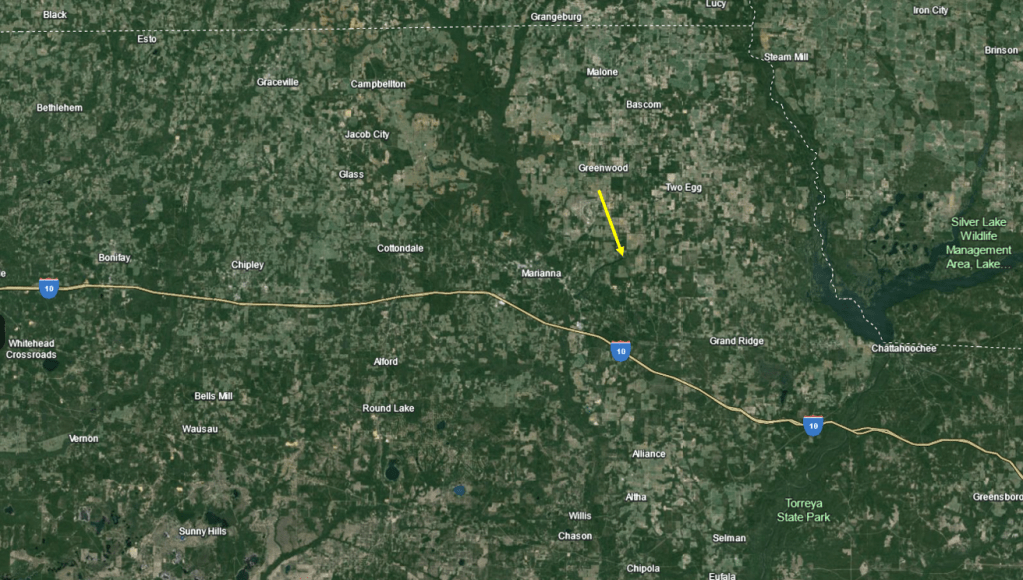
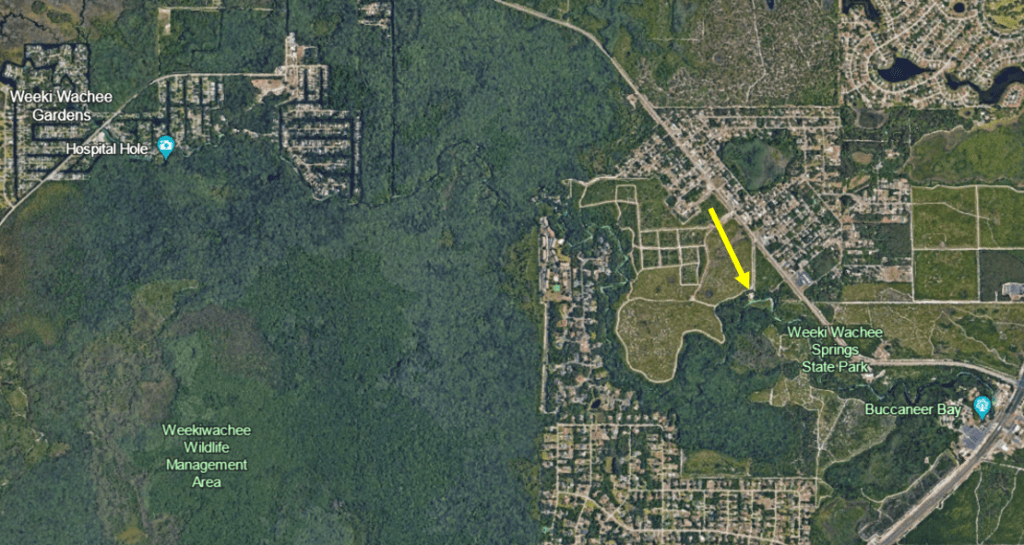
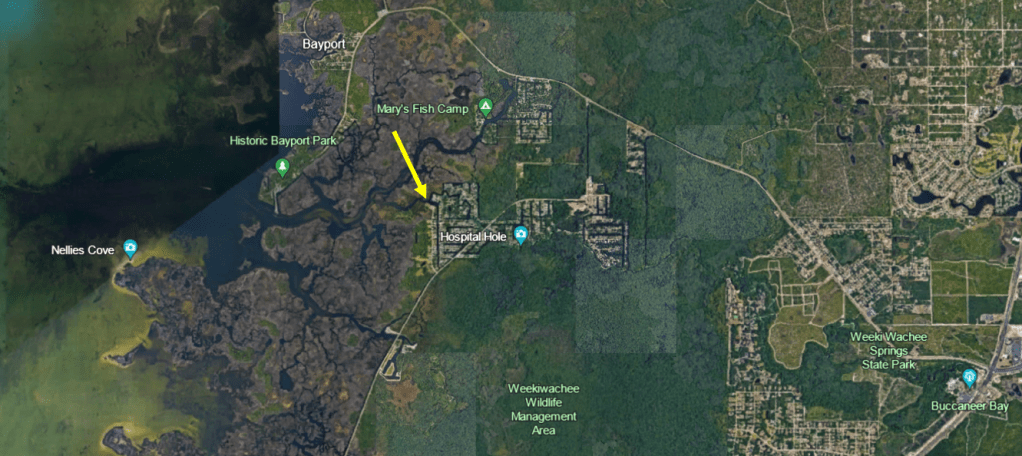
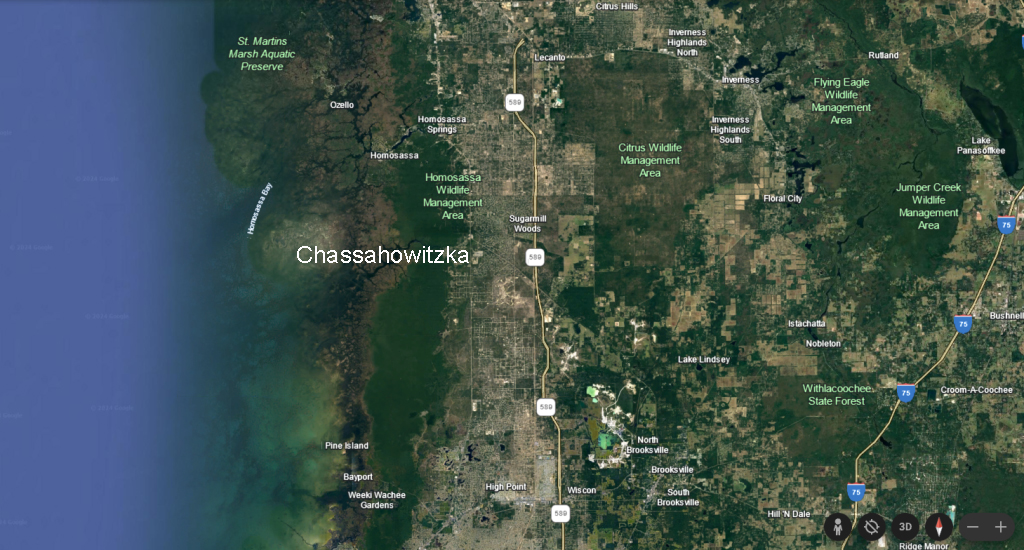
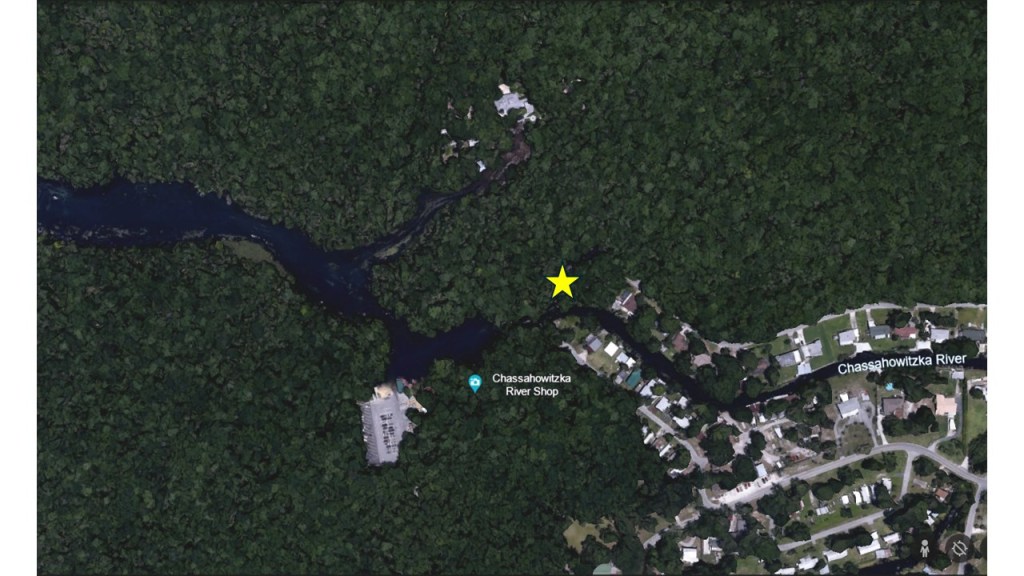
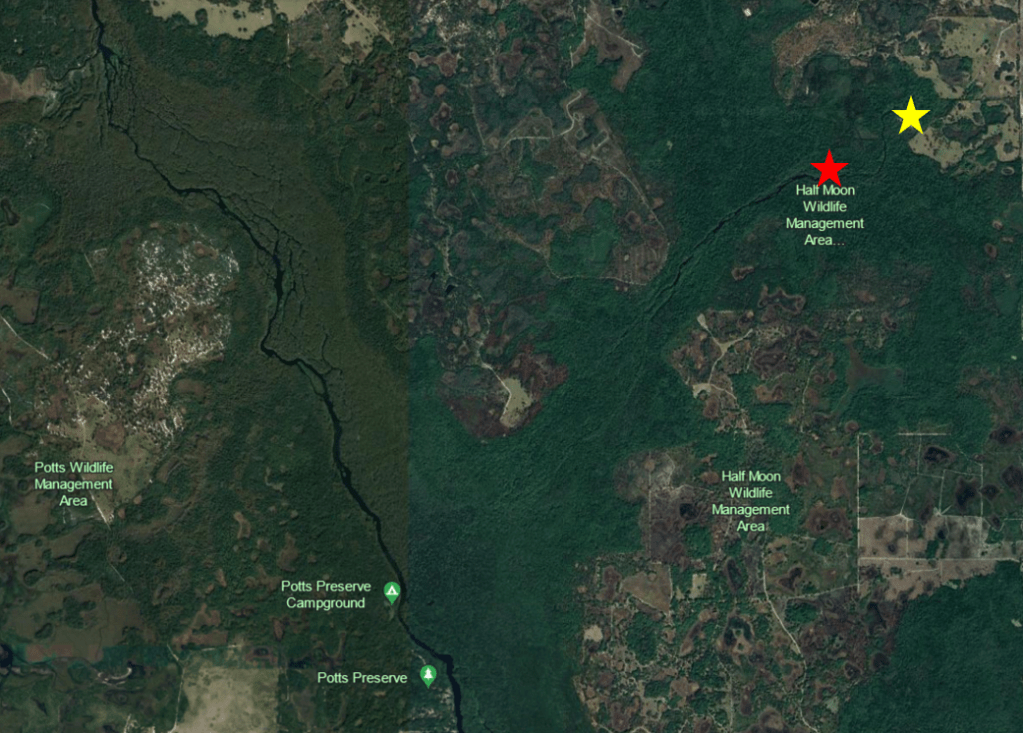
Floridians also like to name things Gum swamp. I titled this post as I did because “Gum” and some version of “slough” or “swamp” show up all over the state (a slough is essentially a flowing swamp). There’s the Gum Slough near Lake City that is a described by Apple Maps as a lake, but looks more like a wetland. There’s a Gum Swamp at the northern end of the Okeefenokee Swamp. There are Big Gum Swamp, Little Gum Swamp and Gum Swamp Creek at the southern end of the Okeefenokee. There’s a Gum Swamp southeast of Jacksonville. There’s Gum Root Swamp northeast of Gainesville. There’s a Gum Swamp that appears, on Google Earth, to connect the Manatee River and Myakka River watersheds. And there’s a Gum Swamp Branch just north of the Hardee Correctional Institution that, if I squint sideways, might connect with the Gum Slough on the Manatee River. And finally, there’s the Gum Swamp surrounding the headwaters of the topic of this post: Gum Slough spring that flows into the southern Withlacoochee River (and yes, we have two Withlacoochee Rivers as well).

Google Earth image of some of the “Gum” slough/swamps in Florida. The yellow star indicates the location of the Gum Slough that is the topic of this post.

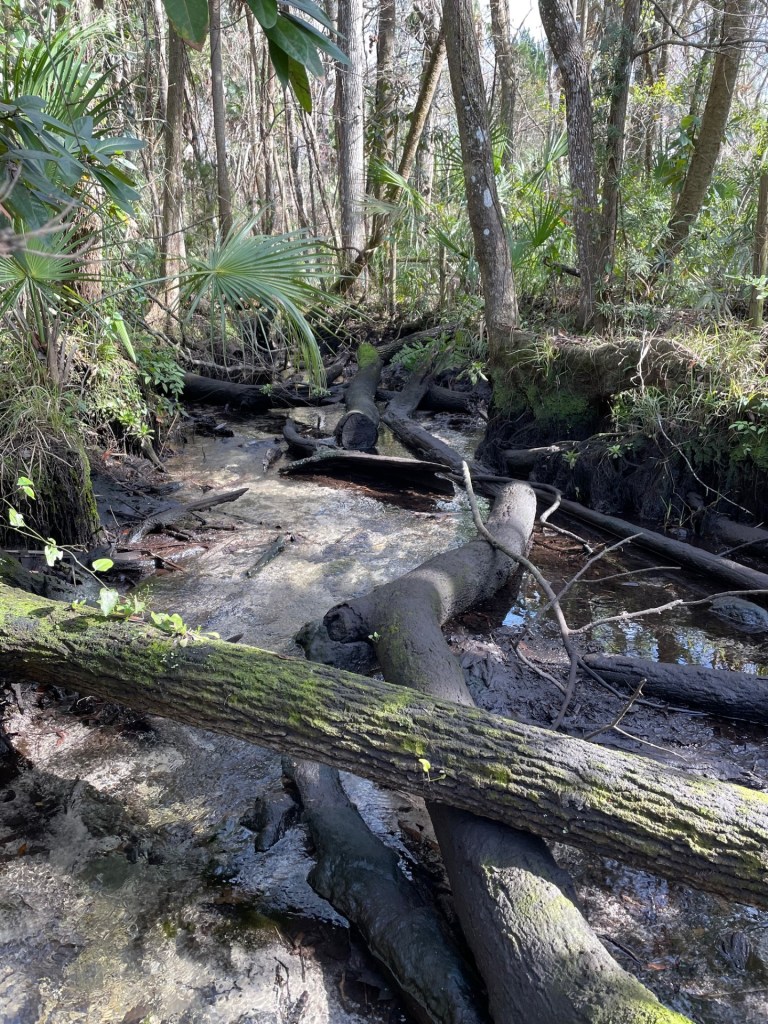
The development pressure in the area is intense, with Ocala to the north and The Villages to the east. However, the land around the spring itself is still swamp, forest, and pasture. All of the land that abuts the spring is either wildlife management area or nonprofit. Visiting the headspring, which is owned by a nonprofit, feels very remote, a bit like you’re going back in time.

At least seven vents provide the majority of the flow for the spring, three at the start of the spring, three about a mile downstream, one more that I did not find, and perhaps even a few others that have only been seen on a SWFWMD lidar map (kind of like radar). I was told by one of the owners of the nonprofit that the flow from first three springs is equivalent to a second magnitude spring, but the addition of the other four springs downstream elevates the flow to a first magnitude spring.
Google Earth (top) and Google Map (bottom) images of the Gum Slough run. The locations of the two clusters of seven springs are represented by the stars in the top map. The bottom map shows the braided morphology of both the Withlacoochee River and Gum Slough.
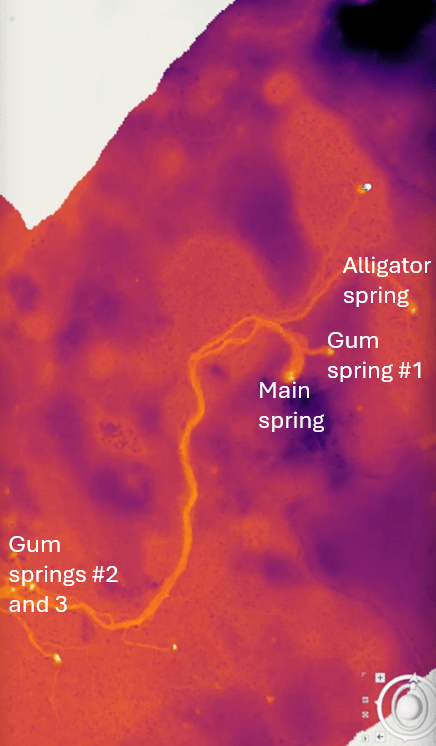
Screenshot of a lidar image of Gum Slough from a SWFWMD video (https://www.swfwmd.state.fl.us/media/video/6042) about exploring the springs of Gum Slough. According to the video, the bright spots are springs. A couple of the lighter, unlabeled springs had runs that were too shallow and narrow to paddle.

Even with the substantial flow inputs, the spring is narrow and intimate in the upper mile or so. In fact, at low water, the spring can be so shallow in the upper reaches that kayaks need to be portaged in spots. I have not yet paddled lower Gum Slough, but given how braided it is and photos that I have seen, I think that it would feel intimate downstream as well.
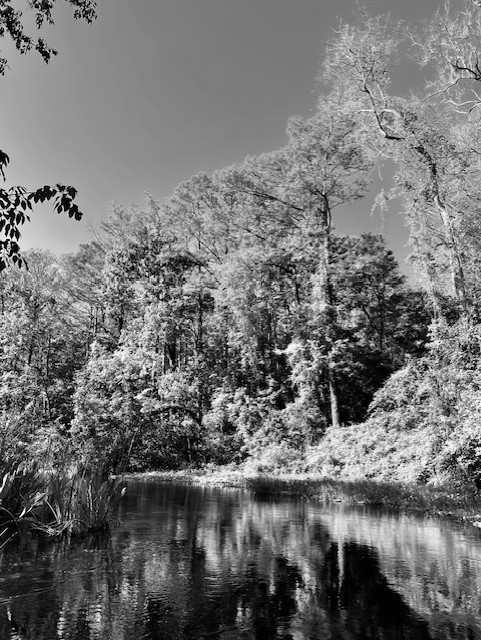
Gum Slough just downstream of the first three springs in March.

Gum Main Spring

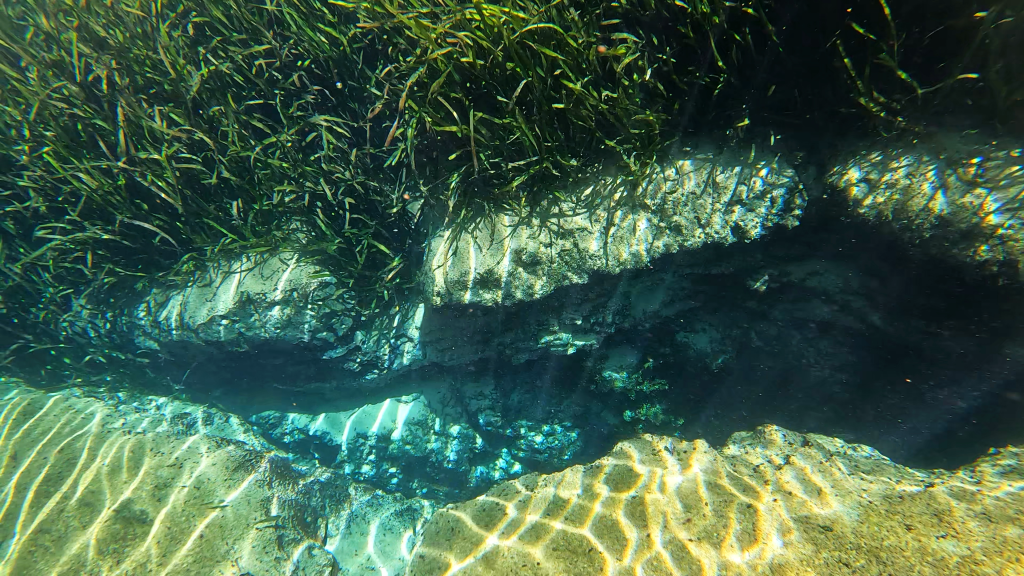
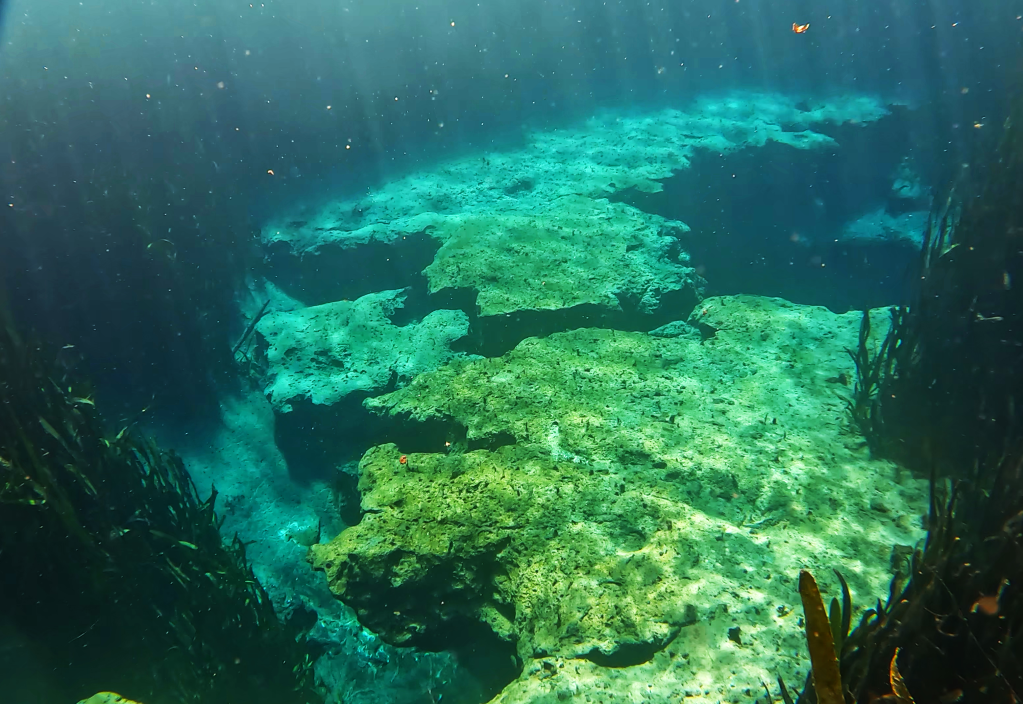
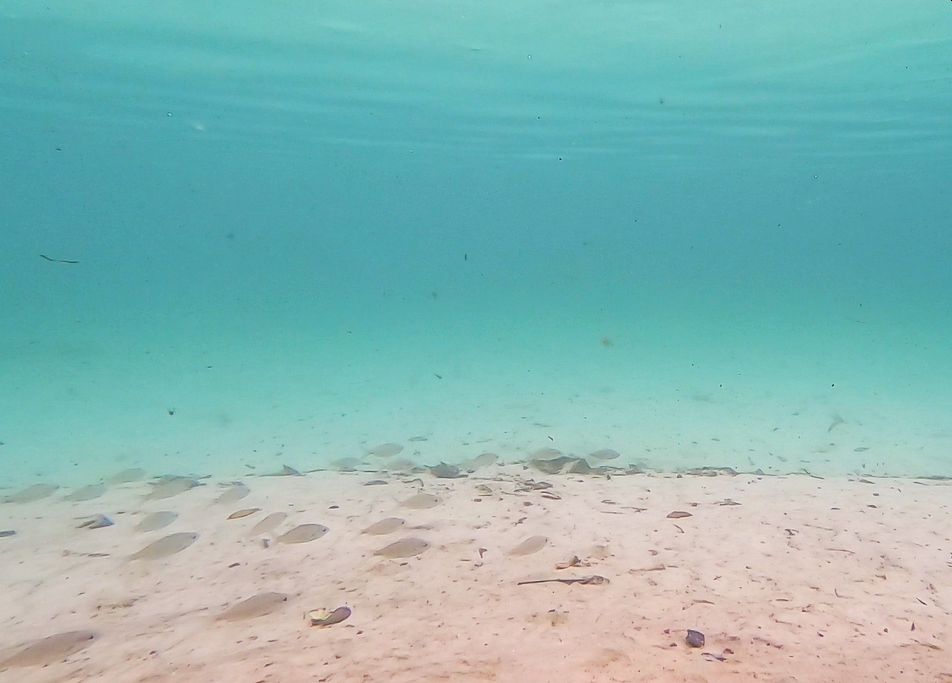
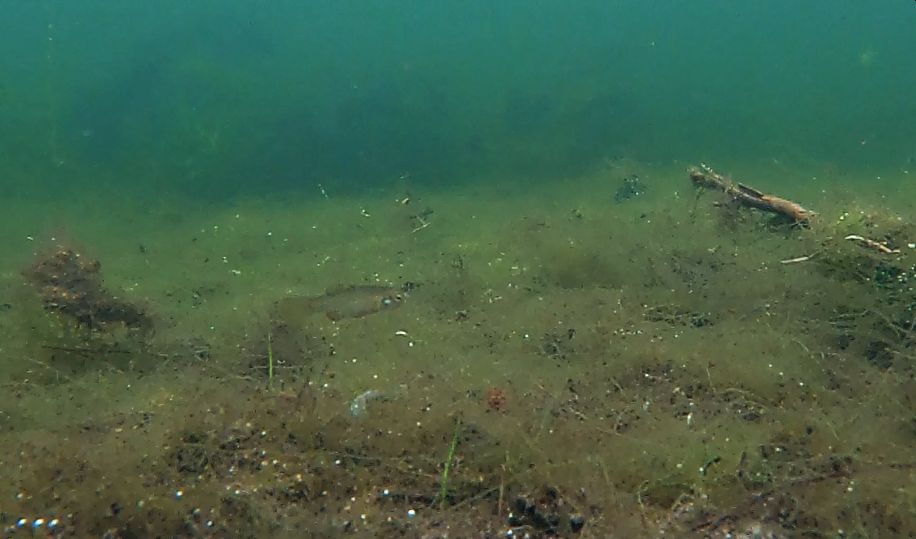
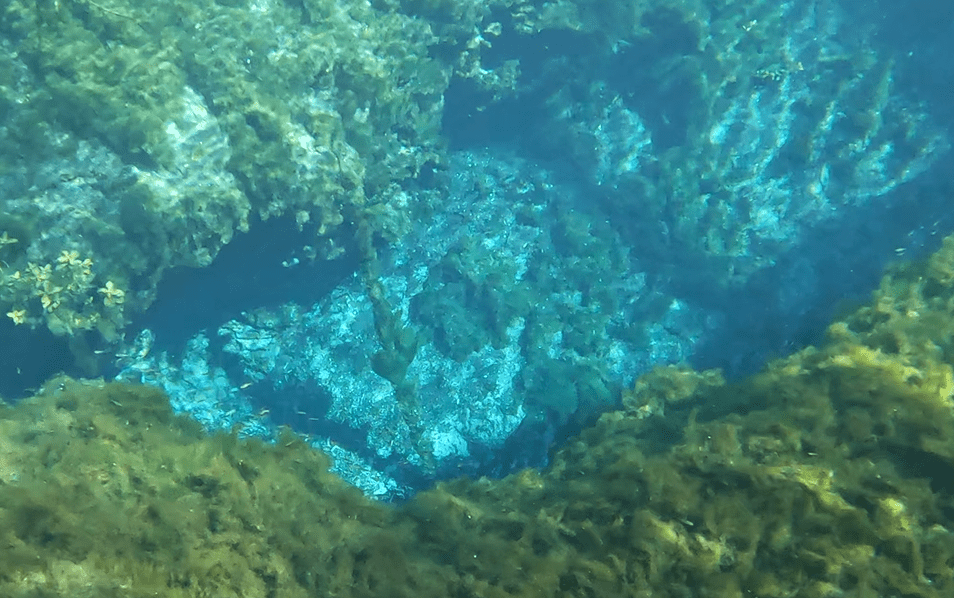
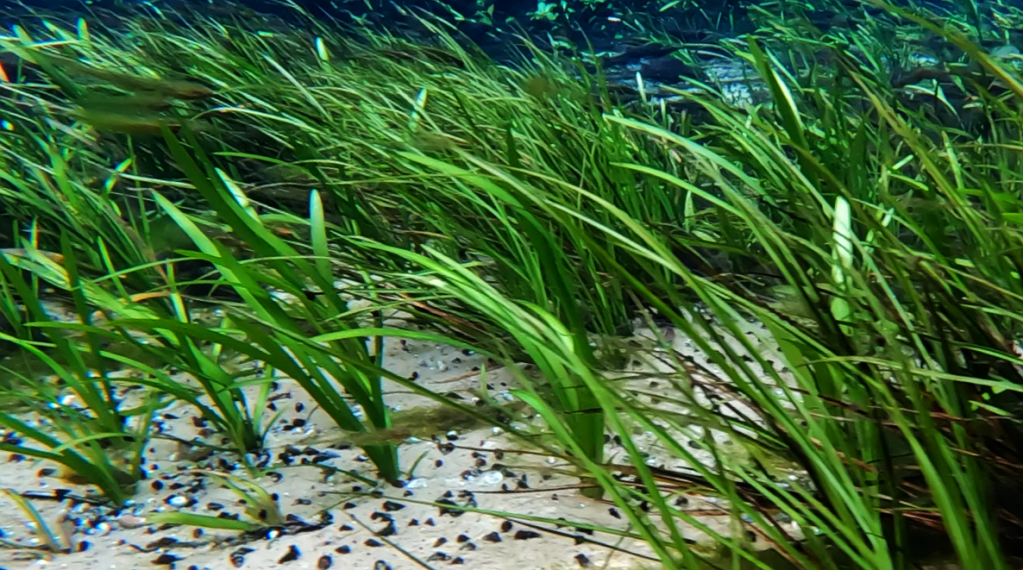
The Gum Slough main vent is represented by perforations in a large limestone pool. When I visited in January and March, algae blanketed both the floor of the main spring run and a lot of the eelgrass (Valisneria americana) just downstream, but the snails did not seem to mind. There were thousands upon thousands of snails, both on the eelgrass and on the exposed sand.
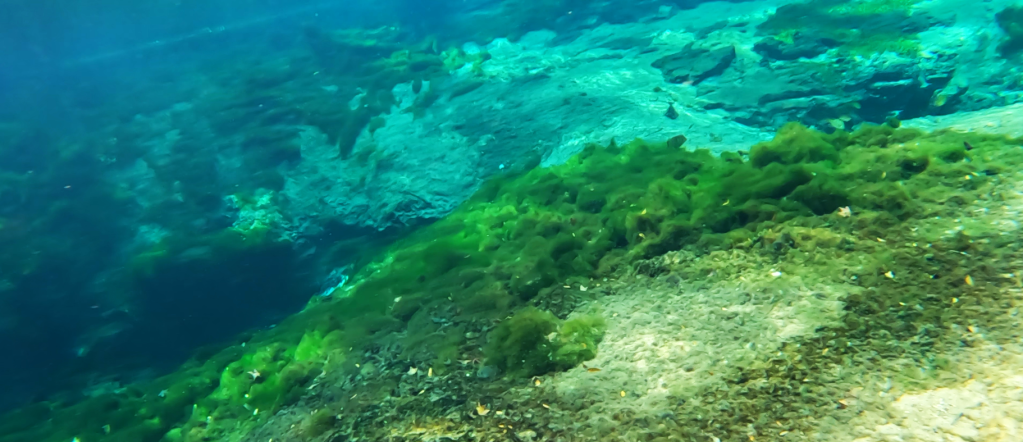
Gum Slough main vent (top) and the run downstream (bottom). The entry of Gum Slough Spring #2 is visible in the top right corner and dozens of snails can be seen in the lower left corner.

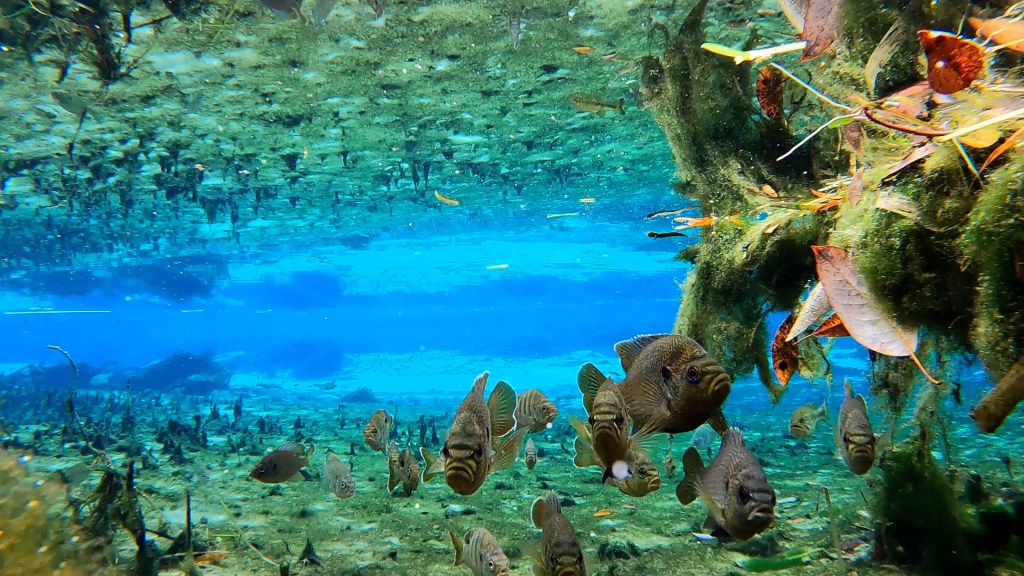
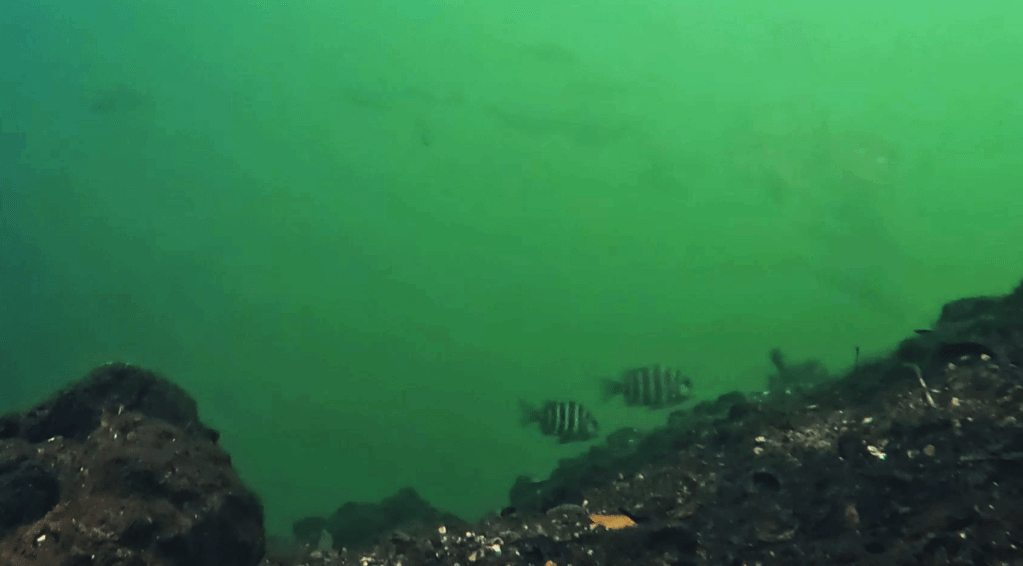
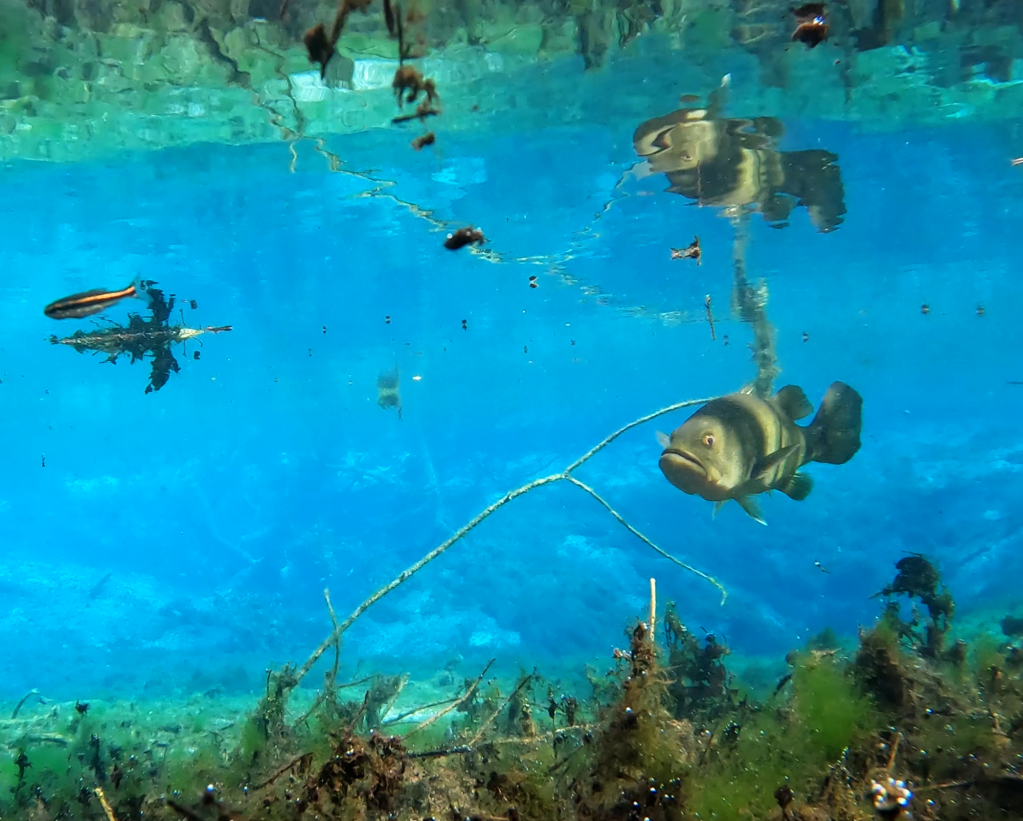
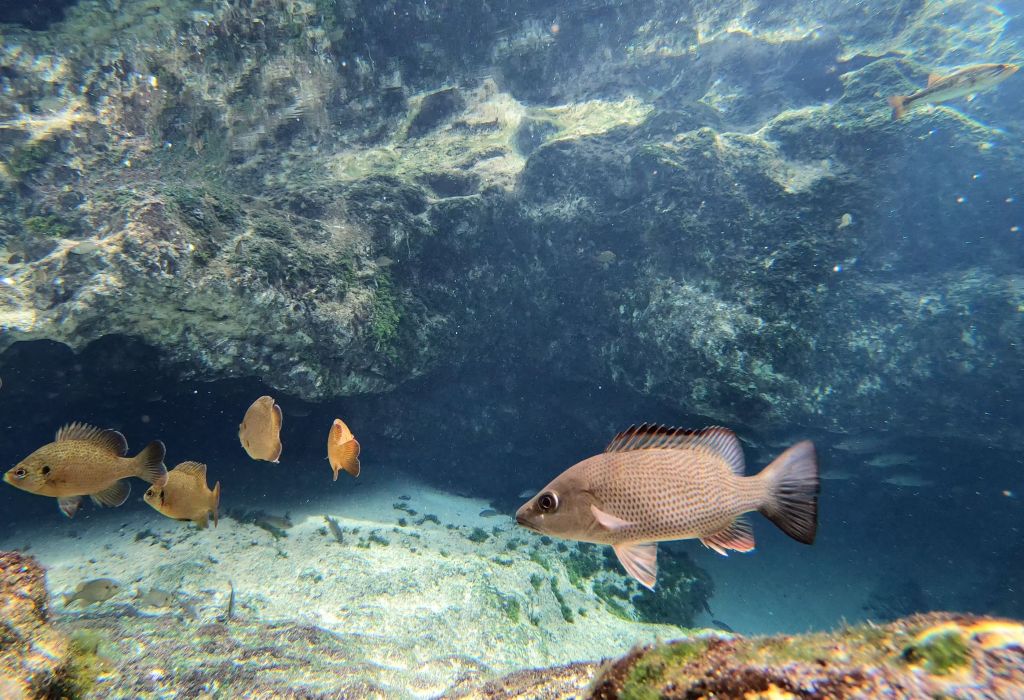
I recorded an impressive number of sizeable largemouth bass (Micropterus salmoides)–also, loads of sunfish, particularly spotted sunfish (Lepomis punctatus)–among the ten sites that I collected video. The clear water gave some good views of bowfin (Amia calva) as well. The rippling motion of their dorsal fins is a cool way to move.
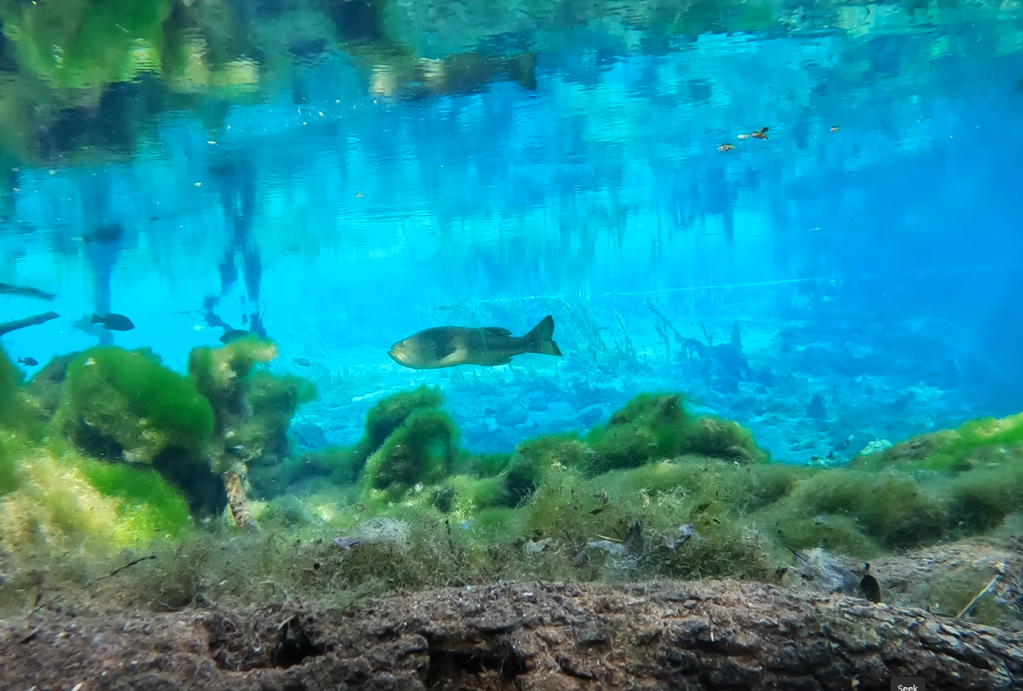
A skinny largemouth bass at the headspring in March and a bowfin with a spotted sunfish just downstream in January. I mention the difference in sample time here because the algae is green the top photo and brown in the bottom photo.
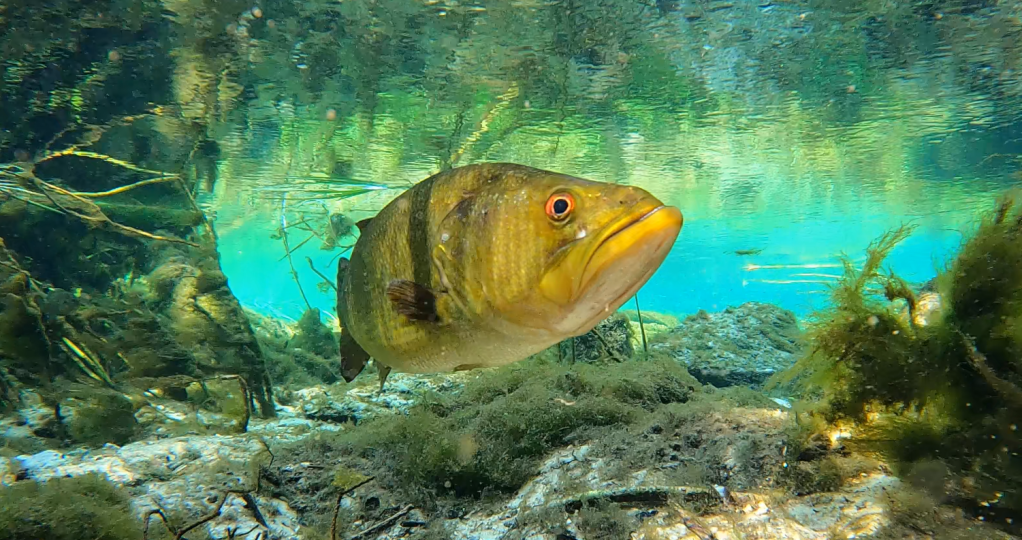
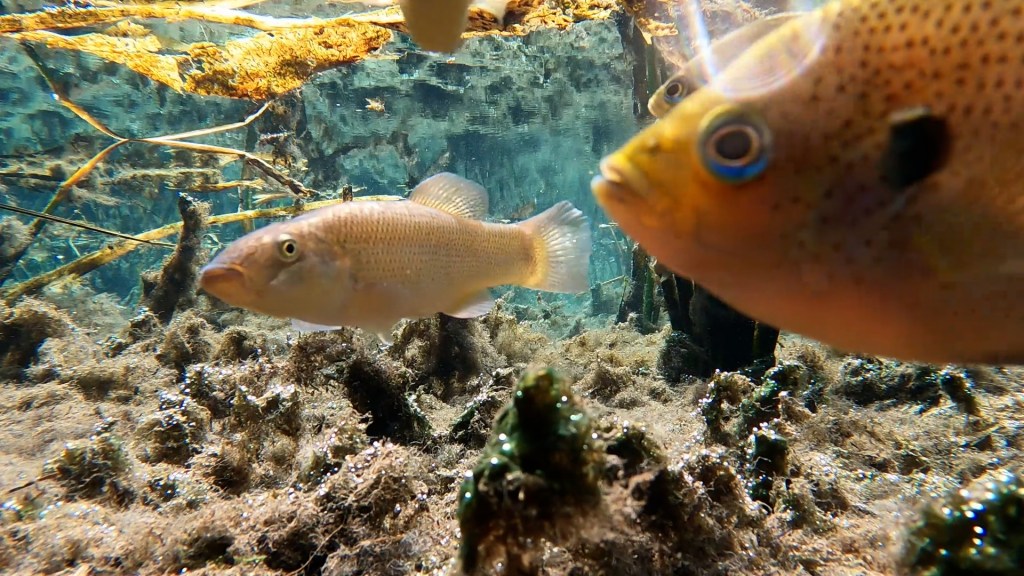
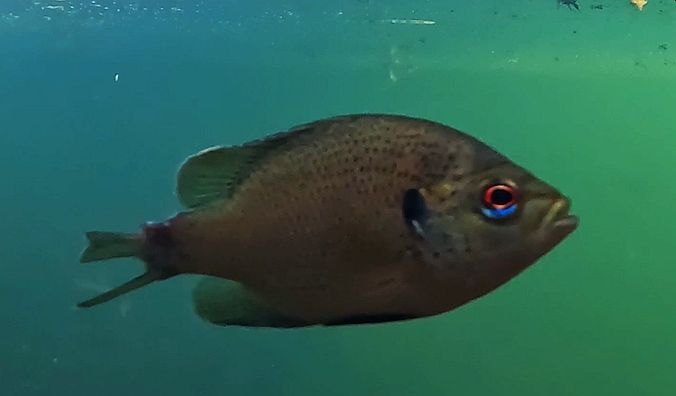
From further downstream, a large and golden largemouth bass, a very large seminole killifish (Fundulus seminolis) with a spotted sunfish, and a pretty redbreast sunfish (Lepomis auritus, bottom).

Downstream where there was some structure, I found shoals of shiners, both adult (photo) and larval (video). Note the larval shiners streaming from one mass of plants to another. They slightly rerouted when the bass approached.

Gum Spring #1

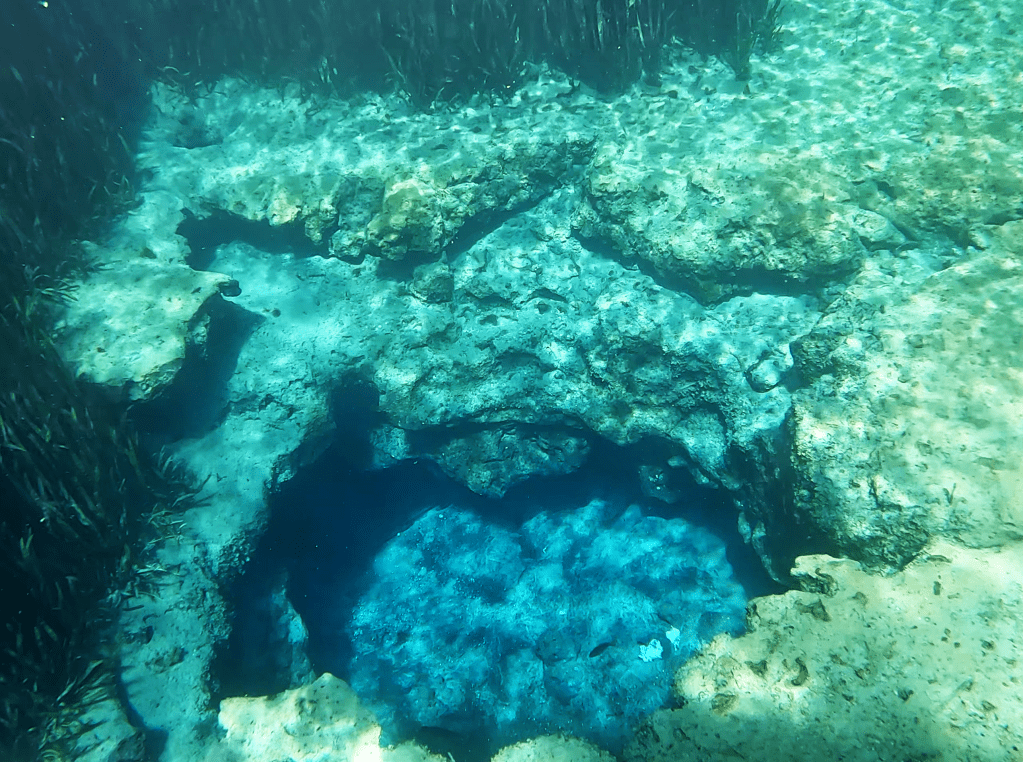
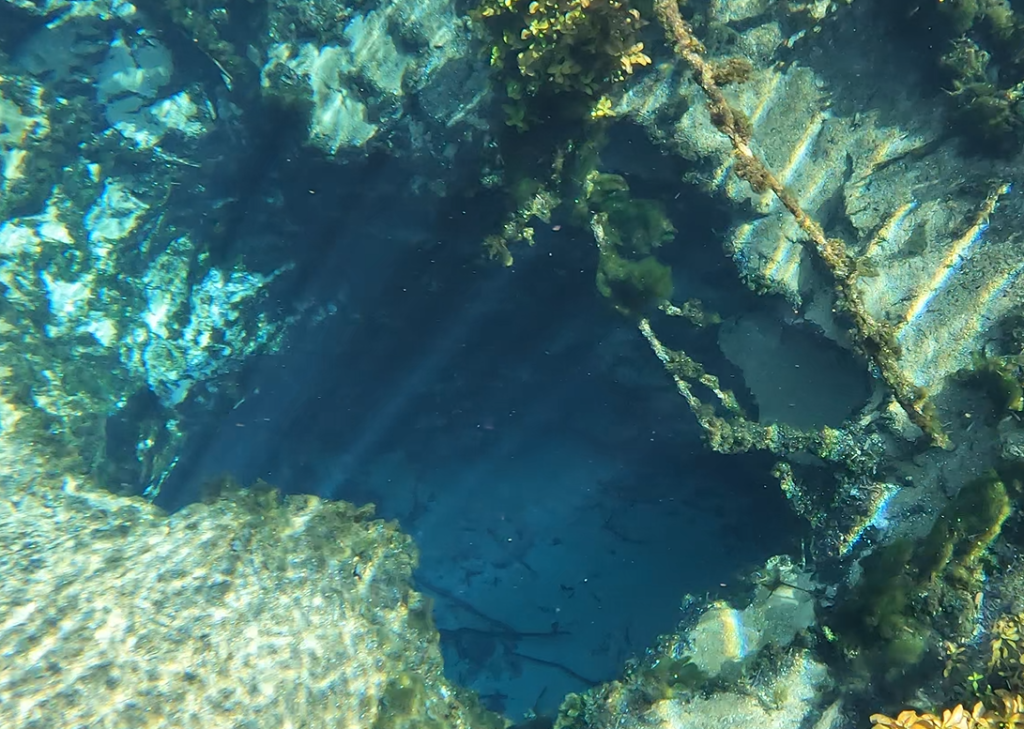
The Gum Slough #1 vent was just meters away, but it looked completely different than the main spring, much more blue. The pool was much narrower, so the banks were steeper and the vent itself was obscured by plants.

Gum Slough Spring #1 vent (top) and its short and shallow run (bottom)

Like the main spring, Gum Slough #1 supported shiners, killifish, sunfish, bass, and turtles.
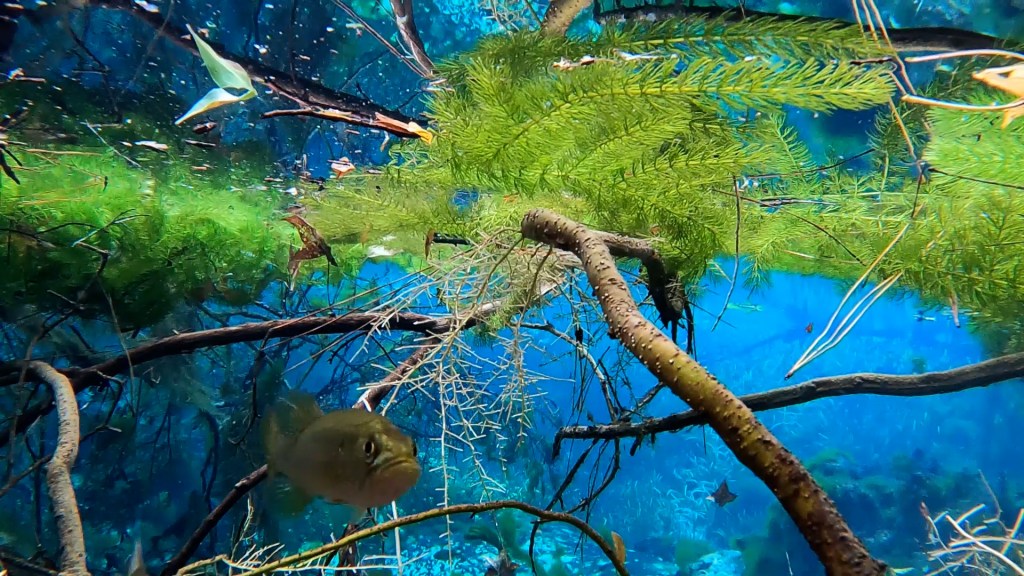
A largemouth bass near the edge of the Gum Slough #1 vent.

Spotted sunfish attacking a) food that is impossible to see (top) and b) my float (bottom).

Alligator Spring

Of the springs that I visited on Gum Slough, Alligator Spring was my favorite to paddle. The run was windy and tree canopy-covered with dappled sunlight falling on the water. Below water, the vent dropped off quickly, producing a limestone wall, although it was covered in algae.
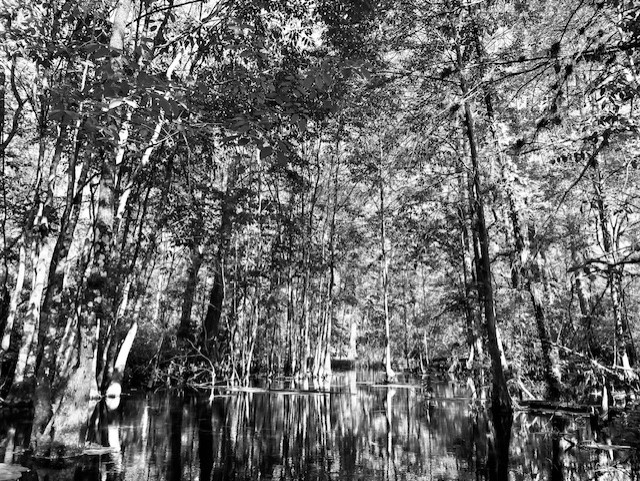
Looking up Alligator Spring run toward the headspring.
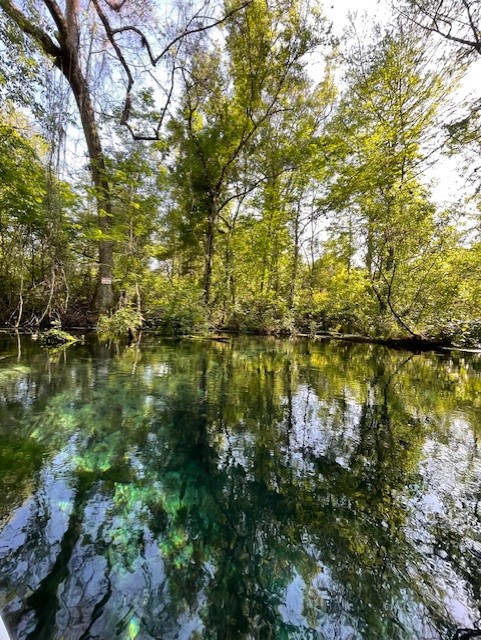
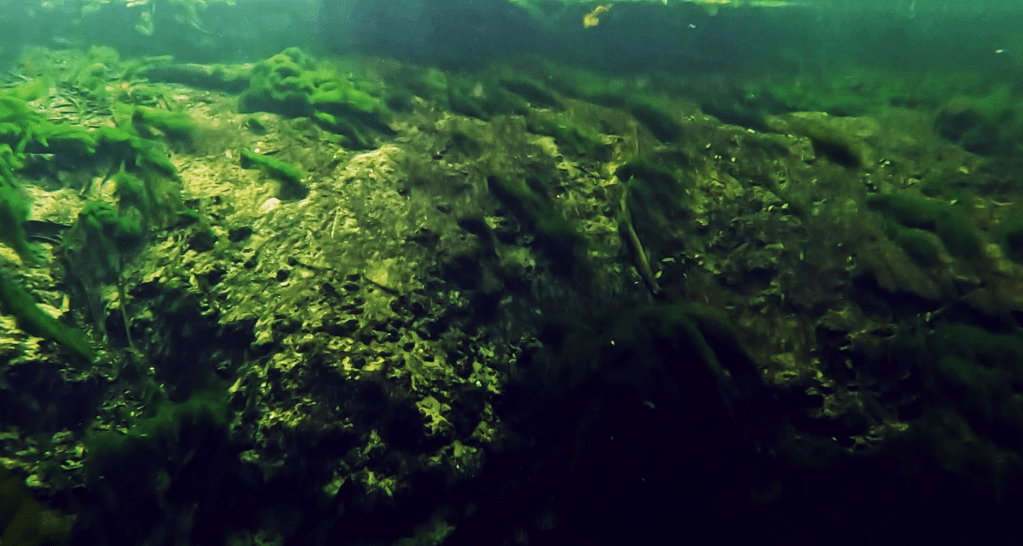
Alligator Spring vent above water (top) and the limestone wall of the vent below water (bottom).

Alligator run was a bit more tannic than the other spring runs, but I observed the same suite of fish along its length as I did in the other two runs upstream.

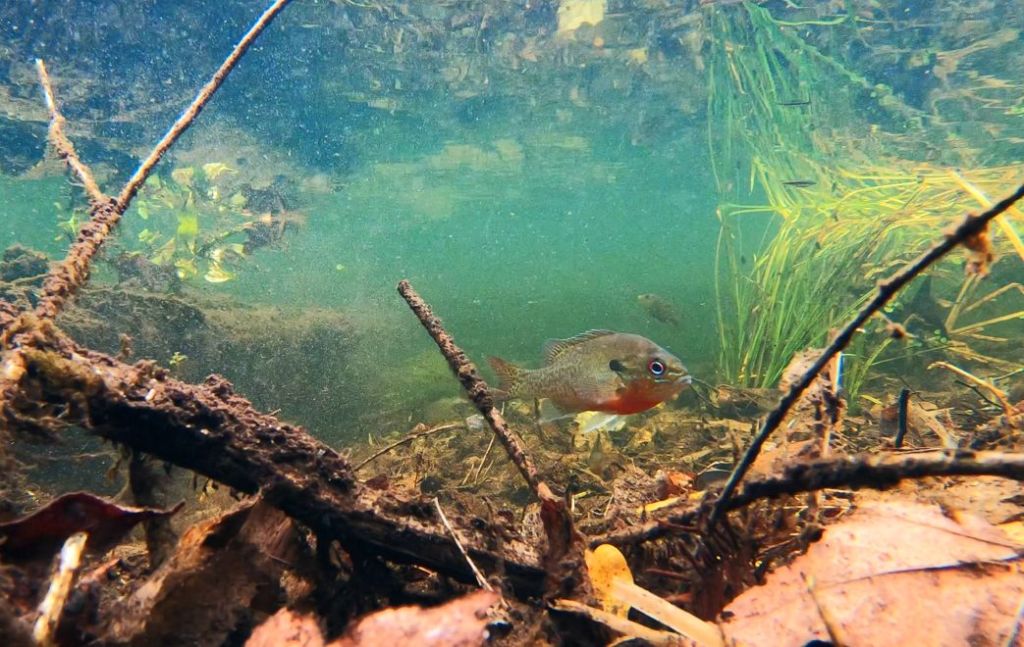
Some impressive largemouth bass and colorful redbreast sunfish (Lepomis auritus) in Alligator Spring run.

Gum Slough springs #2-3.

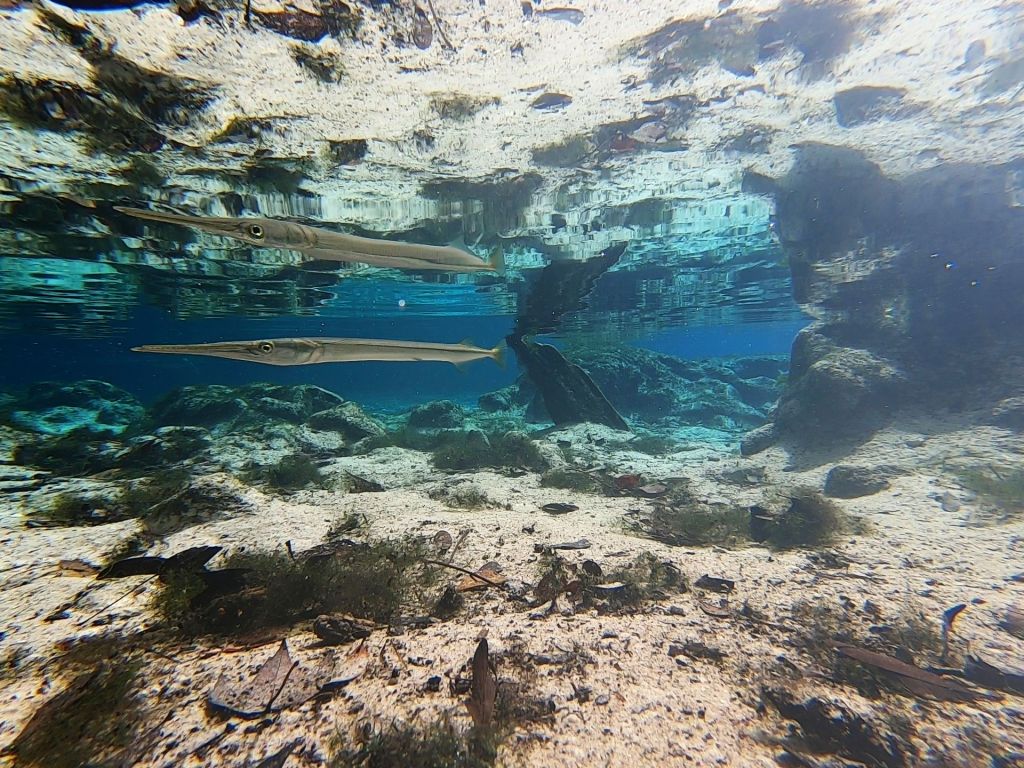
The downstream spring vents seemed much bigger than the upstream vents. And unlike the springs upstream, the downstream vents were right in the middle of the channel, rather than at the start of a run. An impressive number of large predators (largemouth bass, Florida gar, and bowfin), roamed these vents. While the largemouth bass cruised through singly or in pairs and the bowfin always were alone, at least 19 Florida gar hung over the vent of Gum Slough #4. I usually see Florida gar on their own, not in groups.

Gum Spring # 2 with a sunfish and a largemouth bass.
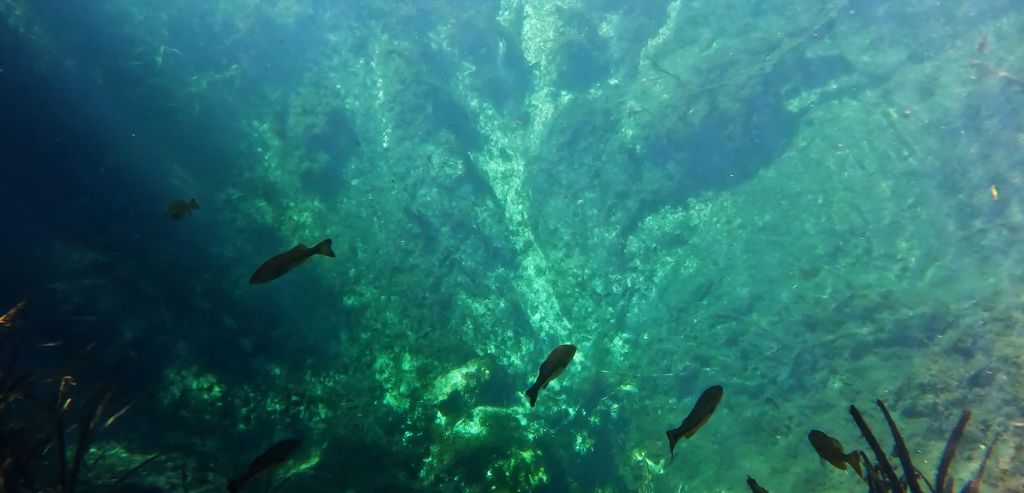
Gum Spring # 3 with several largemouth bass and a couple of sunfish.
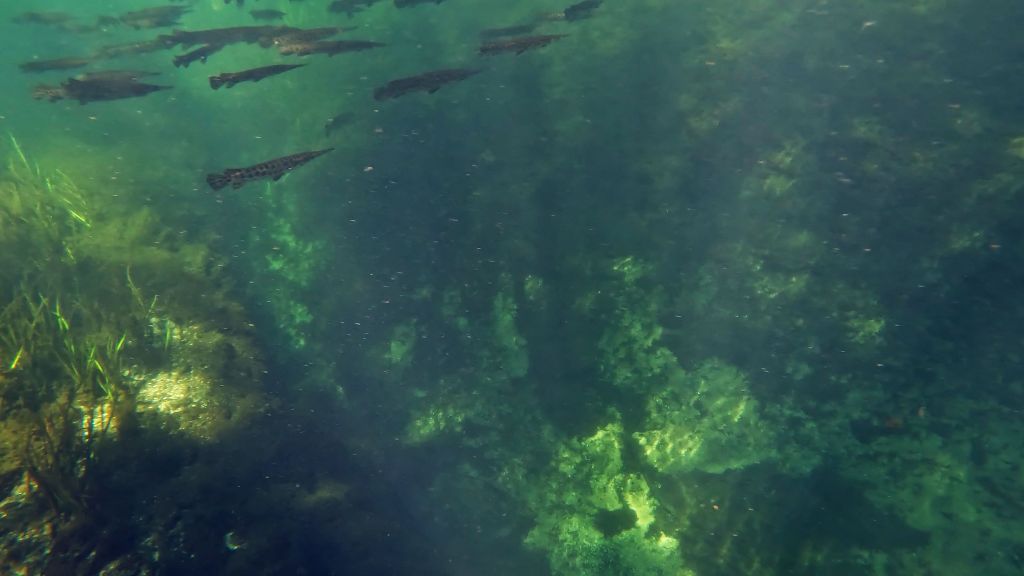
Gum Spring # 4 with a boatload of Florida gar (Lepisosteus platyrhincus) near the surface. That group was the largest number of Florida gar that I have ever seen together.

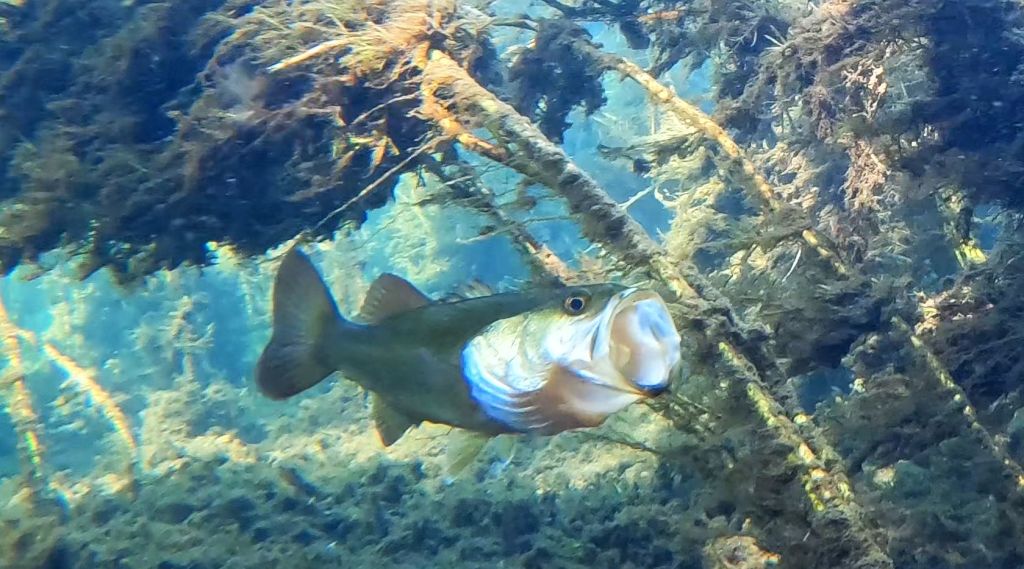
Two impressive largemouth bass, one showing off its large mouth.

The Florida gar following each other around–mating?

Despite the large number of predators, I also observed a fair number of small fish like shiners and killifish, probably because I set my cameras back in the plants. Plants can provide cover from that large mouth on the largemouth.
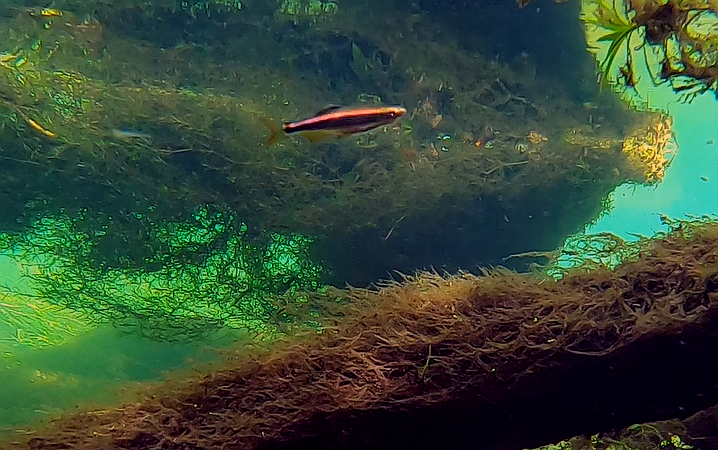
A metallic shiner (Pteronotropis metallicus, top) and three bluefin killfish (Lucania goodei, bottom).

In addition to the loads of snails on the run, when I visited in March, there were impressive numbers of mayflies and blue damselflies taking advantage of the warmer weather.

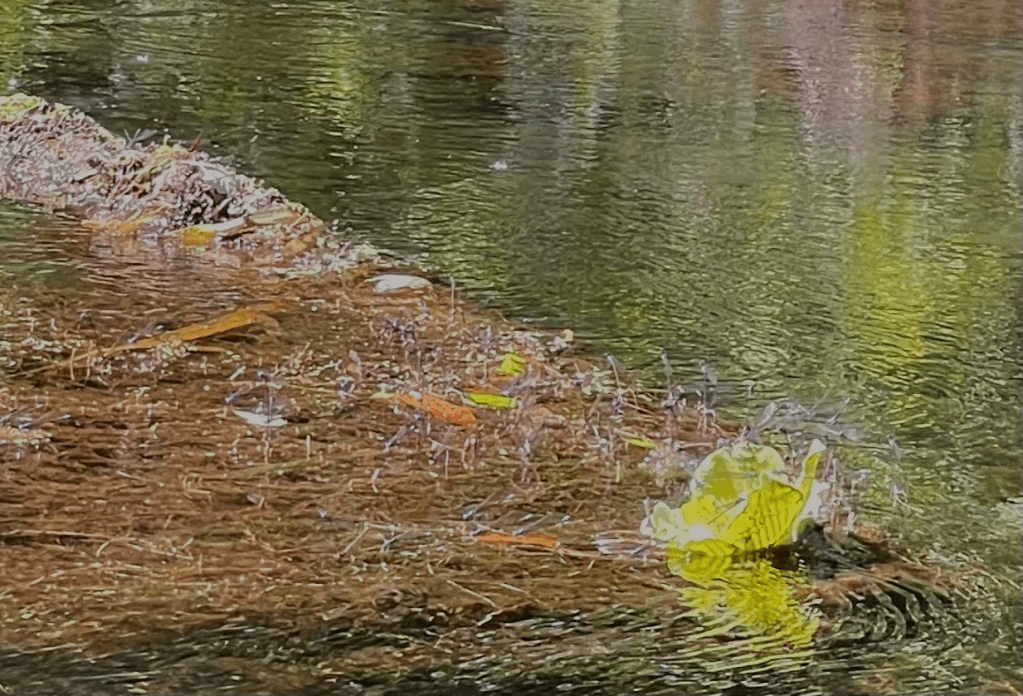
A mayfly on my data book (top) and loads of blue damselflies on an exposed log (bottom).

Out on Gum Slough, the spring feels very remote. However, the Sarasota Water Atlas categorized Gum Slough as “Impaired” (https://sarasota.wateratlas.usf.edu/waterbodies/rivers/14493/gum-slough) and the thick algal beds that I observed on multiple visits would support this interpretation. The discharge of Gum Slough has varied between 55 and 159 cfs, according to the USGS (https://waterdata.usgs.gov/nwis). The Gum Slough Minimum Flow and Level plan puts the average streamflow at 98 cfs over the period of 2003-2010, making it just shy of first magnitude, although the time series was quite short (https://www.swfwmd.state.fl.us/sites/default/files/documents-and-reports/reports/Original-Gum_MFL_Report_0.pdf).

USGS had no water quality data for Gum Slough, but there were some in the SWFWMD MFL plan (again, a short time series). The temperature of Gum Slough headspring was on the warm side (~23-24oC according to both SWFWMD and my data), but it was a little cooler below the second set of vents when I measured it (21.5-22.9oC). The dissolved oxygen was moderate at the headspring (3.11 mg/L for SWFWMD and 2.5-4 mg/L for me), but it was higher when I measured it downstream (~5-7 mg/L). This increase is not surprising, given all the submerged plants and algae. The conductivity was predictably low (324 microS/cm for SWFWMD and ~370 microS/cm for me), given the distance from a source of saltwater.

The SWFWMD MFL plan reported an average nitrate concentration of 1.02 mg/L, ranging up to 2.28 mg/L. These values are quite high, much higher than the often-cited 0.35 mg/L background concentration (the MFL report actually used a much lower number for the background: 0.05 mg/L). The report says that: “this [nitrogen concentration] is slightly higher than the mean of 1.17 mg/L for the Rainbow Springs for the same period”. This comparison is interesting, given the much more obvious overlap between human development and Rainbow Spring (there are neighborhoods just north of the headspring and houses down one bank of its run). The MFL plan reported a phosphate concentration of 0.04 mg/L, which is within a stone’s throw of the likely background concentration. So… while Gum Slough feels untouched as you float down it, it has been touched underground by human activity.

Floating down Gum Slough in March.
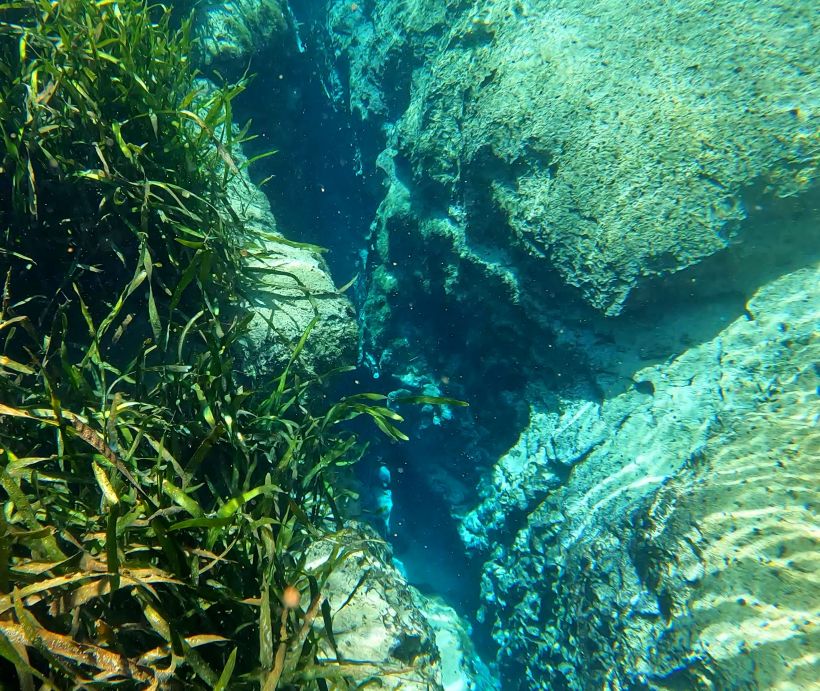
Jackson Blue Spring

May 2024

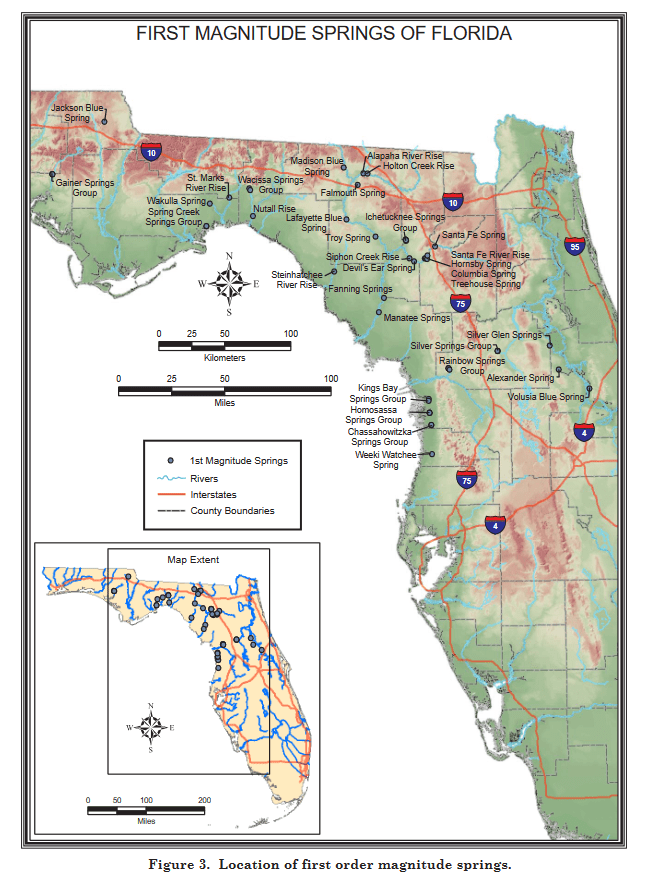
Jackson Blue was my last stop in the panhandle and my last big “Blue” to visit. Back in the day, a lot of springs must have been really blue because “Blue” appears to be the most common name for springs in Florida: Gilchrist Blue, Jackson Blue, Levy Blue, Madison Blue, Volusia Blue, etc. Now each “Blue” is distinguished from the others using the name of the county in which it occurs. Jackson and Volusia Blue are two of the 33 first magnitude springs in Florida.

Figure from Scott et al. (2002) The Springs of Florida: https://lake.wateratlas.usf.edu/upload/documents/FirstMagnitudeSprings-OpenFileReport85-FGS.pdf. Jackson Blue is in the upper left corner.

Jackson Blue Spring is in a heavily agricultural area, just to the east of the town of Marianna, Florida Caverns State Park, and the Chipola River into which it flows. It is dammed downstream where it passes just south of Marianna. According to Jackson County, this dam produced a reservoir that is now a “nationally known fishing site” (https://jacksoncountyfl.gov/services/parks-recreation/blue-springs-recreation-area/). The run would be big without the dam, but it is especially wide along its length because of the dam. As an interesting aside, the park originally hosted a club for Graham Air Force Base officers.

Google Earth images of the landscape around Jackson Blue Recreation Area (top) and of the dammed run (Merritts Mill Pond, bottom).

Locations of the springs in Jackson Blue Spring run (from: https://floridadep.gov/sites/default/files/JacksonBlue-MerritsMill-nutr-tmdl.pdf)

Jackson Blue Recreation Area (home to the headspring) is a medium-old Florida sort of place, with a dirt parking lot and a small ticket booth attended by a woman who was, perhaps, a high school student. The park is open only during the warm season and the swimming area is surrounded by a cement wall on the upstream end and a moveable wall on the downstream end.

The Jackson Blue swimming area.

On my visit, I put in below the swimming area, which already was starting to fill up with swimmers and divers when I arrived. As soon as I pushed off, I was in an eelgrass (Valisneria americana) wonderland all across the wide run.

Thick beds of eelgrass blanket most of the bottom of the Jackson Blue run.

Much of the eelgrass and other plants were somewhat coated with algae, all of which was photosynthesizing rapidly in the clear water. The evidence for this process was the production of copious bubbles. When plants or algae photosynthesize faster than the water can absorb the oxygen, oxygen bubbles form, covering the producers or rising to the surface if they get too big or disturbed.

Bubbles of oxygen streaming off the eelgrass leaves (and algae).

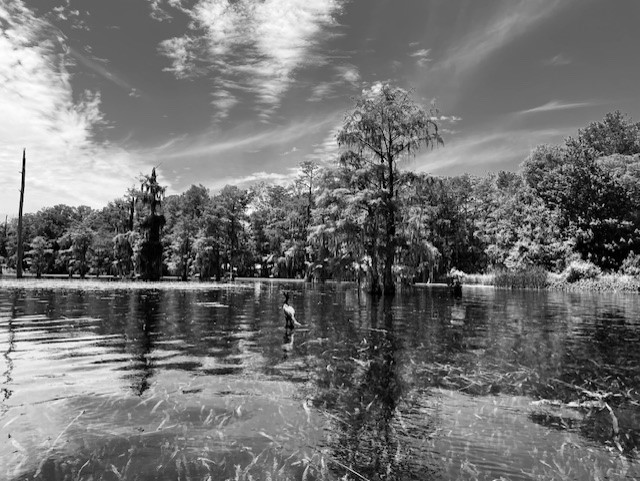
Beyond the swimming area, lovely old cypress trees (Taxodium distichum) produced shade close to the banks.

Cypress trees in the shallows of Jackson Blue Spring. Duckweed (Lemna sp.) covered the surface of the water in many areas.

Downstream of the headspring, several other springs dot the run. The most famous of these is Shangra-La Spring on northern bank of the run.

Shangri-La main spring above water (top) and underwater (bottom).

The Shangri-La second vent just off shore, photographed above the water (top) and underwater (bottom).

Twin Caves Spring is a little further downstream next to a swimming platform near the southern bank of the run.

Two views of Twin Caves Spring.

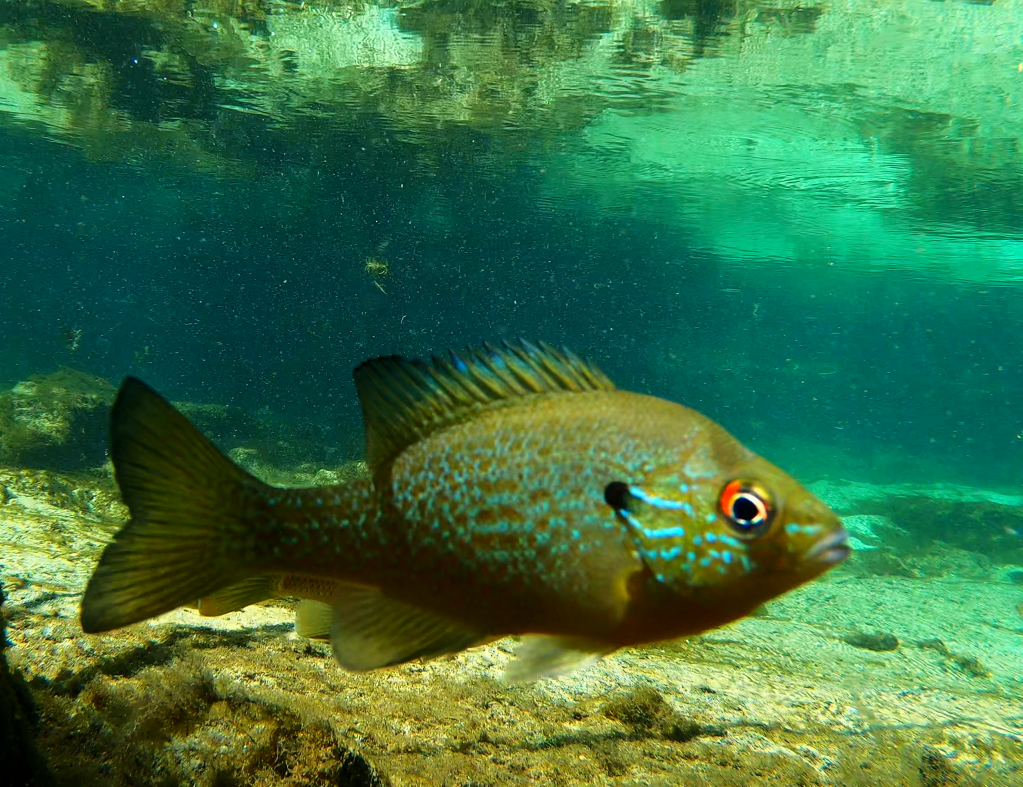
Just below the swimming area, the algae was pretty thick, but back under the trees along the banks, the sandy substrate was more visible. In the shallows under the cypress trees, there were more juvenile largemouth bass (Micropterus salmoides) than I have ever seen in one place. And, of course, there were lots of sunfish, especially spotted sunfish (Lepomis punctatus), all over the run.

Thick algae with spotted sunfish just downstream from the canoe launch.

Several juvenile largemouth bass passing through as two bluefin killifish (Lucania goodei) flared bright blue dorsal fins in a territorial display.

Still more juvenile largemouth bass downstream.

In addition to the large sunfish and largemouth bass populations, the turtle populations also seemed to be healthy.

A turtle passing by two spotted sunfish.

A tiny loggerhead musk turtle (Sternotherus minor) climbing over the rocks in this view from Shangri-La Spring out toward the center of the run (below).

Like most other springs in Florida, the available data for Jackson Blue Spring is a bit spotty. The discharge time series reported by USGS (https://waterdata.usgs.gov/nwis) and DEP (https://floridadep.gov/sites/default/files/JacksonBlue-MerritsMill-nutr-tmdl.pdf) only ranged from 2005 to 2010. Over that period of time, Jackson Blue discharge ranged from 38 to 219 cfs, a massive 576% difference in magnitude from the lowest to highest discharge. The temperatures at the headspring were comparatively cool (USGS data from 1972-2023: 20.5-21oC; 21.1-22.3oC for me). The dissolved oxygen concentrations were high for a spring (USGS: 7-10.3 mg/L at the headspring; 7.05-9.17 mg/L for me). The high values for the headspring suggest that the water issuing from the spring is not underground long. High dissolved oxygen downstream also would have been related to the large producer (plants and algae) populations. The conductivity was low, as expected given the spring’s distance from the Gulf: 197-287 microS/cm for USGS and 280-310 microS/cm for me.

For many of the biggest springs in Florida, the state developed MFL (Minimum flow and level) plans to maintain spring discharges and TMDL (Total Maximum Daily Load) plans to restore nutrient concentrations. I could not find an MFL plan for Jackson Blue, but the TMDL plan reported nitrate concentrations that ranged from 3.1-3.4 mg/L in recent years, an order of magnitude higher than the concentration in 1960 and than the background concentration of 0.35 mg/L used for many springs across the state. DEP examined the isotopic ratios of the nitrogen (14N vs 15N) in Jackson Blue and came to the conclusion that most of the nitrate emerging from the springs was from fertilizers. As organisms process nitrate, they use the lighter 14N before the heavier 15N, so their waste tends to have a low ratio of 14N:15N. The reported phosphorus concentrations, happily, all were low, about 0.02 mg/L.

Figure from: https://floridadep.gov/sites/default/files/JacksonBlue-MerritsMill-nutr-tmdl.pdf

Weeki Wachee Spring

March 2024

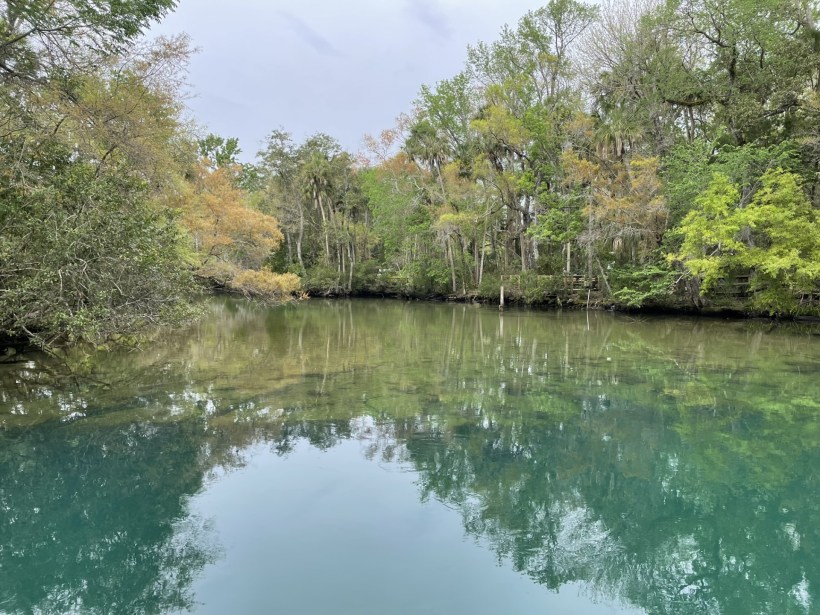
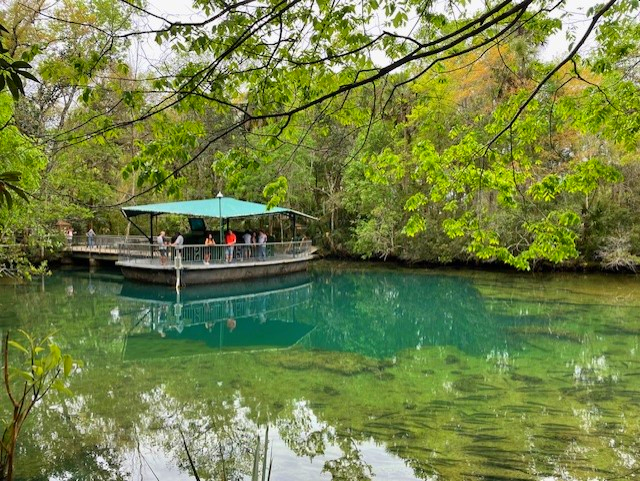
View of the mermaid show building from “Buccaneer Bay”, looking upstream at the headspring (top) and down the run at the waterslide (bottom).

Weeki Wachee Spring was not what I expected. I had only been to the park once in the early-mid 2000s for a conference on spring conservation. I brought my sons who were smallish at the time and they had a blast playing on the water slide and whatnot. Therefore, I expected the water slides and, of course, the mermaid theater for which the park is so famous. However, I did not expect the gloriously blue and clear water of the run below the water park. It was wonderful.

The park sits at the southern end of a swath of undeveloped coastal land and salt marsh, due east of Brooksville. Like Homosassa Springs, the west of the springhead is green coastal forest and salt marsh, but downstream development punctures the green between the spring and the Gulf. However, there the comparison ends. Homosassa is wide, deep, and relatively straight with development right outside the park and all down the north side. Weeki Wachee is narrow, shallow, windy, and turquoise, with a substantial house-less stretch of the run just downstream of the park.

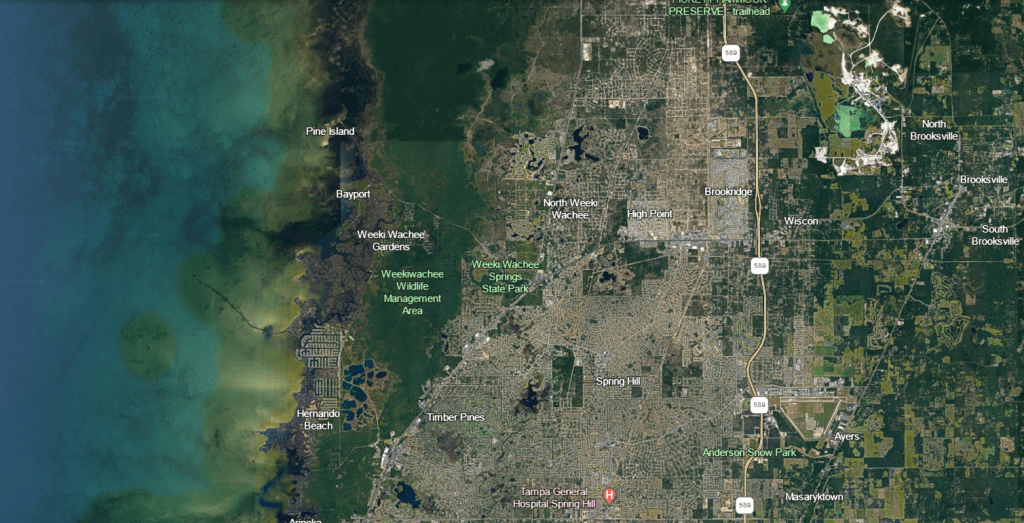
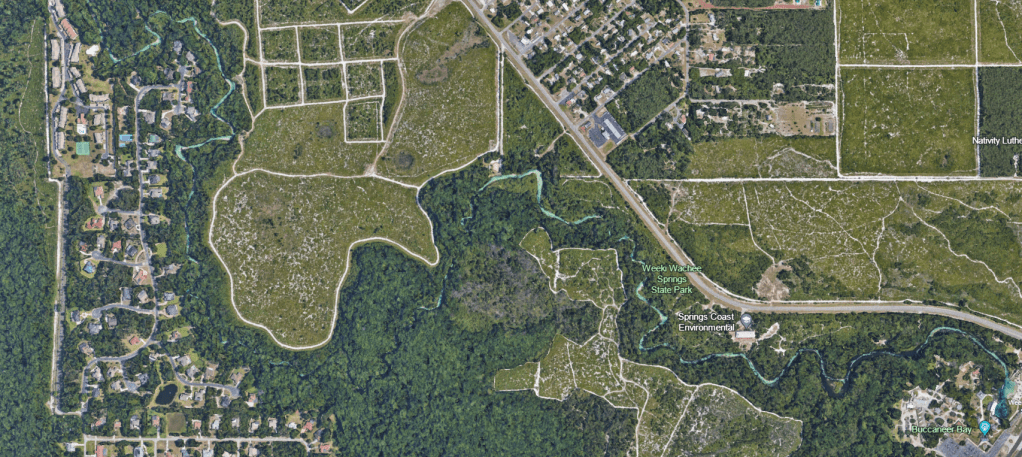
Google Earth images showing Weeki Wachee State Park, Wildlife Management Area, and nature coast development (top) and the blue of the run, even visible by satellite (bottom).

Happily, the park let me in before the visitors arrived, so I was able to photograph unobstructed.

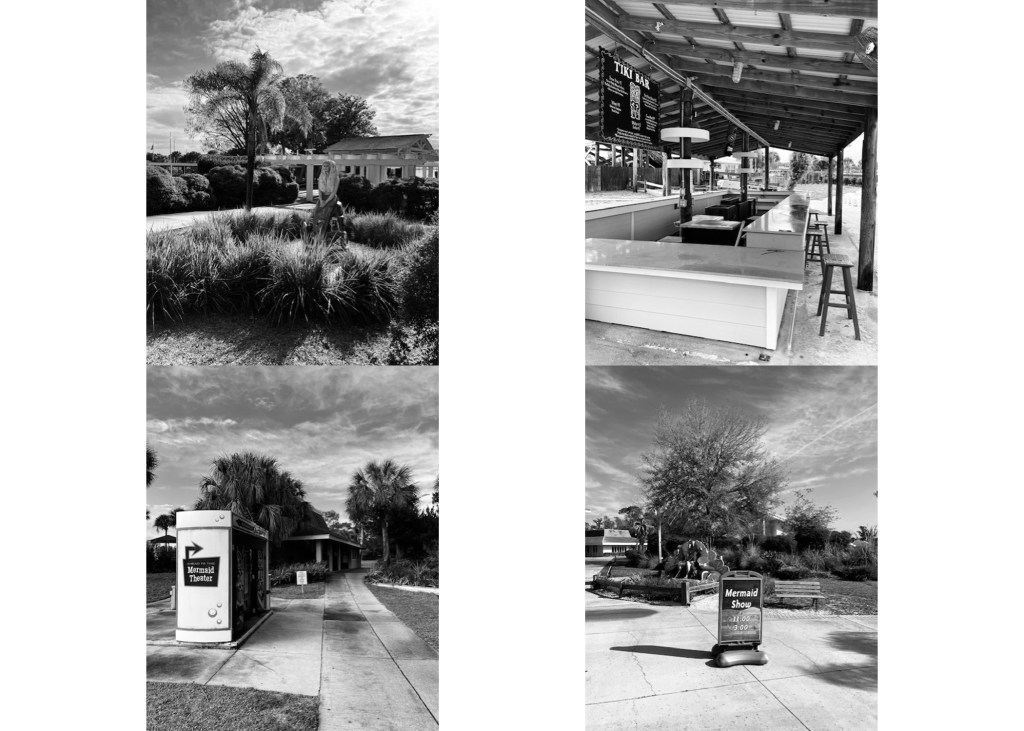
Features of the park, often highlighting the mermaids.

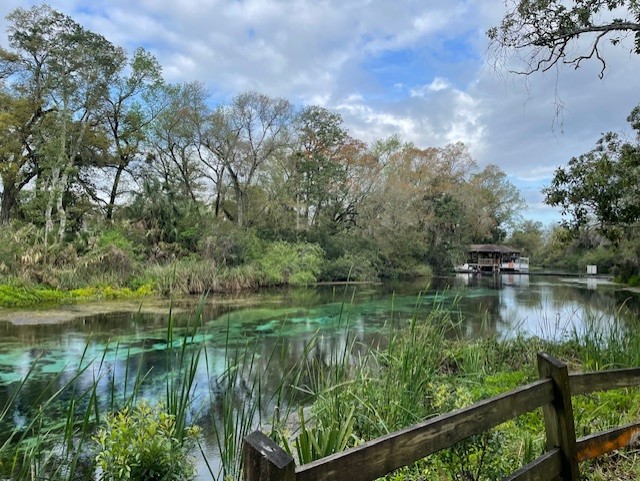
Despite the built environment of the mermaid theater, Buccaneer Bay, and the support buildings surrounding the headspring, the run was clear and wonderfully blue.

View downstream of Buccaneer Bay, looking at the ecotour dock (top) and of the run further downstream as I floated downstream (bottom).

When I first started filming, the park was very quiet. After a quick splash, I saw a diver disappear into the large headspring. This round-ish headspring measures approximately 100 ft across and the mermaids swim down to a depth of about 20 ft and cave divers report that the main pool is 45 ft deep (https://www.floridastateparks.org/learn/history-weeki-wachee, http://www.caveatlas.com/systems/system.asp?ID=89). However, divers have explored down past 400 ft, making it the deepest cave system in the US (https://www.swfwmd.state.fl.us/projects/springs/weeki-wachee). As I set up my first camera, I had no idea that someone had a rock soundtrack going underwater for their work that day until I watched the video that I collected.

A three legged turtle swimming to Ozzy Osbourne’s Crazy Train.

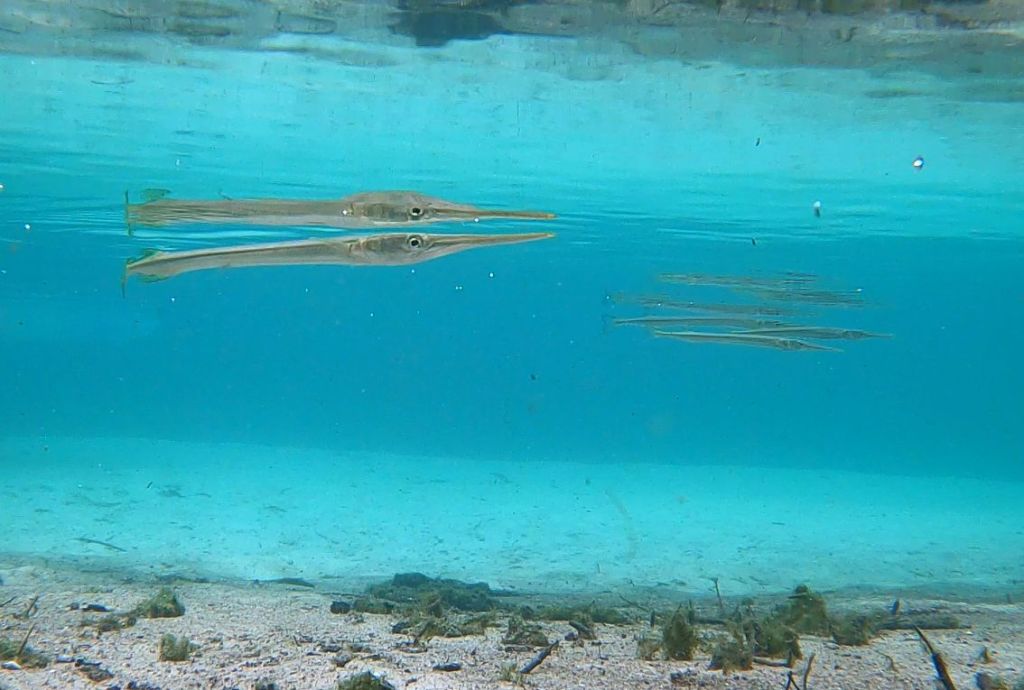
I was pleasantly surprised at the diversity of fish, even at the headspring. I recorded a variety of shiners and sunfish (Lepomis spp.), bluefin killifish (Lucania goodei), largemouth bass (Micropterus salmoides), gar (Lepisosteus sp.-in the distance so harder to ID), striped mullet (Mugil cephalus), Atlantic needlefish (Strongylura marina), and sheepshead (Archosargus probatocephalus) in addition to several turtles. None of these fish are rare, but still the diversity was higher than several other springs that I visited.

The above-water view as I set my camera downstream of Buccaneer Bay (seen in the distance, top) and the underwater view as bluegill (Lepomis macrochirus) and spotted sunfish (Lepomis punctatus) checked out the camera.

A largemouth bass posing at this same site with striped mullet and sheepshead in the background.

Further downstream: so many bass (top) and two Atlantic needlefish facing off (bottom).

There also were some fun predator-prey dynamics. A bass dropped down the bottom of the run, right behind some algae, a little like a police officer positioning their car behind some trees to spot speeders. After the bass disappeared, its potential prey (shiners) reappeared.

The bass landing on the bottom (speed 500x).

Shiners coming out of hiding in a very busy spot (video speed is 1000x).

I floated downstream through the clear blue water and eelgrass (Valisneria americana) with riparian forest on either side. I turned around when I saw the first building, which appeared to be some kind of camp.

Google Earth image showing where I turned around.

Downstream, there was more algae and somewhat more suspended particles, but it was still lovely. I picked up more mullet and needlefish downstream. I also filmed some rainwater killifish (Lucania parva), which I have observed in springs with higher conductivities.

Mullet scraping off the algae growing on the eelgrass with needlefish in the background.

Mullet and a sheepshead.

Later, I paddled upstream from the neighborhood where I had rented an Airbnb on a canal. Here boat traffic was higher and much of the vegetation disappeared, although there still were scattered beds of eelgrass.

Google Earth image of the area between the neighborhoods.

In many of the areas, the bottom was pure sand and I picked up an additional salt-tolerant fish, the tidewater mojarra (Eucinostomus harengulus).

Tidewater mojarra.

Needlefish and mullet downstream of the park.

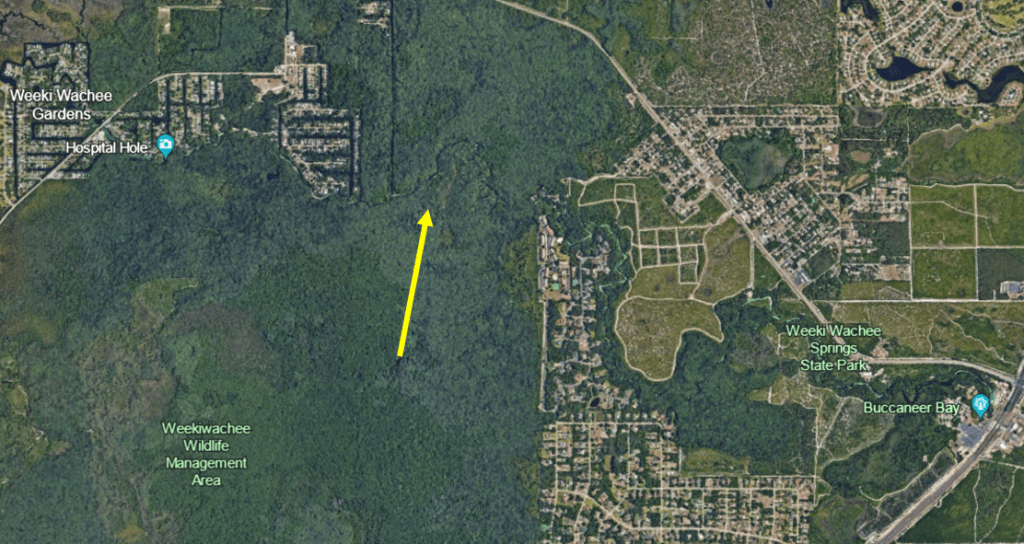
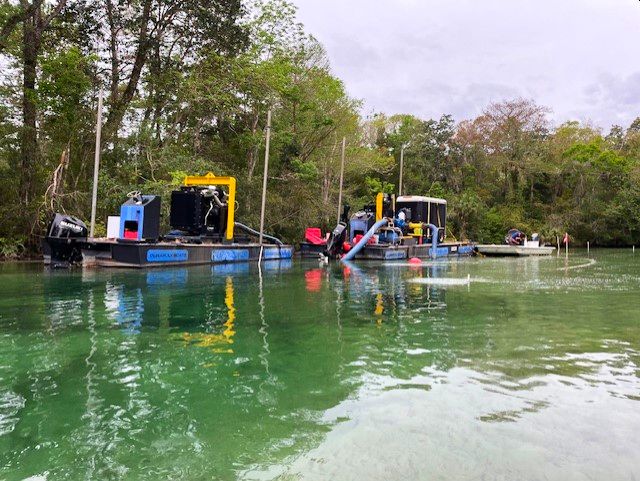
Just upstream of Weeki Wachee Gardens, a dredge operation was deepening the channel. Even so, as I paddled late in the day, after the workday was done, I saw a manatee.

Dredge operation upstream of Weeki Wachee Gardens.

I also ventured downstream Weeki Wachee Gardens, heading toward the Gulf. As I floated downstream, I saw crevalle jacks, gar, and snook as well as the bass, mullet, needlefish, and sheepshead that I observed upstream.

As I left the neighborhood, the landscape changed to saltmarsh and the water got very salty and murky. However, I could just barely make out a gulf killifish (Fundulus grandis), more mojarra, and what appeared to be a snapper.

Google Earth Image of the area where I videoed downstream of Weeki Wachee Gardens (top) and a view of the sunset over the salt marsh (bottom).

Gulf killfish in the saltier water downstream of the neighborhoods.

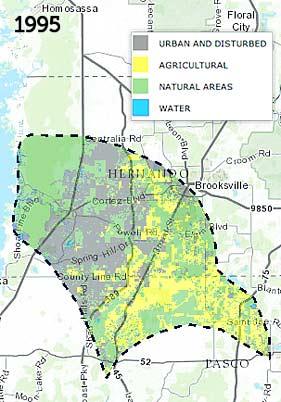
Like the other Nature Coast springs, the springshed of Weeki Wachee is highly developed to the east, but relatively untouched to the west.

Weeki Wachee springshed landuse map (from https://www.swfwmd.state.fl.us/projects/springs/weeki-wachee/dashboard)

The SW FL Water Management District water quality dashboard indicates that the water clarity today (6/10/24) is 67 feet at the headspring, allowing clear views of the mermaids (and fish). It produces somewhere between 80 and 140 million gallons per day, making it a first magnitude spring. A graph on the dashboard suggests that disharge is higher now than it was in the mid-2000s. The spring is very slightly warmer than many Florida springs (SWFWMD = 75.1oF, I measured 23.6-24.1oC) and the dissolved oxygen concentrations are moderately low (SWFWMD = 1.81 mg/L at the headspring today, I measured 2.09 near the headspring). The oxygen increased as I traveled downstream, reaching 8.18 mg/L in the portion of the run between the two neighborhoods, likely due to a combination of turbulence, oxygen production by eelgrass upstream, and the more abundant algae in this region of the spring. The conductivity of the upstream portion of the spring is relatively low (SWFWMD = 370 microS/cm, I measured ~360 microS/cm). Below Weeki Wachee Gardens, the conductivity shot up considerably to 3960-5250 microS/cm), likely accounting for the larger number of salt tolerant species in this region of the run.

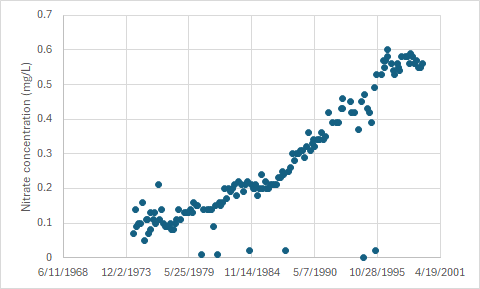
Like many Florida springs, the nitrate concentration of Weeki Wachee has increased over time. However, for the last decade, it has maintained a fairly constant, but very high, level (the background level used for DEP planning for springs in FL is 0.35 mg/L). The seminal studies on nitrate in FL springs showed increases through the 1970s, but Weeki Wachee was at the commonly-used baseline in the early 1990s. Fortunately, Weeki Wachee has been monitored for well over 100 years, so I was able to find nitrate data back to the 1970s (the earlier data would be for streamflow only). In fact, Weeki Wachee does show this same increase in nitrate that has been observed in other springs–it just started a lower concentration (~0.1 mg/L). Hopefully, the leveling off that the data suggest has happened will be a long term trend (even better would be a decrease, of course).

Increase in nitrate concentration in Weeki Wachee spring over time from the 1990s to the present (from: https://www.swfwmd.state.fl.us/projects/springs/weeki-wachee/dashboard).

Increase in nitrate concentration in Weeki Wachee from the 1970s to the 1990s (data from USGS NWIS: https://maps.waterdata.usgs.gov/mapper/index.html). The upper end of this graph matches the start of the graph above perfectly, showing that the nitrate concentrations steadily increased from the mid 1970s to the early 2010s.

Homosassa Springs

March 2024

The Homosassa Spring main vent, called “The Fish Bowl”.

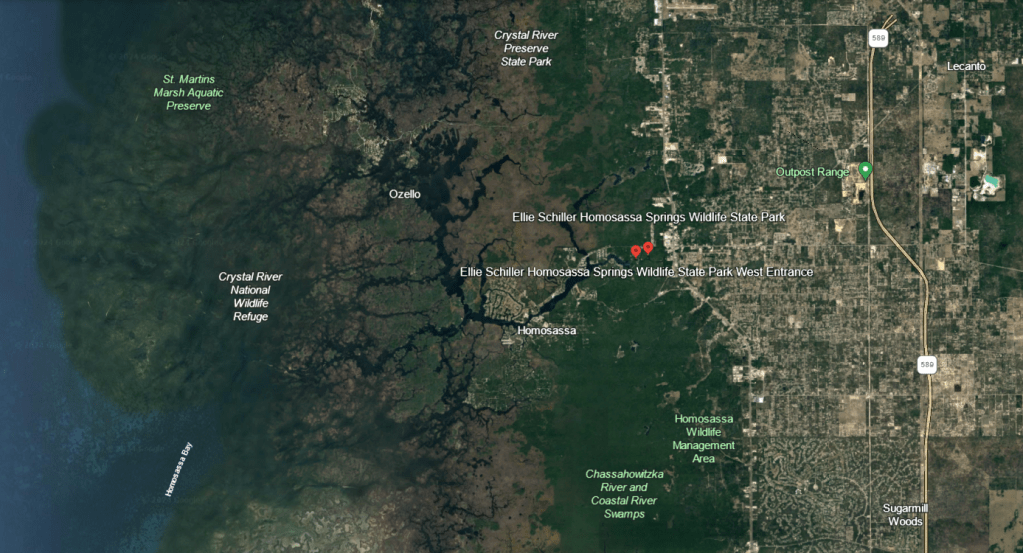
Homosassa Springs is like no other: part spring, part rehabilitation facility, part zoo. It sits on the “Nature Coast”, just south of Crystal River and north of its famous cousin, Weeki Wachee State Park. The whole coastline in that region of Florida is fairly undeveloped, but a ridge just to the east of the coastline has experienced rapid development. The land just to the east of that ridge has been in agricultural use for many, many decades.

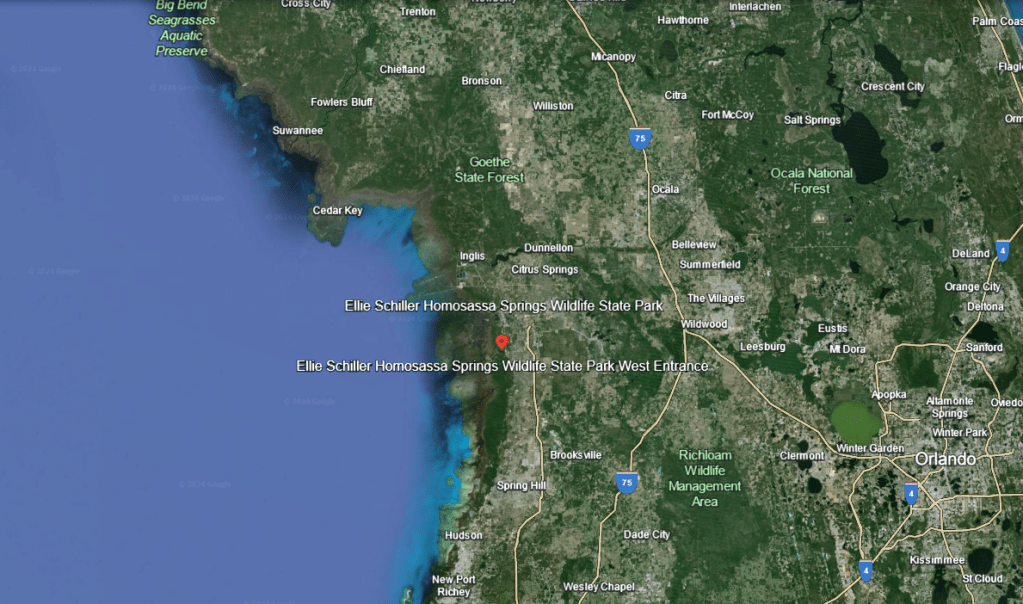
The location of Ellie Schiller Homosassa Springs Wildlife State Park in the Nature Coast.

A close-up of the Nature Coast showing Homosassa Springs feeding into the matrix of channels along the Nature Coastline.

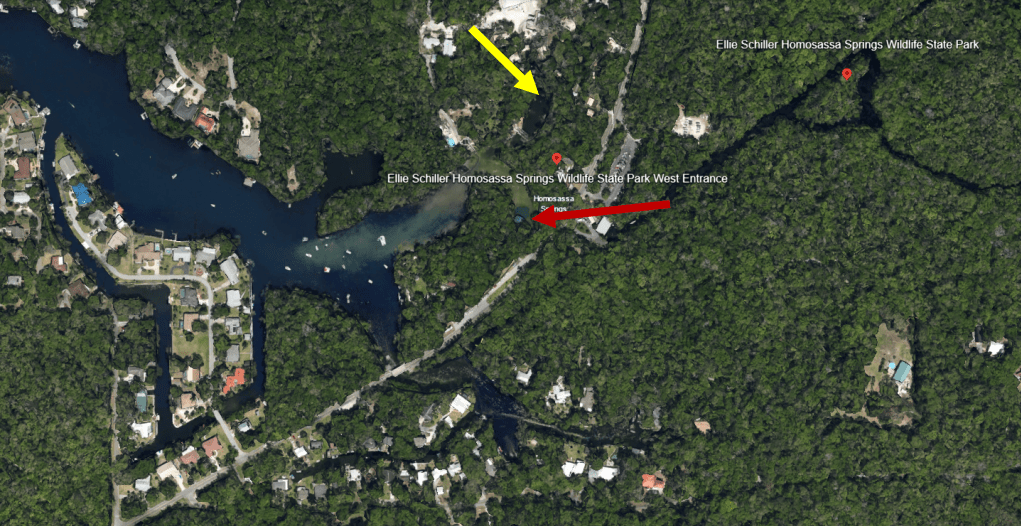
An even closer close-up of the spring showing the clear water flowing into the larger channel of the Homosassa River. The red arrow shows “The Fish bowl” and the yellow arrow shows the wildlife park.

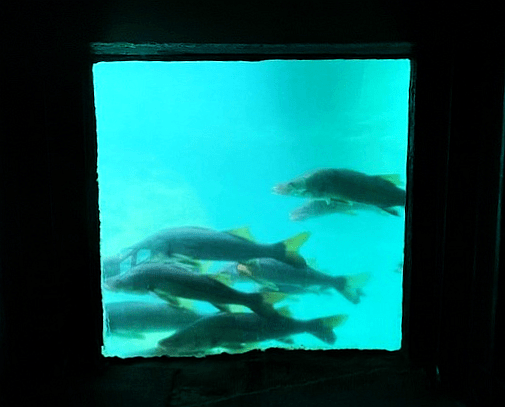
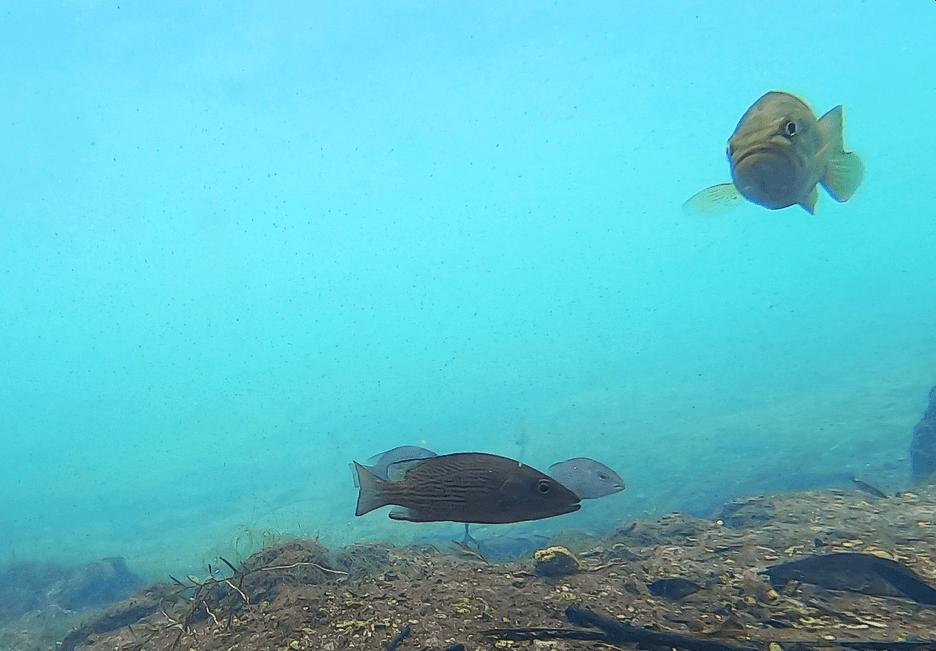
Officially called Ellie Schiller Homosassa Springs Wildlife State Park, the spring has been an attraction since the late 1800s. The park was one of Florida’s earliest attractions; a train bought visitors to the spring from 1893 to 1941. In the 1920s, a bridge built over the 55 ft. main vent, christened “The Fish Bowl”, allowed visitors to see through the clear water to the fish below. In the 1950s, an observation platform and underwater observatory replaced the bridge to give visitors an even more intimate view of the abundant common snook (Centropomis unidecimalis) and grey snapper (Lutjanus griseus) in the headspring. The state bought the property in 1989 and named the park for noted fisheries biologist/environmental advocate/philanthropist Ellie Schiller.

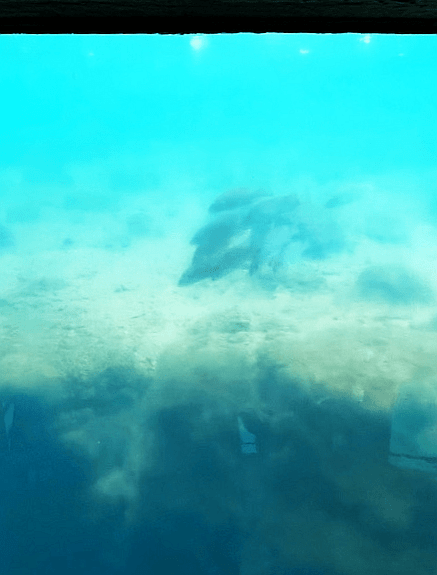
Common snook (top) passing by the window of the underwater observatory and some grey snapper (bottom) contemplating the drop off to the vent at the headspring.

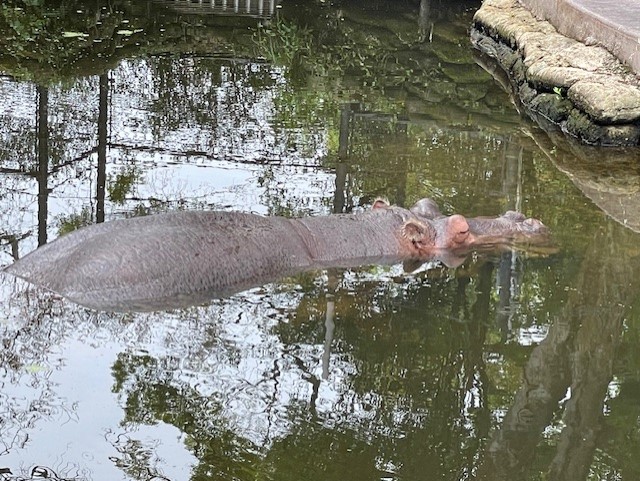
In the 1940s, the wildlife park contained a variety of exotic animals like lions, bears, and monkeys. Now all the animals in the park are native to Florida, with the exception of Lu the hippo.

Lu, the hippo (Hippopotamus amphibius).

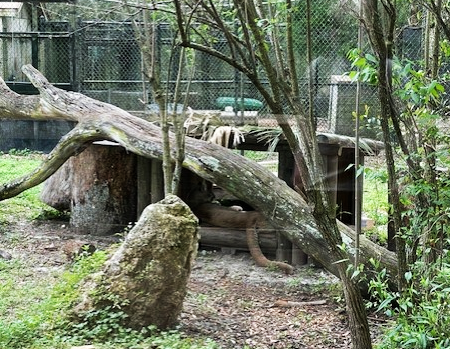
A Florida panther (Puma concolor coryi) resting in its house.

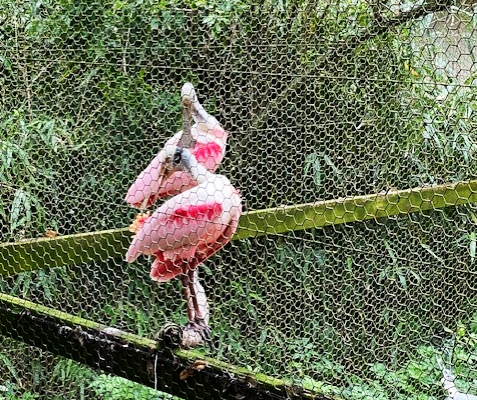
Two roseate spoonbills (Platalea ajaja) preening.

A barred owl (Strix varia) looking decidedly unimpressed.

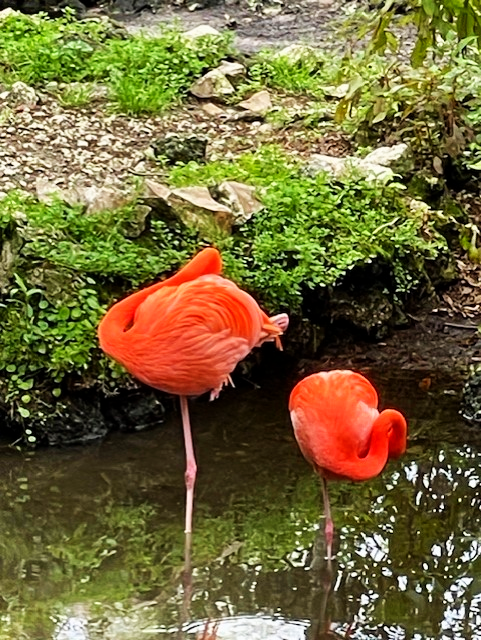
Two flamingos (Phoenicopterus ruber) resting on one leg.

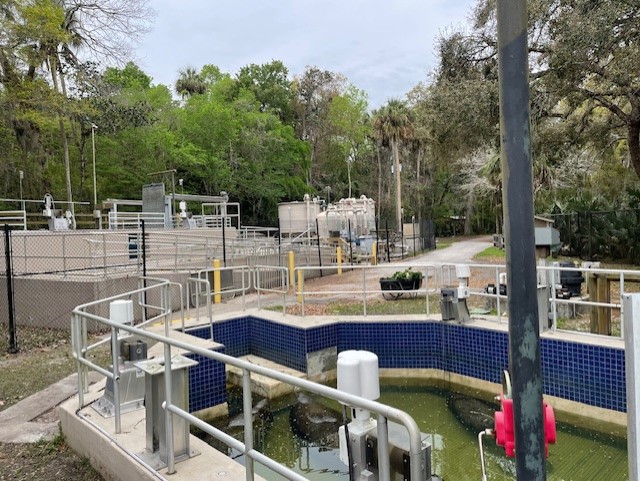
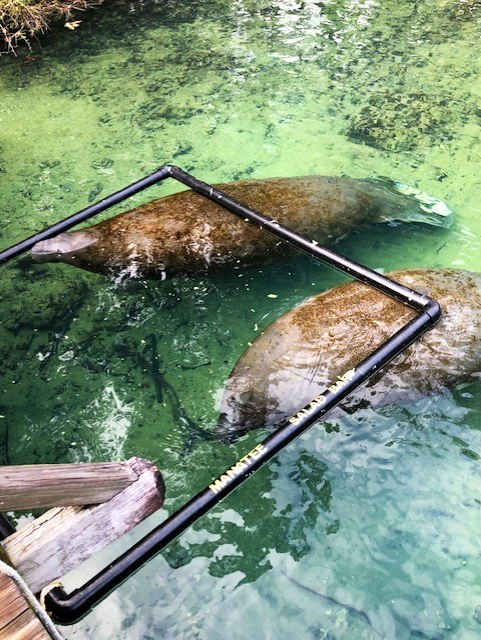
The park also rehabilitates injured manatees and serves as a refuge for uninjured manatees (Trichechus manatus). Manatees that have been hit by boats or stricken by cold stress (one of the most common sources of mortality for manatees after boat strikes) can recouperate in tanks on land. Once healthy enough to leave the tanks, they may be released into a large pen in the spring itself.

Manatees in the rehabilitation tanks (top) and in the natural pen being fed supplemental food (bottom).

Unfortunately, my access to the water was somewhat limited, given the many uses and high public presence at this spring. The vast majority of the fish that I observed were in one of three salt-tolerant species: common snook, grey snapper, or sheepshead (Archosargus probatocephalus). I also observed a couple of Atlantic needlefish (Strongylura marina). Among the freshwater species, I recorded largemouth bass (Micropterus salmoides), spotted sunfish (Lepomis punctatus), and mosquitofish (Gambusia holbrooki).

Common snook in The Fishbowl.

Three grey snapper and a largemouth bass near the bridge on the run that leads into the wildlife sanctuary.

Two sheepshead in the Homosassa Springs’ Blue Spring.

Two spotted sunfish near the bridge on the run that leads into the wildlife sanctuary.

Homosassa Spring a first magnitude spring, with discharge ranging from 30 to over 100 cfs. The temperature (~23.5oC) and dissolved oxygen (2.3-4.7 mg/L) measurements that I collected were in line with the data collected by the Southwest Florida Water Management District and the USGS and are reasonably typical for Florida springs. As might be expected from the large number of salt-tolerant fish, Homosassa Springs is one of the higher conductivity (sort of the freshwater version of salinity) springs in Florida. A Southwest Florida Water Management District website reports that the spring receives flow from three vents, each differing in salinity, although there are more small springs in the springshed (https://www.swfwmd.state.fl.us/projects/springs/homosassa). The conductivity that I measured was more than an order of magnitude higher (3100 to 5000 microS/cm) than the conductivity at most of the other springs that I visited (in the 100-300 microS/cm range). The high conductivity, the large number of predators, and my limited ability to sample likely account for the low number of freshwater fish that I observed.

This spotted sunfish was chewed by something…

Unfortunately, Homosassa Springs is one of the Florida springs that has experienced dramatic and linear increases in nitrate loading, perhaps due to a combination of agricultural and residential land use. The Basin Management Action Plan (BMAP) produced for Homosassa Springs by the FL Department of Environmental Protection in 2018 cites farm fertilizer as the largest source of load (24%) followed by urban turfgrass (19%), septic systems (15%), and sports turfgrass (12%). Livestock waste also has contributed substantial nutrients to the springshed (11%). A variety of projects have been planned, including fertilizer application reductions, education programs, and transitioning homes from septic to sewer. Interestingly, the numbers appear to have dropped off in the last couple of years.

Wakulla and Sally Ward Springs

February 2024

At a discharge of 400 million gallons of water per day, Wakulla Springs is one of Florida’s monster spring systems. Its wide headspring drops off quickly to the vent 185 ft below the surface, fed by an extensive cave network that has connections from just south of Tallahassee to the Gulf. Sally Ward Spring enters Wakulla just below the headspring.

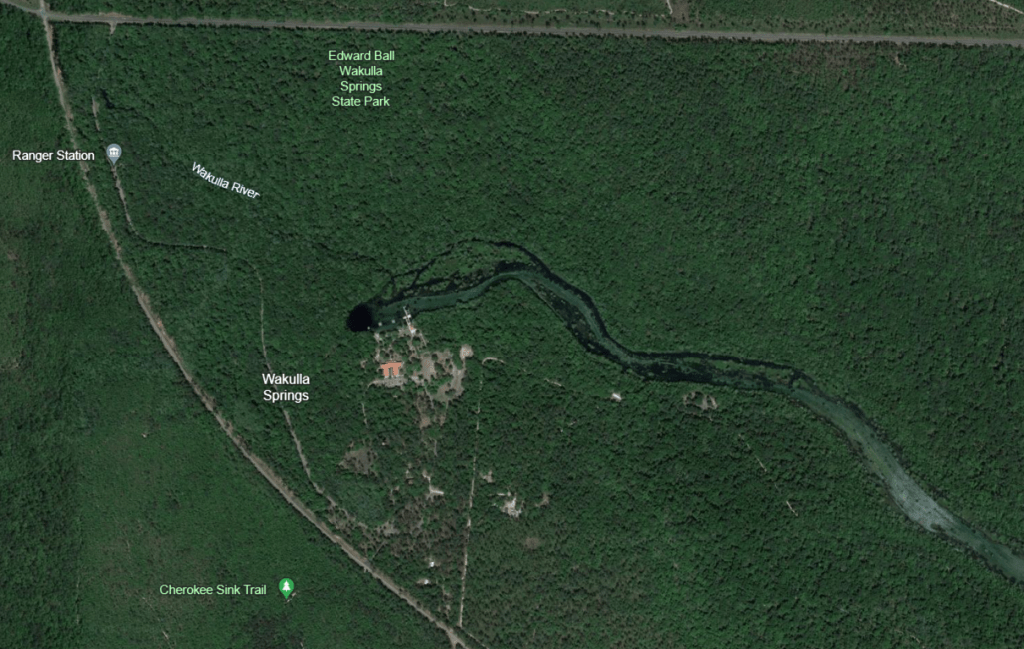
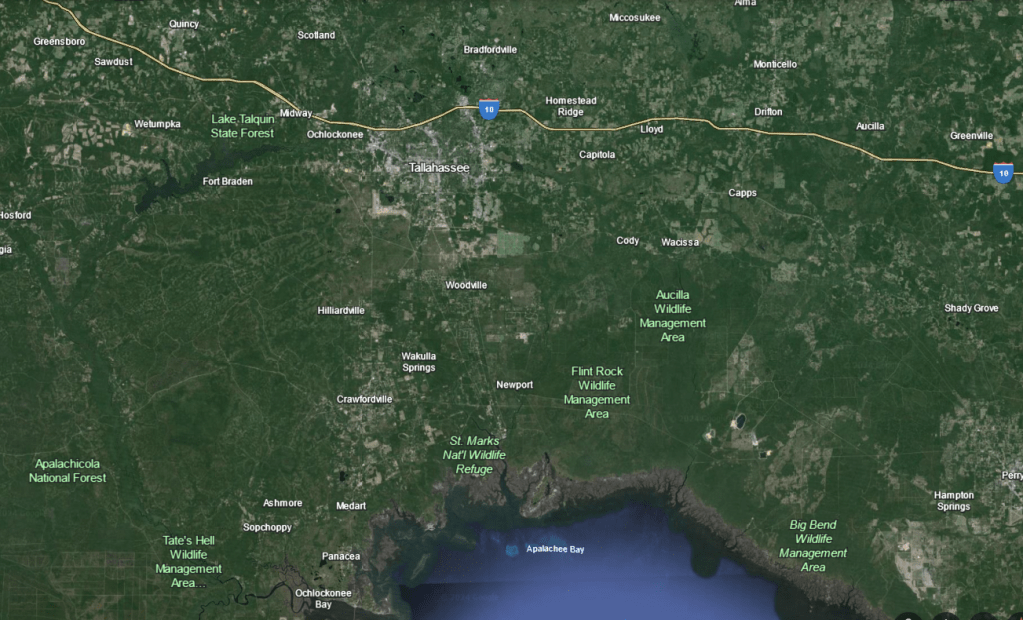
The Wakulla headspring looks like a deep dark hole on the map. The run beyond it is wide and fairly shallow. The water labeled “Wakulla River” on the map is actually Sally Ward Spring.

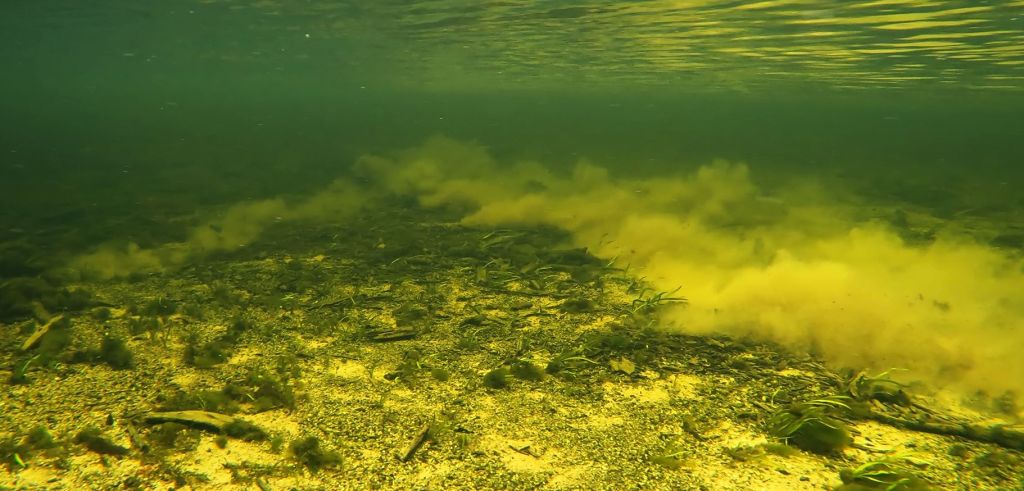
In some ways, it is one of the best protected springs in the state as well as one of the largest. When he deeded the land to the state, Edward Ball stipulated that the general population would only be allowed beyond the swimming area on escorted tours. He wanted to ensure that the spring would not be loved to death, as they say. As a result, the swimming area with its dive platform, shown in the opening photograph, is the only way that an individual can get on the water without getting a ticket for a pontoon boat ride. Much of the landscape to the east and west of the spring is heavily protected.

Map of the big bend area of Florida, with Wakulla Springs shown south of Tallahassee.

However, given the extensive connections in the region, the water leaving the vent has likely been impacted at multiple points within its springshed. Landscape impacts are a reality for all Florida springs, but the Wakulla connections are especially vulnerable (an infographic by FusionSparks media is particularly helpful in seeing the flow direction: http://www.fusionspark.com/portfolio/wakulla-springs-interactive-graphic/)

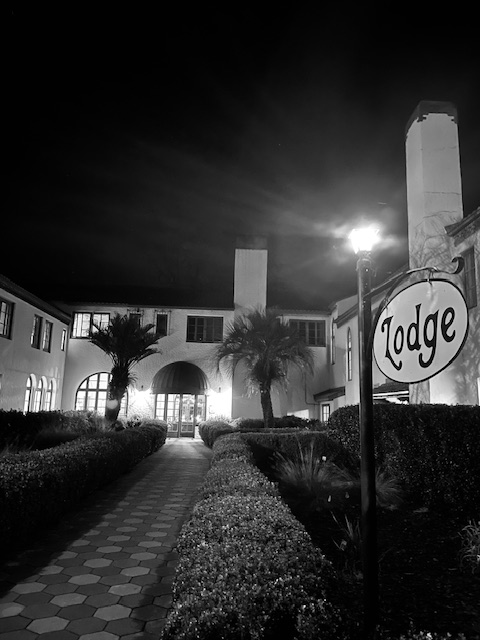
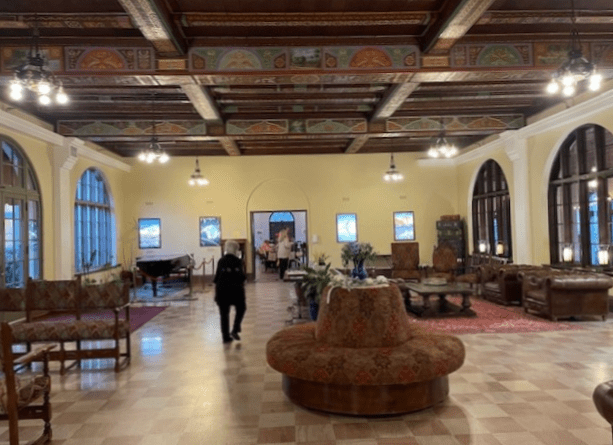
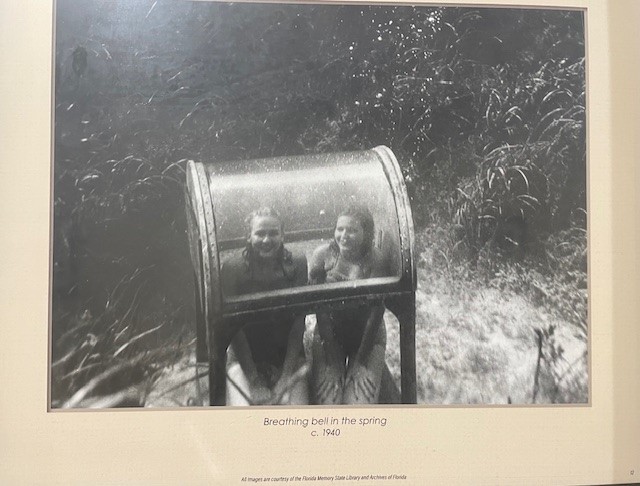
In addition to protecting the spring from heavy human use, Edward Ball also provided the park with a mansion that functions as a lodge and restaurant now. While it has amenities like wifi, history lives on in the lodge.

The entrance to the Lodge.

The lobby of the Lodge with hand painted ceiling beams.

A whole row of historic photos grace the hallway walls.

The Lodge at night, photographed with my back to the spring.

A visit to Wakulla Springs is fun on many levels, but I was there to work. I started on Sally Ward Spring.

Sally Ward Spring

The first Sally Ward vent.

Most people miss Sally Ward Spring. Its runs roughly parallel to the driveway into the park and the access point to the spring is shortly after the entrance to the park off the highway. However, it is difficult to see from the road and there is no obvious parking for it. I must confess that I have not seen the absolute source of all of its water as there is water running from a culvert that runs under the road. However, it seems that most of the water is coming from the two vents below the culvert, and they shimmer with the aqua blue that make so many Florida springs lovely.

The second vent was in a bit of shadow as it was late in the day.

Many of the fish that I observed were mosquitofish (Gambusia holbrooki), shiners, and sunfish of various species (Lepomis sp.). However, there were more species on the footage than I remembered initially: a fair number of bluefin killifish (Lucania goodei) milling around, some striped mullet (Mugil cephalus) streaming past the camera, a surprising number of largemouth bass (Micropterus salmoides), a golden silverside (Labidesthes vanhyningi), and a couple of turtles.

A largemouth bass with a bluefin killifish getting out of its way.

A shoal of mullet.

These small fish originally appeared to be shiners. However, when I zoomed in on the photo, their tails looked square rather than forked, so I think that they are juvenile bluefin killifish narrowly avoiding 10 (!) largemouth bass. I counted a dozen bass on another video downstream.

A golden silverside and a turtle.

I had originally intended to film at 5 locations on Sally Ward Spring (my typical plan). However, there was a large alligator between station 5 and me. I do not usually worry too much about alligators while I am in my boat, but the run was very narrow and I was warned about an alligator at this exact spot in 2017. While looking right at me, it sank down into the water and I decided instead to film where the hiking trail intersects the run downstream. I was rewarded with my favorite video of the entire trip.

The bridge over the Sally Ward run.

Two largemouth bass in Sally Ward run at the bridge.

My favorite: a brown water snake (Nerodia taxispilota), identified by Terry Farrell, foraging on Sally Ward run at the bridge.

Wakulla Spring

Sunrise at Wakulla headspring. Part of the vent was still in shadow.

The next morning I sampled Wakulla Spring at 8 am. Wakulla in the early morning is glorious. The massive spring feels almost prehistoric, with its gnarled old cypress trees running in a line down the north side of the run and petrified cypress stumps under the water line.

Some of the ancient cypress trees (top) and a petrified stump under the water in a photo looking back towards the headspring (bottom). The pontoons are the tour and park service boats.

Although the spring was not as clear as I had hoped, the clarity was still good enough to work. The ranger told me that the spring usually clears up after spring break, but the extent of the brown water is new, likely the result of groundwater abstraction upstream in the aquifer (https://news.fsu.edu/news/science-technology/2018/10/24/why-is-wakulla-springs-water-turning-brown-fsu-researchers-may-have-the-answer/). The video below, taken at the headspring, gives an idea of the volume of water expelled and how dark it was this past February. It appears that the darker water was denser than the clearer water, although this effect could have been an artifact of the camera.

Florida gar (Lepisosteus platyrhincus) in the Wakulla headspring.

Some striped mullet munching their way down the spring. It looks like there is a band of darker water above the sediment.

As I worked my way downstream, I was surprised to see a manatee. When I surveyed at Wakulla seven years ago, I saw none.

A manatee friend next to my boat.

Besides the impressively large spring, the gorgeous old cypress trees, the mastodon bones, and the chorus of birds in the morning, one of the notable things about Wakulla Spring is its cohort of beautiful largemouth bass and Florida gar. In addition to the bass and gar, a variety of poeciliids (mosquitofish and sailfin mollies, Poecilia latipinna), killifish, shiners, sunfish, and mullet made the fish assemblage fairly diverse. Turtles were abundant, too.

Largemouth bass.

Some lovely redbreast sunfish (Lepomis auritus).

A big seminole killifish (Fundulus seminolis) and a couple of spotted sunfish (Lepomis punctatus).

More striped mullet.

A turtle at the confluence of Sally Ward and Wakulla Springs.

As I worked my way down the run and up the side channel, I was passed by the park service staff escorting a couple of scientists, one an older gentleman. I am not sure who he was, but he asked me if I was filming the little fish. He said that bluefin killifish disappeared from the spring for a while. Happily, I filmed a lots of them.

Bluefin killifish and a redear sunfish (Lepomis microlophus).

My only disappointment was that I failed to get on video the baby alligators that I scared (by accident) from a nest or the older (but still small) alligator from the bank. All I got was the trail.

The trail of a startled alligator.

Because I was trying to look for saltwater influences on spring fish assemblages, I decided to try filming downstream at the State Road 30 bridge. Although I saw a crab and a couple of sunfish, most of the animals that I observed were olive nerites (Vitta usnea), which represent a brackish species that occurs in the Gulf of Mexico and the Caribbean.

This video of olive nerites crawling is sped up 3000x. A small bass zooms through the video if you can catch sight of it.

With the exception of the tannin stained water coming out of the vent, the water quality of Wakulla Spring appears to be generally fairly good. The likely culprit for the increase in tannin-stained water coming out of the vent, according to FSU scientists, is higher groundwater withdrawals to support growing populations in the region. Tannins are produced naturally when plant material decomposes in swampy conditions, much like steeping tea. The tannin-stained water then enters the aquifer in the regional forests naturally. However, prior to increases in groundwater withdrawals, there was enough clear water in the system that this tannic water was diluted or flowed elsewhere.

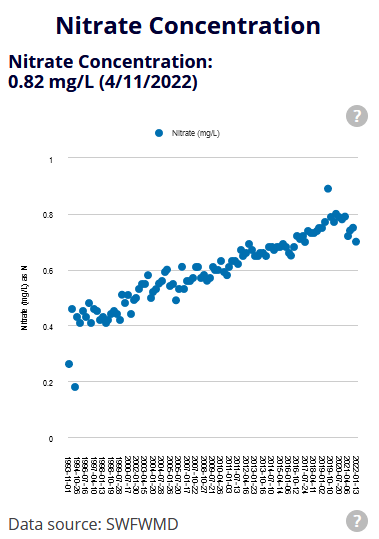
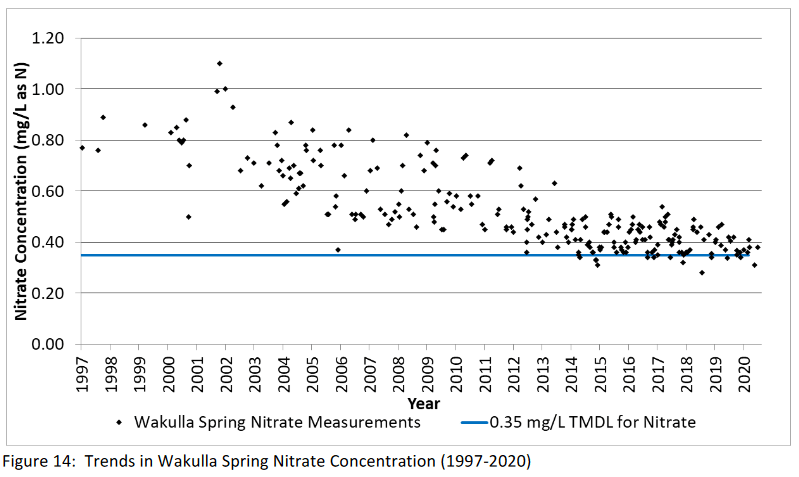
With respect to nutrients, the spring has undergone several studies and the history of this work is outlined in the spring’s MFL plan (minimum flow and level). One such study, in 2004-2005, suggested that the city of Tallahassee’s water treatment facility was contributing a great deal of nitrate to the spring due to leakage through the underground connections in the limestone. The water treatment facility was upgraded in 2012. Later, BMAP (basin management action plan) and MFL programs were developed for the spring in 2018 and 2021, respectively. The BMAP, which was primarily focused on nutrient abatement for the spring, again identified Tallahassee’s water reclamation facility as the largest contributor to nitrate concentrations in the spring. As a result, the facility was upgraded again, this time to “advanced wastewater treatment”. The MFL document, which was primarily focused on water quantity but also included water quality and ecological data, reported that by 2021 septic tanks were the largest contributor of nutrients (34%), followed by atmospheric deposition (27%), and farming (21%). As a result, Leon County aggressively constructed four major septic-to-sewer projects, which put homeowners on sewer rather than septic, between 2019-2021. Since the late 1990s, the nitrate concentrations appear to have dropped by almost half. It appears that the biggest improvement was from that 2012 upgrade, but that the other two programs, initiated by the BMAP and the MFL, have continued the nitrate concentration decline towards the 0.35 mg/L baseline goal.

Figure from: Recommended Minimum Flows for Wakulla and Sally Ward Springs, Wakulla County, Florida, Northwest Florida Water Management District.

The conductivity (freshwater version of salinity) of Wakulla and Sally Ward springs has tended to be moderately low for Florida springs (~300+ microS/cm). My measurements agreed with this trend (308-346 microS/cm) in the two springs and the conductivity was only slightly higher in the Wakulla River at the State Road 30 bridge (334-380 microS/cm). Similarly, the dissolved oxygen has tended to be fairly low in Wakulla Spring (1-3 mg/L). The dissolved oxygen that I measured was fairly low at the Wakulla vent (2.0 mg/L) and in the vicinity of the Sally Ward vents (3.0 mg/L). However, the oxygen downstream of the Wakulla headspring was a bit higher (3.3-6.6 mg/L), as it was in Sally Ward (3.9-8.4 mg/L), likely due to the large eelgrass (Valisneria americana) and algae beds.

Econfina Creek: Gainer and Bluff Springs

February, 2024

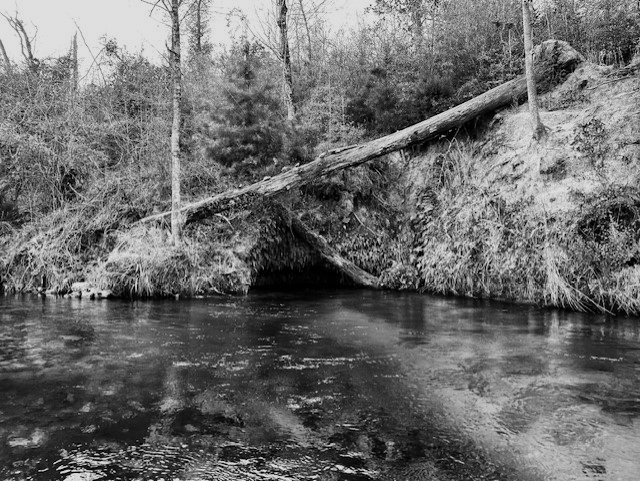
Like the Choctawatchee River, Econfina Creek is a hotspot for springs in the panhandle. Many of those springs, alas, are on private land, but fortunately, there are some springs accessible from public land.

The SR 20 canoe launch. I travel light.

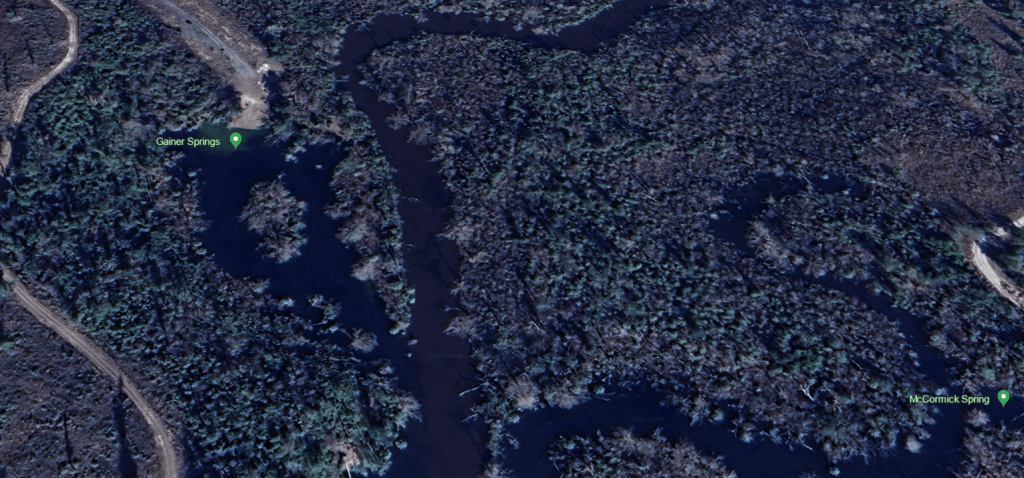
Econfina Creek flows into Deerpoint Lake just north of Panama City. Although the area to the west looks a little like agricultural land, it is actually part of the Econfina Creek Water Management Area. It felt much more natural on the ground than it appears in the Google Earth image. It was a lovely drive over.

A few of the many springs on Econfina Creek.

During the planning stages of this project, I was told that the area was completely transformed by the loss of large riparian trees during Hurricane Idalia. Some large trees made through the storm, but clearly the area had been ravaged.

A Google Earth image from 40 m with some downed trees still visible (top), a photo from the river showing trees stripped of most or all of their branches (middle), and some trees that made it through the storm (bottom).

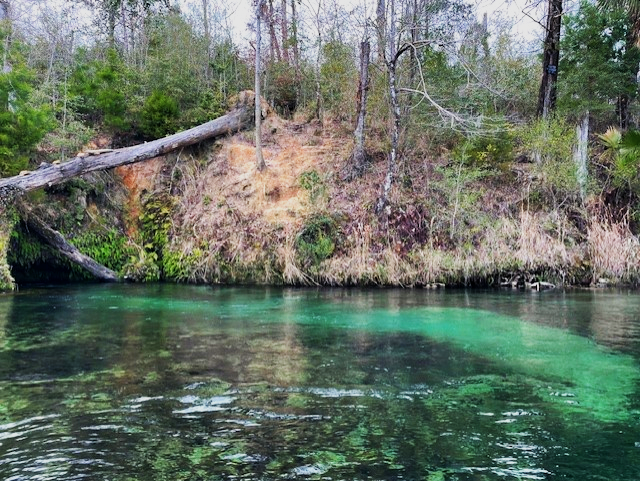
The creek was flowing very brown, turbid, and fast, so I flew down to the springs. Once there, though, the spring water was clear. Despite being the southernmost of the springs that I visited that day, I found Gainer #2 first. Gainer #2 Spring comes from a small cave in the pitted limestone wall along the edge of the river. The pressure from the spring water shot me backwards as I tried to photograph it.

The limestone banks of the river, just upstream of Gainer #2 Spring.

Gainer #2 Spring cave.

Not surprisingly, given the water flow, there were few fish to film. Next to the strong flow out of the cave, there was a little backwater area with a few shiners, but not much else. Fish aren’t stupid.

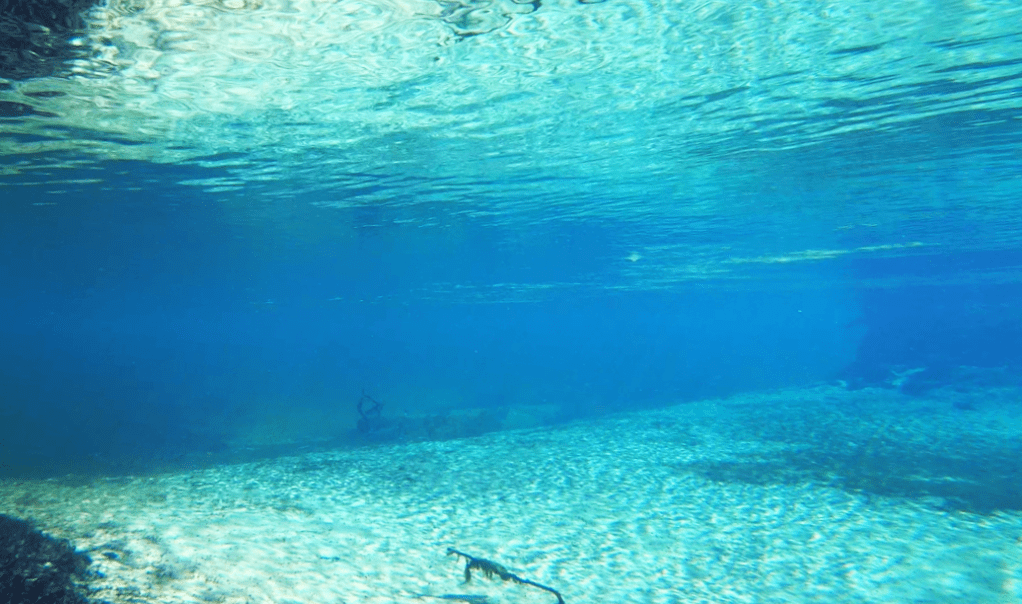
The cave and its outflow area (top) and the outflow area underwater (bottom). The pressure from the strong water flow from Bluff Spring blasted the sand clear of vegetation and detritus.

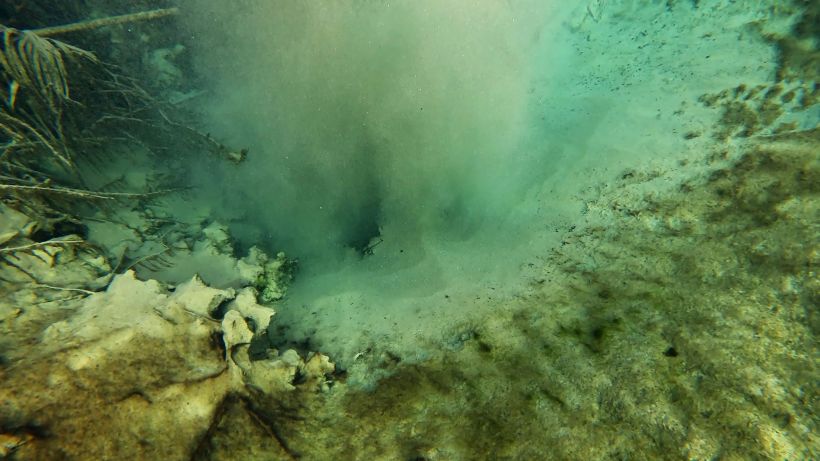
After Gainer #2 Spring, I paddled upstream a hundred meters or so into a little run to reach the Gainer #3 springs. Although the description of this system is Gainer #3, there were actually two springs up this run (and apparently, I missed a third), which formed a large pool with an island in the middle. The spring on the right side of the pool (facing upstream) was a large vent on the bottom and the spring on the left side of the pool came out of a cave in a limestone wall, like a smaller version of Gainer #2. The large vent on the bottom had been the real goal for the day because it is a first magnitude spring, discharging more than 150 cubic feet per second. I missed the spring coming out of the wall on my first visit, but I could not miss the main vent, which was blasting sand out in a plume. It was gorgeous.

Gainer #3 main vent blasting sand.

The caves that represent the other Gainer #3 vents (one on far left, another closer to middle, a third on right).

This system was much bigger than the Gainer #2 system and it supported a lot more fish, including some redear sunfish (Lepomis microlophus). I see this species often at Volusia Blue Spring, but I have recorded them only rarely on this survey of Florida western springs. I also recorded a warmouth sunfish (Lepomis gulosus), which I rarely see and is characterized by its large mouth and iridescent rays radiating back from the mouth on the opercula (gill covers). The bottom of the run was blanketed with a mixture of senescent and live algae, like so many other Florida springs.

Redear sunfish with the Gainer #3 vent in the background.

Bluegill sunfish (Lepomis macrochirus), largemouth bass (Micropterus salmoides), and redear sunfish in the Gainer #3 run.

A slightly banged up warmouth sunfish underneath a bluegill near the cave vents that contribute to the Gainer #3 run.

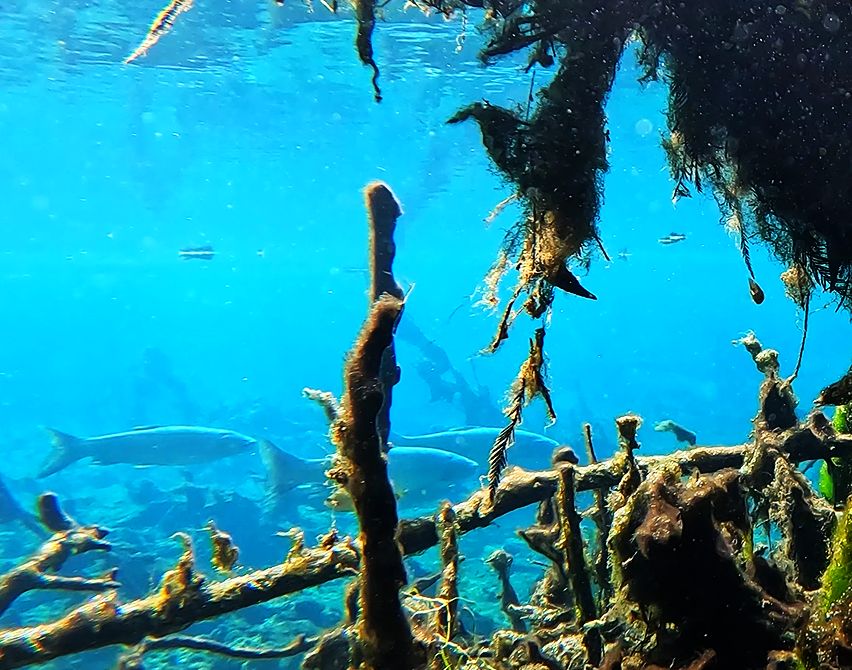
In addition to shiners, sunfish, and bass, I also captured some bluefin killifish (Lucania goodei), Florida gar (Lepisosteus platyrhinchus), spotted sucker (Minytrema melanops), and a few exotic grass carp (Ctenopharyngodon idella). This spring was the only location where I filmed any exotic fish in the panhandle or Big Bend area of Florida.

Florida gar that I scared floating down the run (top) and a spotted sucker (bottom).

Grass carp moving off into the river (bottom).

Racing against the coming end of the day, I also ventured up the Gainer #1 run. This spring run was the longest of the three and much narrower than Gainer #3. However, like the main Gainer #3 vent, it also was shooting out sand, although at a lower volume.

Gainer vent #1C pumping out sand.

The fish that I recorded in Gainer #1C were similar to the two other Gainer springs in the group, although I did not see the grass carp in this shallower spring run. I captured on video mosquitofish, shiners, sunfish, bass, and, in one video, bluefin killifish (Lucania goodei) males showing off their colorful fins in a display of aggression. I also picked up a turtle that passed behind a spotted sunfish (Lepomis punctatus) and a largemouth bass (Micropterus salmoides) in one of the videos taken in the run. The turtle was probably a yellow-bellied slider (Trachemys scripta) according to Terry Farrell, Florida herp expert extraordinaire.

Male bluefin killifish showing aggression.

Spotted sunfish, largemouth bass, and turtle.

Bluff Spring

On my first trip to Econfina Creek, I completely missed Bluff Spring, which was just downstream from Gainer #2. It was substantially smaller than most of the Gainer springs and, although it also had water issuing from small caves, it also had water shooting from underneath a limestone wall. This flow produced a small pool alongside Econfina Creek, which was obvious once I was on top of it by the clear water. All but two of the fish that I recorded here were sunfish; the other two were largemouth bass.

One of the caves releasing spring water (top) and water shooting out from under the limestone wall (bottom).

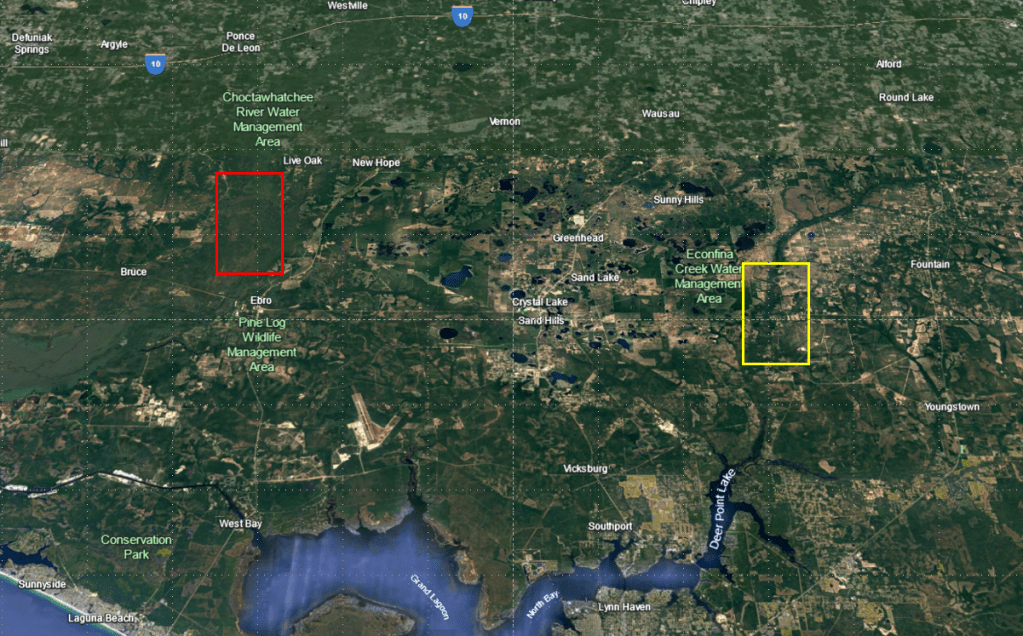
It is interesting that the springs of Econfina Creek were clear when a) the springs of the lower Choctawatchee were not and b) the creek itself felt like it was running fast enough to be flooding. I have a lot to learn about the hydrology of the panhandle.

The clear springs of the Econfina (yellow) as opposed to the brown springs of the lower Choctawatchee (red).

There is a USGS publication that I regularly consult, called the Springs of Florida. It was originally published in the 1977 and it was updated in 2004. Along with lots of useful information about discharge and water quality from the 1960s, 1970s, and early 2000s, there are photos. I do not know when these photos were taken, but in these photos, the substrate of Gainer Springs is bare sand. In my photos and videos, the substrate is covered mostly in senescent and some live algae (the brown is senescent, dying or dead). In fact, in the Gainer vent #3 video, there is a little patch of the senescent algae that goes rolling down into the vent, exposing the sand below, after I apparently disturbed it with my paddle.

Alas, I can find no more current water quality data than what was reported in the Springs of Florida, but those data suggested that as of 2001, the nitrate concentrations were quite low (0.16-0.21 microg/L). I very much wonder what they are now. The temperature data that they reported (21.1-22.0 C) was similar to what I measured on my visit (21.7-22.0 C). Their reported dissolved oxygen (2.12-3.0 mg/L) was somewhat higher than my measurements (1.07 mg/L at the headspring of Gainer vent #1), which may be related to the senescent algae. Their conductivity, which is a measure of salts in the water, was low (82-142 microS/cm), as mine was (133-155 microS/cm). Clearly, these springs are not being tidally influenced by the Gulf, at least not in terms of salt.

Ponce de Leon Spring

February, 2024

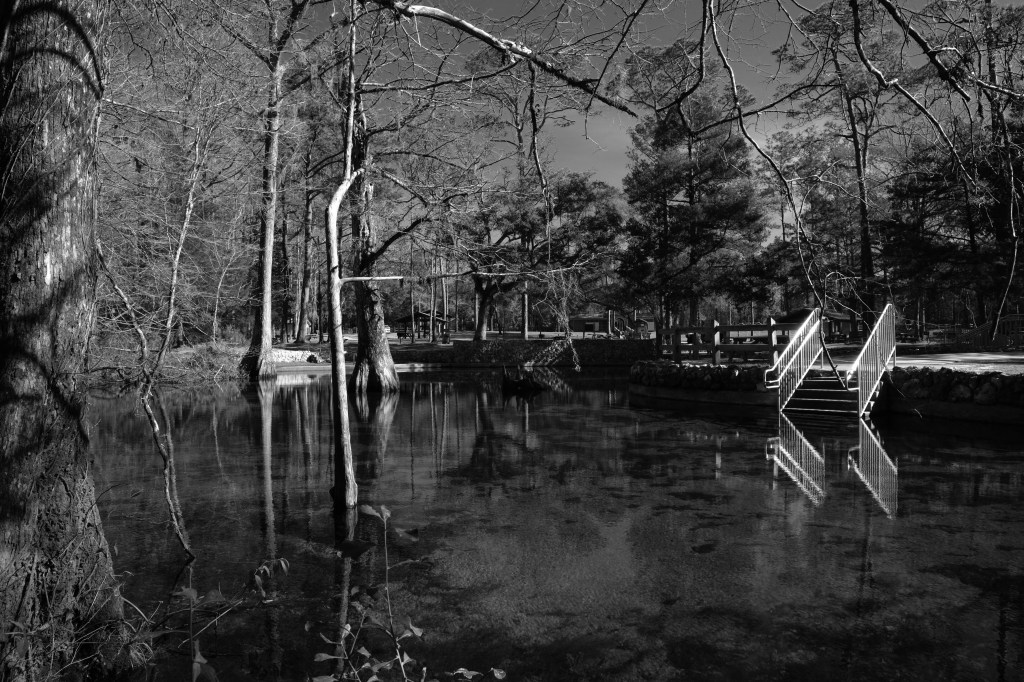
Ponce de Leon Spring was a visually mellow contrast to Vortex Spring. Personally, I find reflections in water compelling, so I liked how the reflections made a zigzag out of the stairs in the foreground and the light on the wall in the background.

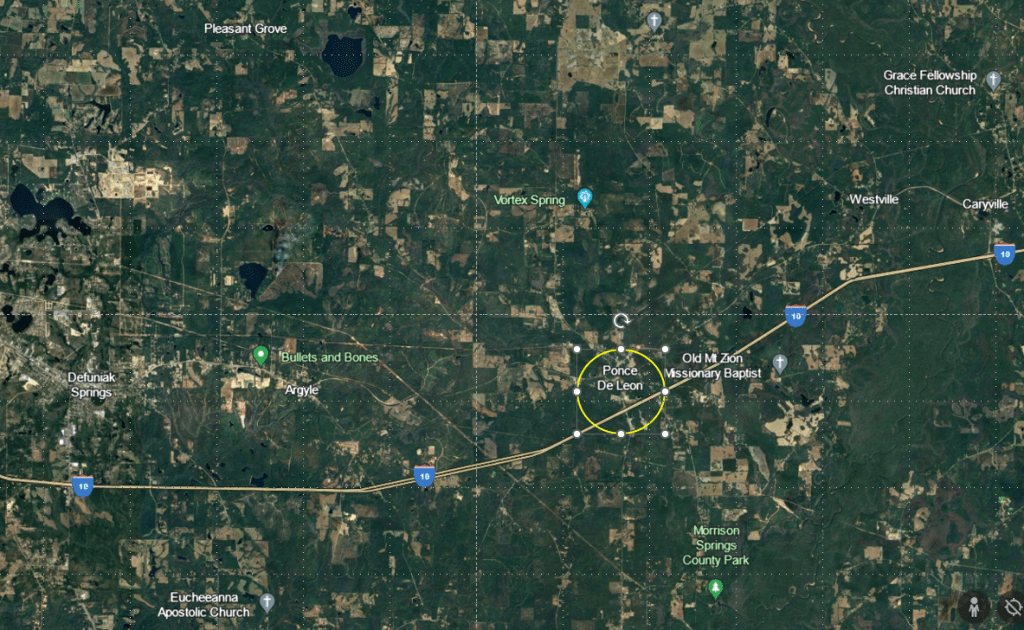
Ponce de Leon Spring is in a state park several miles south of Vortex Spring and it flows into the same creek, Sandy Creek. The park sits in a swath of forest just south of the town of Ponce de Leon. Like Vortex Spring, the spring water ends up in the Choctawatchee River, via Sandy Creek, and eventually in the Choctawatchee Bay, which flows into the Gulf at Destin.

The location of Ponce de Leon Spring just east of Defuniak Springs and west of Tallahassee (top) and the forest matrix in and around the state park (bottom).

The headspring was developed as a swimming area with a large stone and cement wall along one side, complete with a diving board into its relatively deep vent. When I arrived on a chilly February day, no one was using this diving board, so photographing the lovely spring was easy.

The diving board into the Ponce de Leon headspring (top) and a color view of its lovely vent (bottom).

The spring flow coming out of the headspring was somewhat restricted by a weir to produce a pool for swimming.

The weir with a bridge across the run.

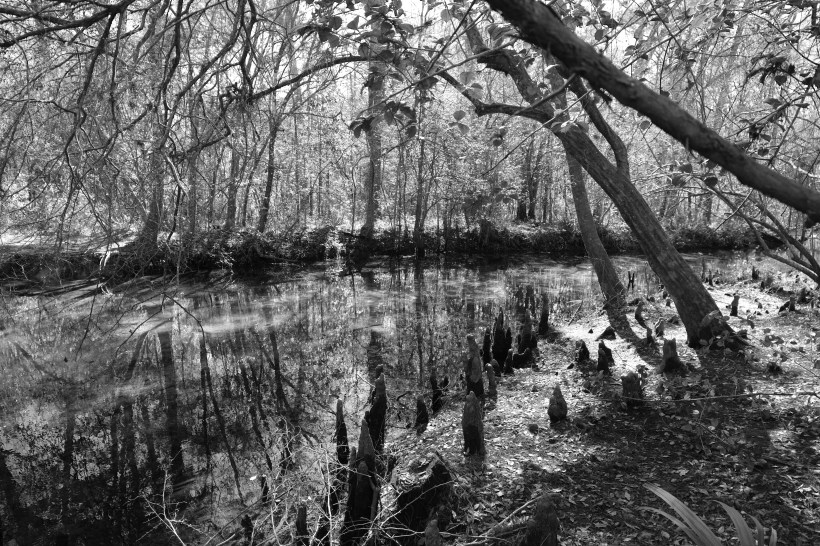
Despite this restriction, I recorded a lot of fish in the headspring area, including lots of shiners, some lovely iridescent dollar sunfish (Lepomis marginatus), and quite a few largemouth bass (Micropterus salmoides). Perhaps in part because of the restriction, the headspring was somewhat blanketed by algae.

Shiners, a dollar sunfish (lower righthand corner), and largemouth bass in the blue of the Ponce de Leon vent.

Below the weir, the run turned shallow and sandy with relatively little algae.

The sandy Ponce de Leon run below the weir.

In addition to the many shiners (including schools of larval shiners) and sunfish, I was lucky enough to catch a darter on camera. Given the distance and lighting, I can only suggest that it is probably a swamp darter (Etheostoma fusiforme).

A school of larval shiners moving (from the right) into a landscape of cypress knees and their reflections reminiscent of stalagmites and stalactites in a cave.

Dollar sunfish in the Ponce de Leon run.

A darter cautiously moving through the detritus and plants.

The Ponce de Leon run is fairly short and enters Sandy Creek, which is as brown as Ponce de Leon is clear and blue. And right above the confluence of the two, I captured a whole shoal of spotted suckers (Minytrema melanops) with one lonely largemouth bass that appeared to be moving in from the creek.

Like Vortex Spring, I had trouble finding a lot of data on Ponce de Leon Spring. However, The Springs of Florida USGS publication contained some data, one set from 1972 and another from 2002. Again like Votex, the temperature of Ponce de Leon was a little colder than the central Florida springs (19-20C vs. 21-24C). The dissolved oxygen was reasonable for a spring (~3 mg/L) and the conductivity was on the low side (~200 microS/cm). My real time measurements were similar, although my oxygen measurement at the headspring was a bit higher (4.7 mg/L), reaching 5.7 mg/L at the confluence with the creek. Probably due to the forested landscape, the concentrations of nitrate (0.14-0.24 mg/L) and phosphate (0.022-0.028 mg/L) were low in both 1972 and 2002. This nitrate concentration is an order of magnitude lower than some of the west central Florida springs in heavily agricultural areas.

Vortex Spring

February, 2024

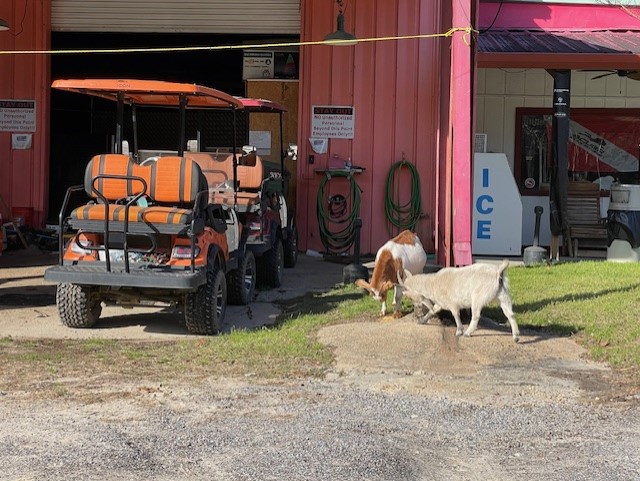
Vortex Spring, as the name would imply, was probably the most culturally unique spring that I visited. Reputed to be an energy vortex, this spring is an interesting mix of private dive school, military dive training facility, and water park. The facility included lodges and campsites, a store, and goats. They were very generous in sharing their park with me with essentially no notice (I got flooded out of some other sites that I had planned to visit that day).

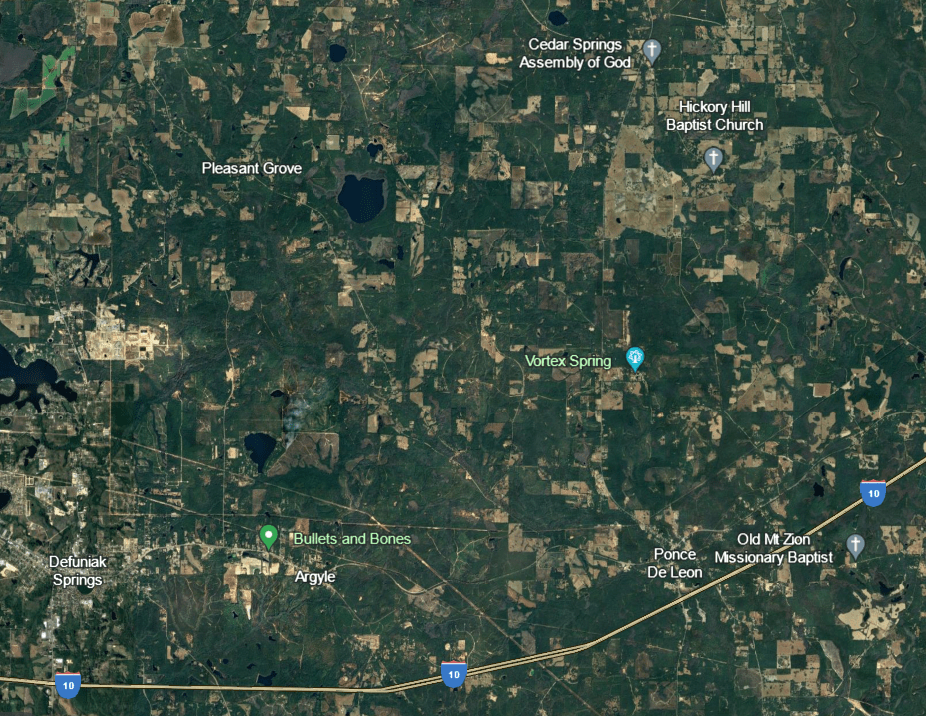
The spring is west of Tallahassee, well into the panhandle, in a landscape of uncut forest, silvaculture, agriculture and small towns.

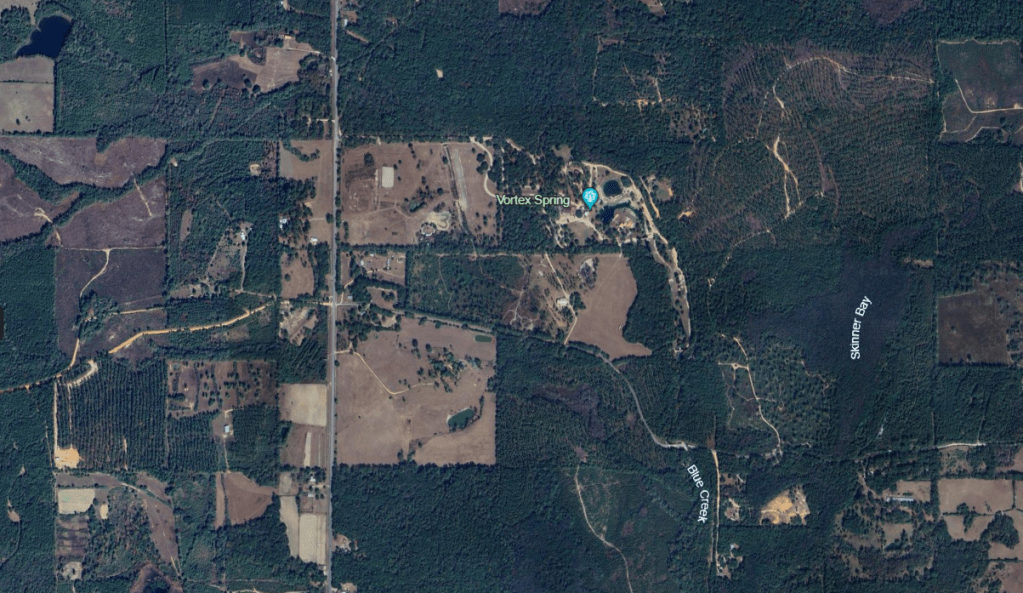
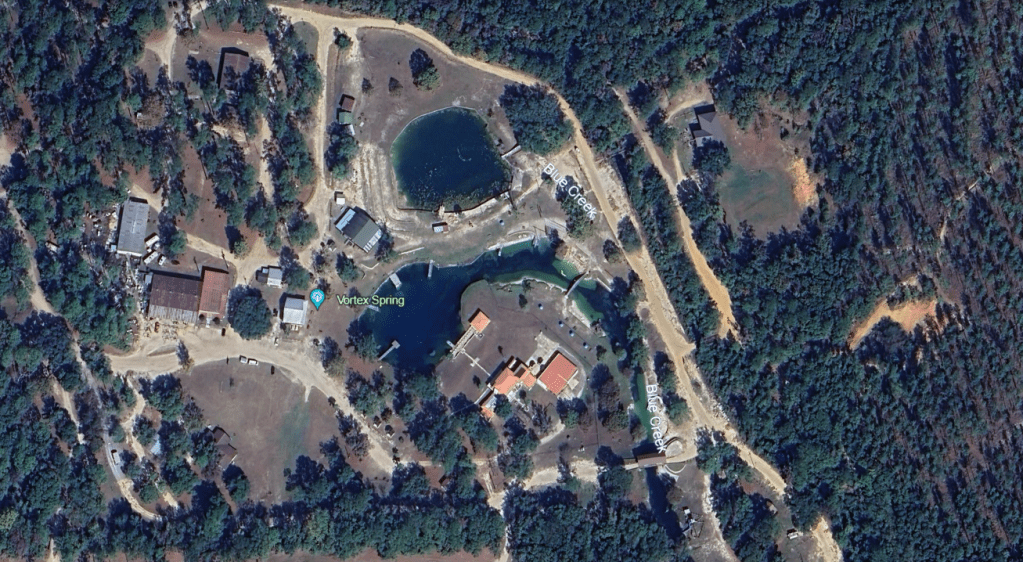
Google Earth images of the landscape matrix around the spring. At 4000 m, the town of Defuniak Springs is visible to the west (top). Zooming in shows the rows of trees in the silvaculture operations (bottom).

The spring at about 100 m up.

The spring run itself is called “Blue Creek” and flows eventually into the Choctawatchee River. The river flows into Choctawatchee Bay, the west side of which is open to the Gulf at Destin.

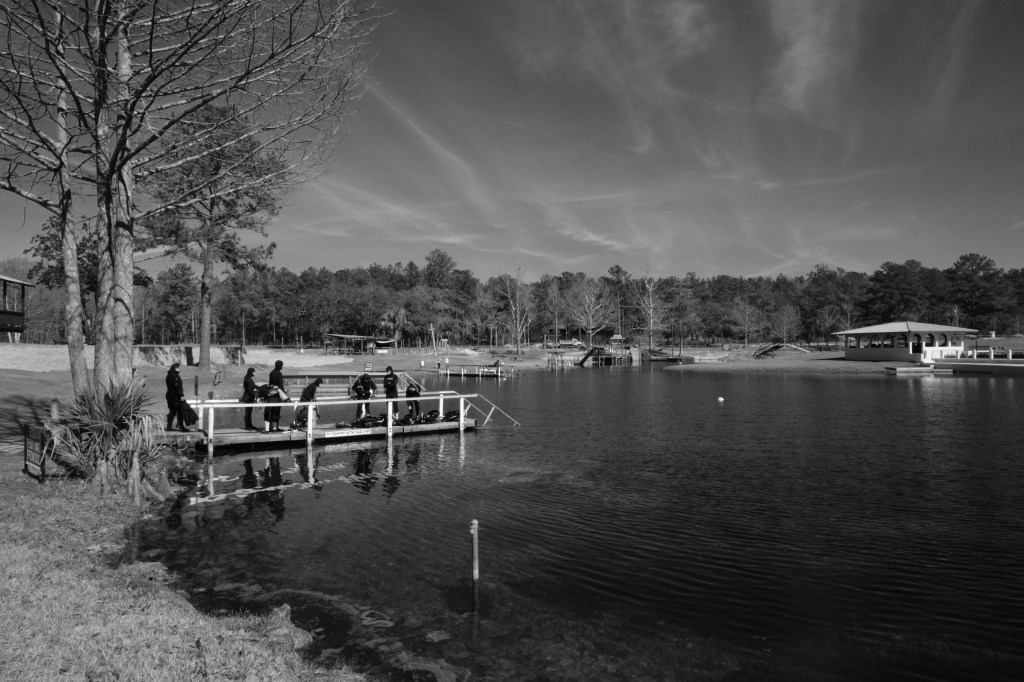
When I arrived, a small herd of pre- or early-teen kids jumped around in wetsuits on the dock awaiting their lesson, lovingly recorded by their parents on the bank.

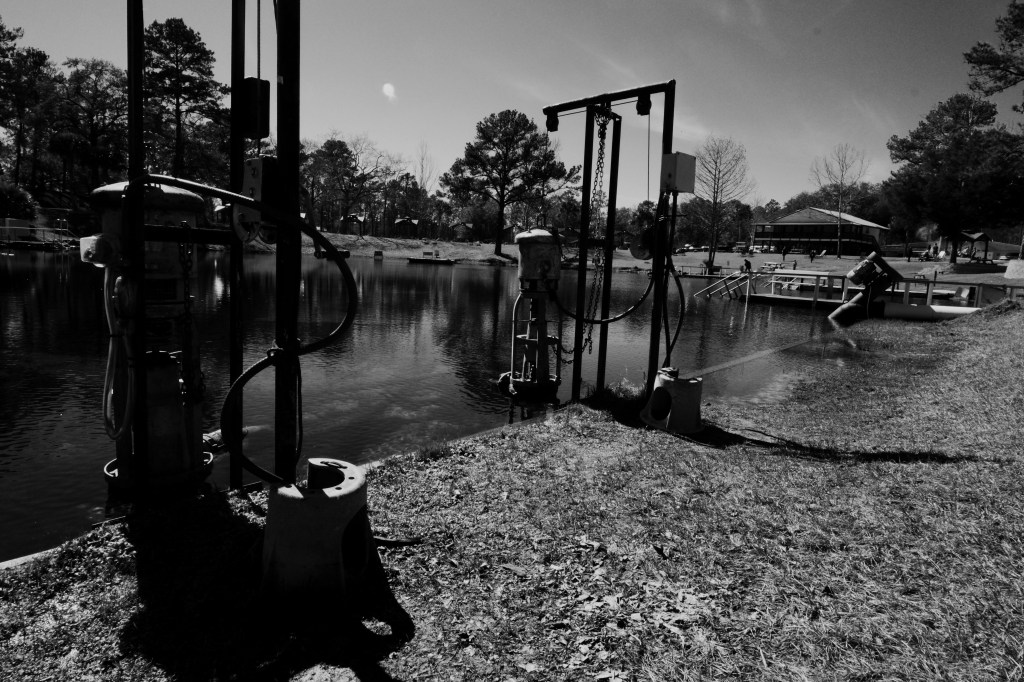
The park’s promotional material describes the spring as a “diving resort” complete with a sunken sailboat to explore. The area around and in the vent contained more gear, both above and below the water and obscure to the non-diver, than any other spring that I have seen.

Gear on bank of the headspring (top), a diver passing by box that I read was a “air bell” (middle), and sunfish and bass completely ignoring the pipes scattered around the headspring (bottom).

The large round pool drops off quickly to 58 feet, at which point a gate blocks the entrance to a cavern that reaches down to 117 feet, accessible only to experienced cave divers with the key. As advertised, the water was, in fact, “gin clear” and filled with fish, mostly shiners, bluegill (Lepomis macrochirus), spotted sunfish (Lepomis punctatus), and largemouth bass (Micropterus salmoides).

The clear water of the pool (top and middle) and a few of the very abundant shiners in the run just below the pool (bottom).

Some of the original sandy run remained, but much of it was covered with algae, as is true of a lot of Florida springs. It seems that shiners, sunfish, and bass are quite tolerant of algal-covered substrate.

A largemouth bass patrolling over an algae-covered sandy run. Lots of bubbles were being released, perhaps due to oxygen supersaturation from rapidly photosynthesizing algae. Supersaturation happens when the algae are photosynthesizing faster than the water can absorb the oxygen, producing bubbles.

Loads of snails littered the sand where it was exposed. Although I have not keyed them out, they appeared to be what the Florida snail expert, Fred Thompson, called “spring elimia” (Elimia sp.).

An Elimia sp. that I pick up off the sand.

As I moved downstream, the park seemed to shift from dive training to water park. Bridges, a jumping platform, massive inflatable alligators, a mock ship’s crow’s nest, and water slides hinted at the crowds of swimmers that undoubtedly visit in the summer.

Some of the summer accessories for the water park.

Past most of the water park equipment, the far bank was forested and the run looked a bit more original. Underwater, the run’s substrate shifted from sand and algae to hydrilla (Hydrilla verticillata) and algae. The water contained a little more particulate matter, probably due to the divers upstream. The fish were still a mixture of shiners, sunfish, and bass. It was kind of theme.

Oxygen bubbles being released from the hydrilla with a largemouth bass in the background.

My measurements of temperature (19.1C), dissolved oxygen (5.74 mg/L), and conductivity (221 microS/cm) at the headspring were in line with the only report that I found about Vortex Spring in my quick search. This spring is 2-5C colder than the springs in central Florida. The oxygen in the headspring was reasonably high and it got much, much higher as I moved downstream (over 10 mg/L), which accounted for the supersaturation bubbles. The conductivity was pretty low–no saltwater intrusion or tidal effects here. The only data that I could find on other water quality parameters were from one sample in 1972 taken by the USGS. Given the algal coverage that I saw, I suspect that the nutrients are higher than the 80 microg/L of nitrate reported for this sample.
Wacissa River (springs) January-February 2024

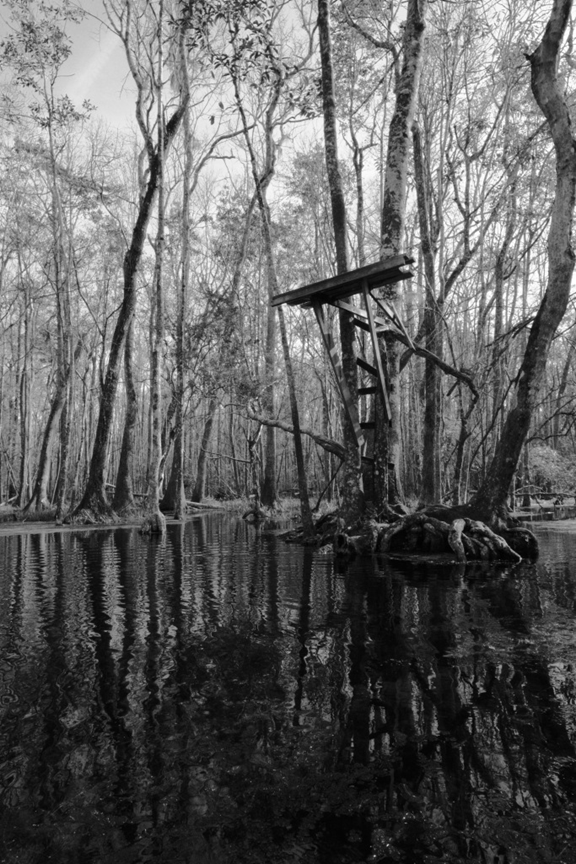
People say that Florida has no seasons, but this photograph says winter to me. The photo is centered on the homemade diving platform at Big Blue Spring on the Wacissa River. The trees, usually so lush, have few leaves, the shadows are long, and the swimmers have been gone for months. Winter on Florida springs is peaceful.

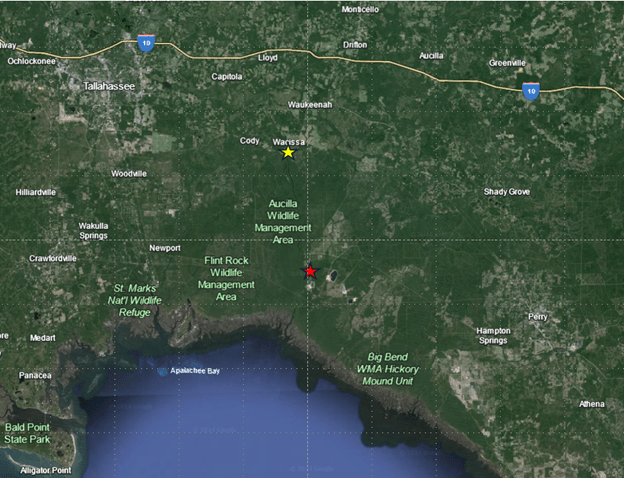
The Wacissa River starts east and slightly south of Tallahassee. It flows through the Aucilla Wildlife Management Area, passing between the Flint Rock Wildlife Management Area and the Big Bend Water Management Area. The drive out to the spring winds through forests or, if coming from Tallahassee, the occasional pasture. About 12 miles downstream from the start of the Wacissa, the river joins the Aucilla River to flow into the Gulf at Apalachee Bay. Together, these two rivers have been categorized as an Outstanding Florida Water.

A map of the Big Bend region that it is the home of the Wacissa River. The yellow star indicates the location of the river’s origin; the red star indicates where the Wacissa joins the Aucilla.

Like the Chassahowitzka, the Wacissa is a river made of springs. It, too, starts with a small spring that feeds into a wide run that meanders to the Gulf, although its meander is roughly 3 times longer. The small spring at the start of the Wacissa, Horsehead Spring, is narrow, somewhat brown, and thick with plants. At the headspring, I could not see the vent at the bottom. The spring seemed more like a hole in the plants than the rocky crevice that was undoubtedly underneath the dark water.

Map showing the location of the first two springs, Horsehead Spring (orange star) and the larger vent downstream at the start of the river proper (blue star).

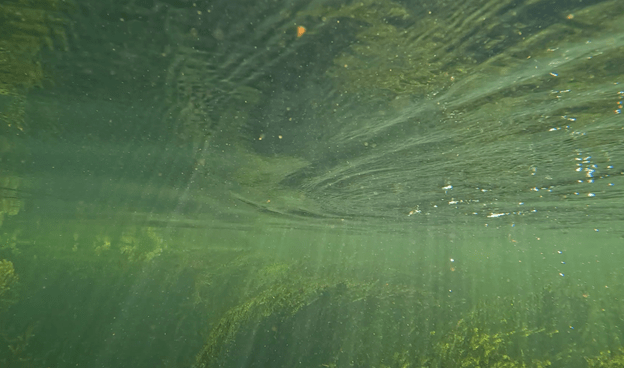
The headspring for Horsehead Spring (top) and light streaming down from the distortion made by my paddle at Horsehead headspring (bottom).

Once I left the Horsehead headspring, the trees converged over this lovely little spring run. The run was so filled with plants that I had to find holes in the plant cover to get a good enough field of view to film. Some of these plants were eelgrass (Vallisneria americana) and some were nonnative hydrilla (Hydrilla verticillata), as seen in the video below.

Shiners and bluefin killifish (Lucania goodei) streaming past the camera at the headspring of Horsehead Spring.

In this small spring, I was rewarded with a fish species new to me, the metallic shiner (Pteronotropis metallicus). Shiners are very hard to identify on film because many of the characters that are needed for a good identification are too small and obscure to see at a distance, but this species has a very wide black stripe on its side and a dark dorsal fin etched in white and orange on the outer edge. As they darted around the plants, the fish popped their dorsal fins up and down, inadvertently signalling to me their species.

Metallic shiners in Horsehead Spring run.

As soon as I floated out of Horsehead Spring, I found myself over a spring vent that I had not realized was there. It was large and dark, but provided substantial flow to the river. I noticed the spring as I floated over it because it, too, looked like a round hole in the plants. In fact, the whole river upstream was thick with plants; the plants were so thick that the birds were walking on them as if on land.

Eelgrass waving in the flow of the river (top) and a little blue heron (Egretta caerulea) standing on the thick hydrilla in the river (bottom).

This thick plant life, both native and nonnative, provided cover for small fish. In contrast to the Chassahowitzka, which had virtually no plants in the main river, lots of predators, and very few small fish, the Wacissa was teaming with small fish. Every video showed some combination of 30-50 shiners, killifish, and livebearers like mosquitofish (Gambusia holbrooki). Large predators, like largemouth bass (Micropterus salmoides) or longnose gar (Lepisosteus osseus) were relatively rare in the videos of either the main river or the many springs that fed into it along its upper length.
A rare group of three largemouth bass patrolling (top) and a largemouth bass scaring shiners into the vegetation (bottom). The shiners wink back into view after the bass moves along.

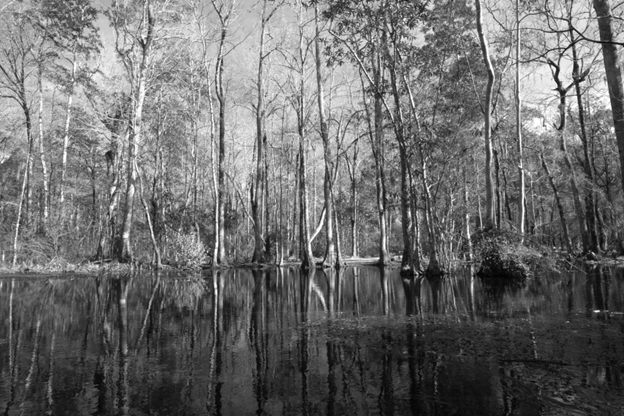
Flooding back into the forest also provided cover for fish. Hurricane Idalia passed over the area in August 2023 and the flood waters still had not completely receded in February 2024. Florida is so flat, its water table is so shallow, and there often is so much precipitation in the rainy season that floods can last a very long time. When the water penetrates back into the woods, the cypress knees and shrubs can provide extra cover from predators for small species.

The homemade diving platform above this knot of tree roots on Big Blue Spring suggests that it is likely on dry land in the summer when the floodwaters recede.

After I finished filming in the main river, I moved into some of the many springs that contribute water to the main flow: Big Blue, Little Blue, Buzzard Log, Garner, and Minnow.

Flooded forest (top) and duckweed (Lemna sp.) so thick that my kayak made a trail (bottom) in Minnow Spring.

I have been thinking lately about how small side springs and flooded forest might contribute to the overall diversity of larger systems. When I filmed back in the side springs of the Wacissa, many of the fish that I observed were the same species as in the main stem of the river. However, I also found some unique assemblages and species. Back in the side springs, I observed more least killifish (Heterandria formosa), our smallest fish species in Florida, than I have ever observed together. The specific epithet of this species references the family name of ants, Formicidae, undoubtedly because of their small size. I also observed a chain pickerel (Esox niger), a large predatory species that I have only caught on camera once in all of the video that I have collected to date.

Tiny least killifish above the slightly larger shiners at Minnow Spring (top) and a chain pickerel at Garner Spring (bottom). The camera at Minnow spring was back in the flooded forest and there was a lot of dissolved and particulate “stuff” in the water. The camera a Garner Spring captured a lot of live and dead algae and plants.

And much to my surprise, I also caught an entirely new type of organism for me: an eastern newt (Notophthalmus viridescens). This animal has a relatively unique life history, with a juvenile aquatic stage, followed by a juvenile terrestrial stage, and finally an adult aquatic stage (https://nationalzoo.si.edu/animals/eastern-newt). Given that I collected the video of this species at two different locations (right off the boat ramp and in Big Blue Spring), it is likely that there are a lot of newts in the system.

Eastern newts in Wacissa River springs.

The fact that the Wacissa River flows through Wildlife Management Areas likely contributes to its good water quality. The nitrate concentrations published by the US Geological Survey are among the lowest that I have observed for Florida springs (0.16-0.33 mg/L). The dissolved oxygen concentrations they published are relatively high (4.9-8.3 mg/L) and my measurements were in a similar range. The conductivity of the river and its springs, both published data and my data, are much lower (0.26-0.30 mS/cm) than what I measured in some of the Chassahowitzka springs (5-10 mS/cm), undoubtedly due to the greater distance between the Wacissa springs and the Gulf. Conductivity is a measure of ion concentrations in water, kind of the freshwater version of salinity. Salinity is a measure of sodium and chloride, whereas conductivity encompasses the broader range of ions typical of freshwater. To give some context, the conductivity of sea water is 3-6 S/cm, so several orders of magnitude higher than in the saltiest springs that I have measured. It is likely that the lower conductivity and the greater distance to the Gulf explains the exclusively freshwater assemblage that I observed on the Wacissa in contrast to the Chassahowitzka.

Chassahowitzka River (springs), January 2024

The springs that produce the Chassahowitzka River provided a perfect start to my new spring survey: springs that flow into the gulf, either directly or indirectly.

Chassahowitzka is situated on the “Nature Coast” between Homosassa Springs to the north and Weeki Wachee to the south, both of which are probably more famous to people from outside of Florida (posts on those two spring systems later).

To locals, however, the Chassahowitzka is famous for Seven Sisters Springs, which is a cave system near the start of the river. These seven interconnected caves are startlingly blue holes in a small landscape of rounded black and grey exposed limestone. Like the other springs of Florida, the limestone eroded unevenly over time to produce these “solution” holes.

The first of the seven sisters and, although I did brighten this photo, they really do look this blue.

The limestone rock formation that forms the Seven Sisters. I took this photo looking down the run from the cave in the first photo.

The Seven Sisters caves are home to a variety of freshwater and salt tolerant fish, such as spotted sunfish (Lepomis punctatus), grey snapper (Lutjanus griseus), and Atlantic needlefish (Strongylura marina).

Spotted sunfish (left) and grey snapper (right) with more grey snapper under the overhanging wall of the cave.

A needlefish in front of one of the caves. Needlefish were among the most prevalent fish in the survey of Chassahowitzka springs.

Although the Sisters are the most famous feature of the spring system, the flow actually starts in several spots.

This zoomed in map shows the multiple water sources that produce the Chassahowitzka River. The star shows the location of the Seven Sisters.

First, a beautiful little creek flows into the Seven Sisters. I tried to paddle up it with a friend a few years ago when the Seven Sisters was covered in brown water, obscuring them. During the rainy season, the water level can rise and the clear water can be covered tannin-stained runoff water. We did not get very far because it is blocked by many fallen trees.

The creek that flows into Seven Sisters, both above (top) and below (bottom) the water level.

A second source source of water to the river is a neighborhood of canals. A third source of water is the big main vent just downstream of the confluence of the Seven Sisters run and the canals. This big vent is just off of the boat ramp.

The view looking upstream from the vicinity of the public boat ramp. The first house in the neighborhood is just visible and the Seven Sisters is around the corner to the left.

The water flowing out of the neighborhood was very turbid, so water clarity was much lower and it was very hard to make out this large vent. However, I could just barely make out Crevalle jacks (Caranx hippos), sheepshead (Archosargus probatocephalus), needlefish, more grey snapper. These fish are all salt tolerant, but I also saw largemouth bass (Micropterus salmoides) and more spotted sunfish. Alas, my photos from the vent are not great due to the turbidity.

Crevalle jacks (top) and sheepshead (bottom) in and around the big main vent at the start of the Chassahowitzka River.

The warm water issuing from these three water sources attracted many manatees, which were all resting in the shallow water across from the boat ramp in the morning.

The last source of water to the start of the Chassahowitzka River is Crab Spring. The spring run was very shallow and the water flowed so fast that after paddling and not gaining ground, I got out and pulled my boat for part of the run.

Crab Spring run.

Unlike the other upstream areas, this run was loaded with plants and when I got to the headspring, the plants were covered in rusty deposits, probably iron. Surprisingly, the large headspring was loaded with fish: sunfish, bass (big ones!), and more needlefish.

Bass in Crab Spring with rusty algae below.

As I floated back downstream, I took a minute to film in a little hole in the plants at the side of the run and was rewarded with some of the few small fish that I observed on the river.

Sailfin mollies (Poecilia latipinna) near the surface and a rainwater killifish (Lucania parva) near the bottom. This shot is not amazing, but it was interesting how scarce the small fish were other than in this little protected area in the algae.

After leaving Crab Spring, I floated downstream towards Baird Creek and “The Crack”. Along the way, I stopped in the “Snapper Hole”, which is a little pool along the Chassahowitzka run. It had even lower water clarity than the main vent, so I decided not to video there. However, as I floated in the middle of the pool, I realized that I was surrounded by manatees. It was a peaceful little interlude to the work.

My last stop on my Chassahowitzka survey was Baird Creek, given my love of sandy creeks with tree canopy, it was a highlight, for sure. It is pretty right off the River, but it gets much more special up near “The Crack”.

The lower run of Baird Creek (top) and the upper portion near “The Crack” (bottom). It started raining a little as I paddled and the spring started steaming.

“The Crack” itself also was a bit murky, but I was happy to see some different fish there: tidewater mojarra (Eucinostomus harengulus) and gulf killifish (Fundulus grandis). I also saw more sunfish, bass, sailfin mollies, and of course, needlefish.

“The Crack” with a rope swing to jump into the vent.

Tidewater mojarra (top) and gulf killifish (bottom)

In addition to the manatees and fish, I was also joined on this trip by a variety of other animals. I got a few shots of fun birds on the trip, although the only photo that I actually liked was this little blue heron (Egretta caerulea).

Now I will make a note about the water quality. First, the goal of this study is to learn about how saltwater connections affect spring fish assemblages. I definitely recorded many salt tolerant fish in this spring system, which was fun and gratifying. However, the pattern of conductivity (a measure of the number of ions, including NaCl salt like in the ocean) is not clear to me. The ion concentration in the vicinity of the Seven Sisters and the main vent was very low, typical of freshwater, but the ion concentration at Crab Spring was 1/5 of seawater. The Crab Spring vent was only on the order of 100 m away from Seven Sisters, so I have some research to do about the “plumbing” underneath the Chassahowitzka. The conductivity of Baird Creek was even a little higher than that of Crab Spring.

The patterns of conductivity are interesting to think about and not necessarily related to human intervention. The turbidity coming out of the neighborhood of canals upstream of the main vent is much more likely to be related to those houses and other development to the east of Chassahowitzka. Although the land to the west of the springs is preserved as wildlife management area, outstanding Florida water, etc., the land to the east is thickly developed. The turbidity is likely a combination of inorganic particulates (just look at all the stuff floating past the manatees) and algae. Based on USGS data, the nitrate concentrations are not super high, roughly on the order of 0.5 mg/L, which is above background for many springs, but not nearly as high as I have seen on some other springs. I also looked for changes in discharge and salinity. It appears that over the period of record (1997 to now), discharge has increased slightly, in contrast to many other big springs in the center of the state. The influence of the proximal Gulf likely affects the pressure in the aquifer under Chassahowitzka, keeping the discharge high. The period of record for salinity was super short (2016 to now), but there was a negative relationship between discharge and salinity over this really, really short record. More to come…