Econofina: Pitt, Sylvan, and Williford Springs

February, 2024

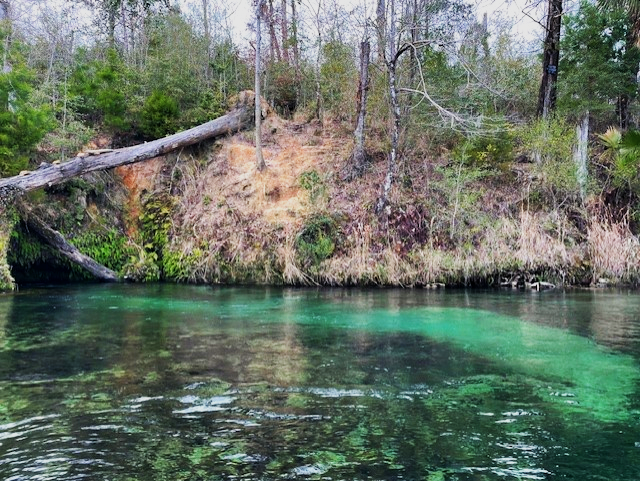
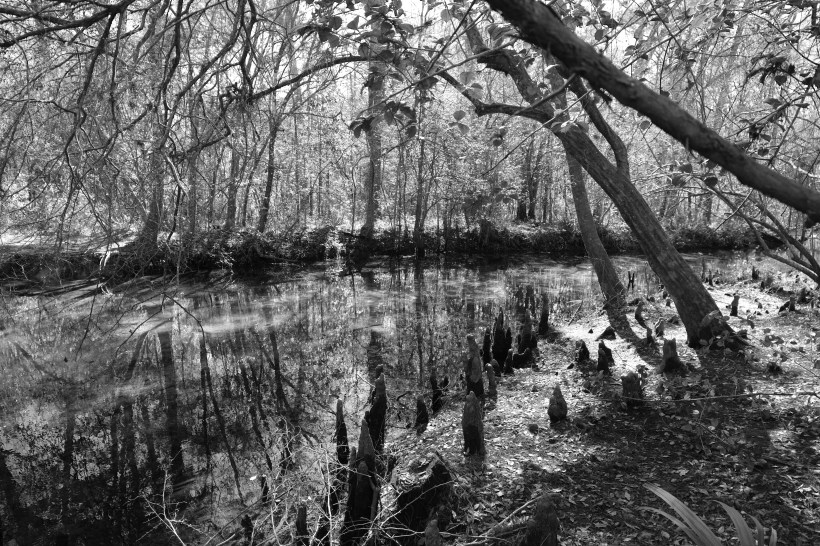
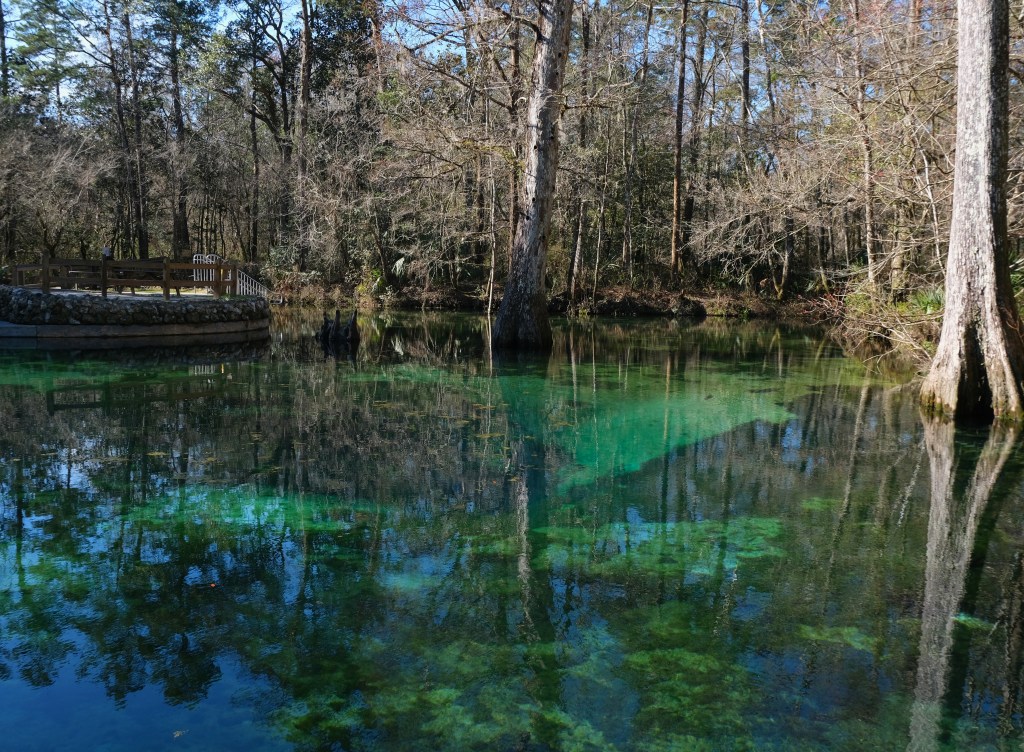
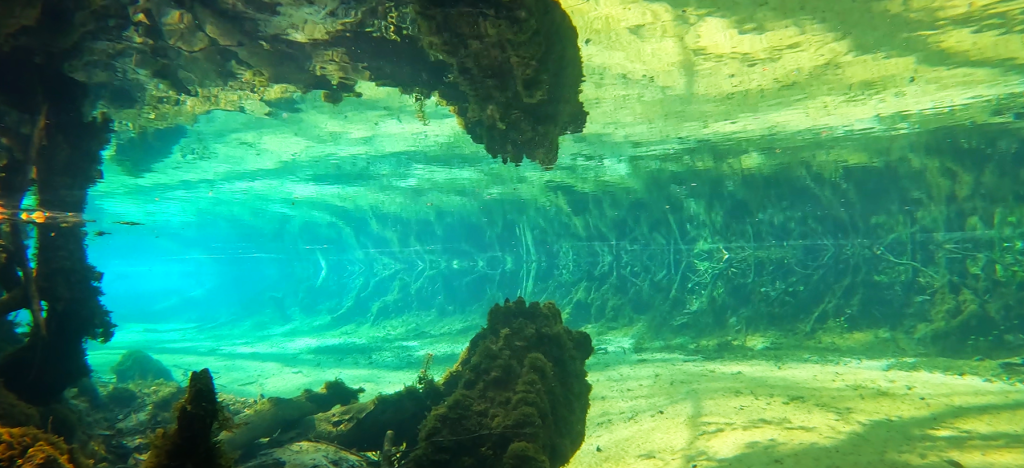
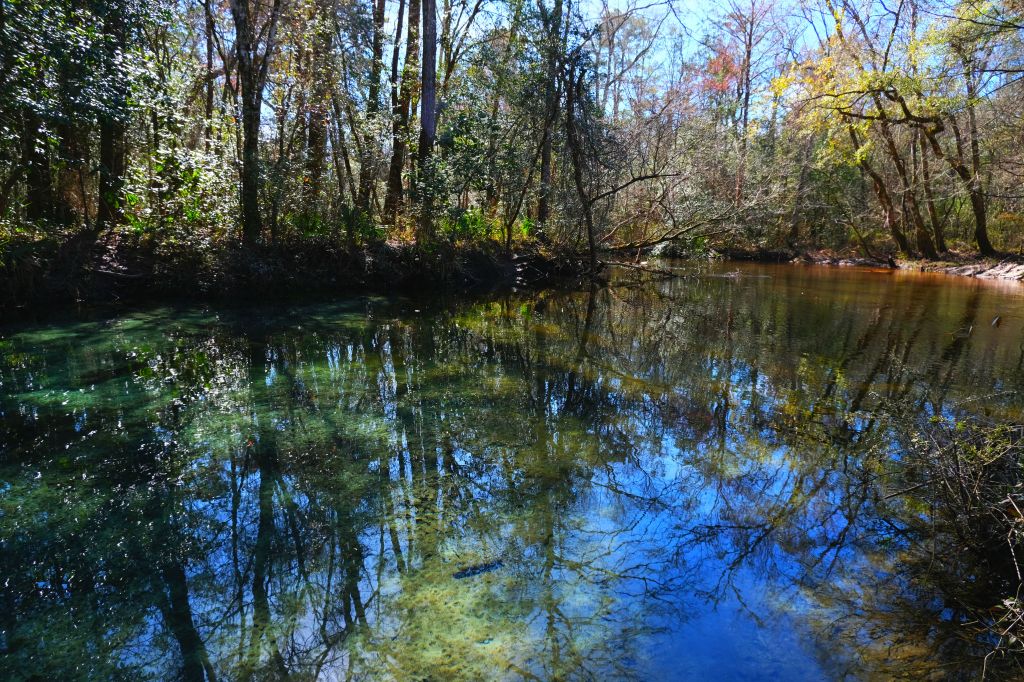
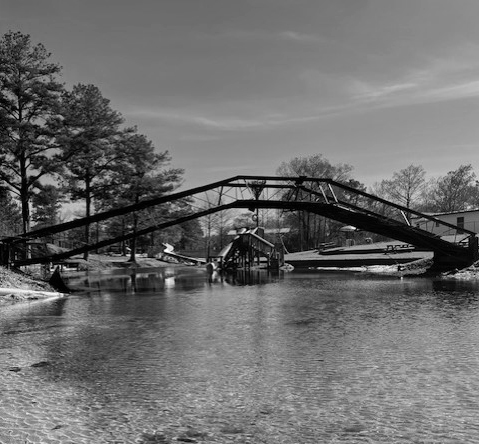
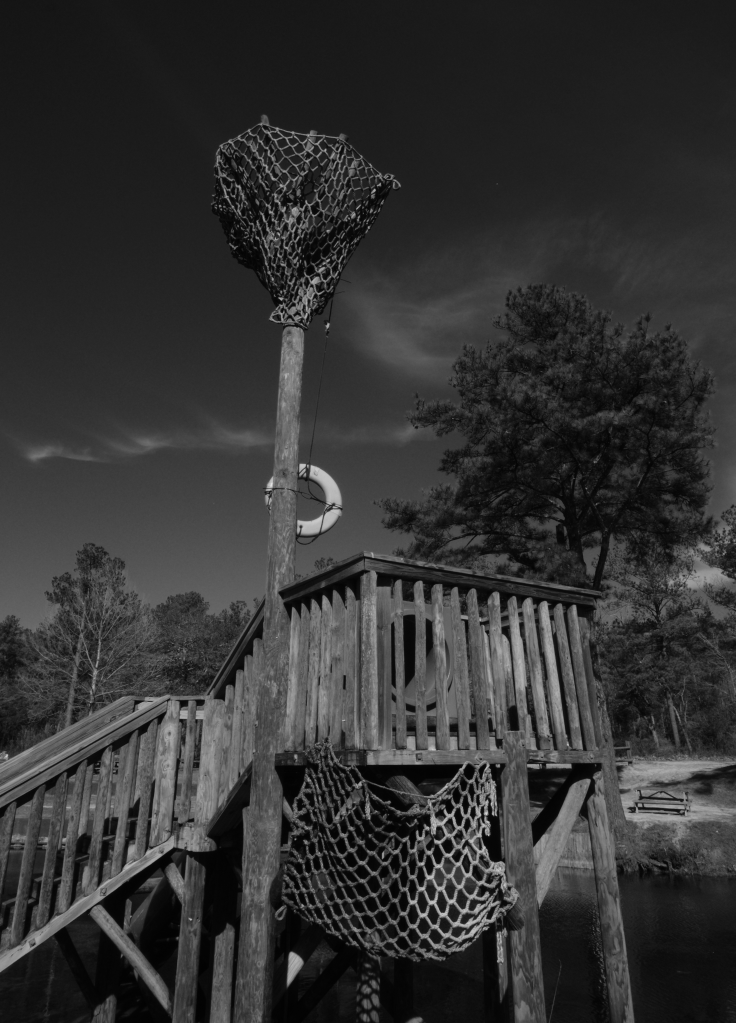
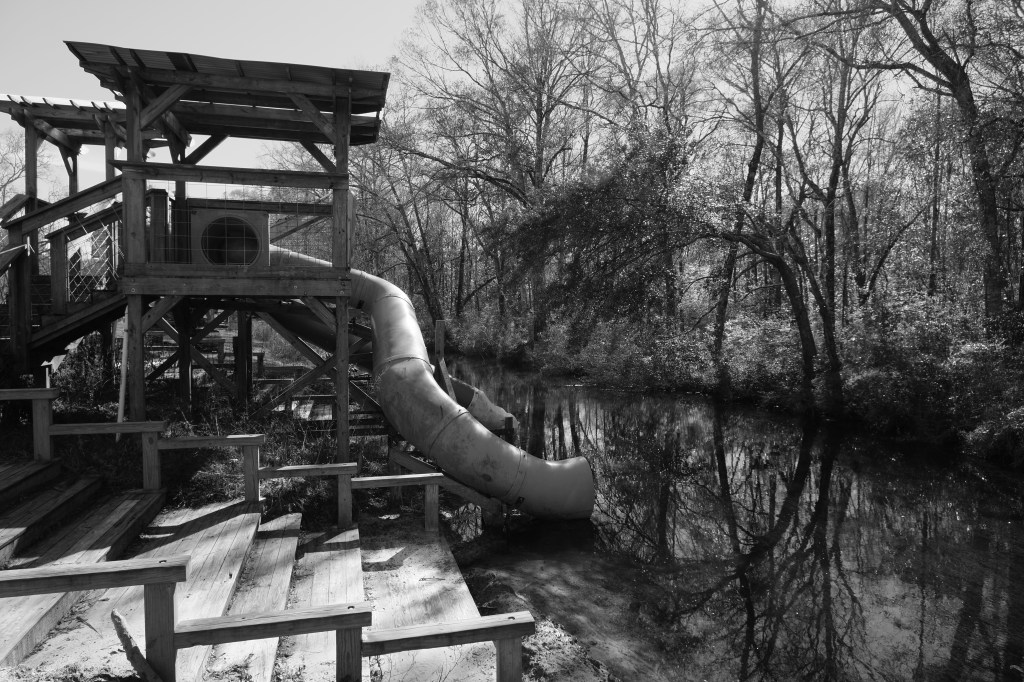
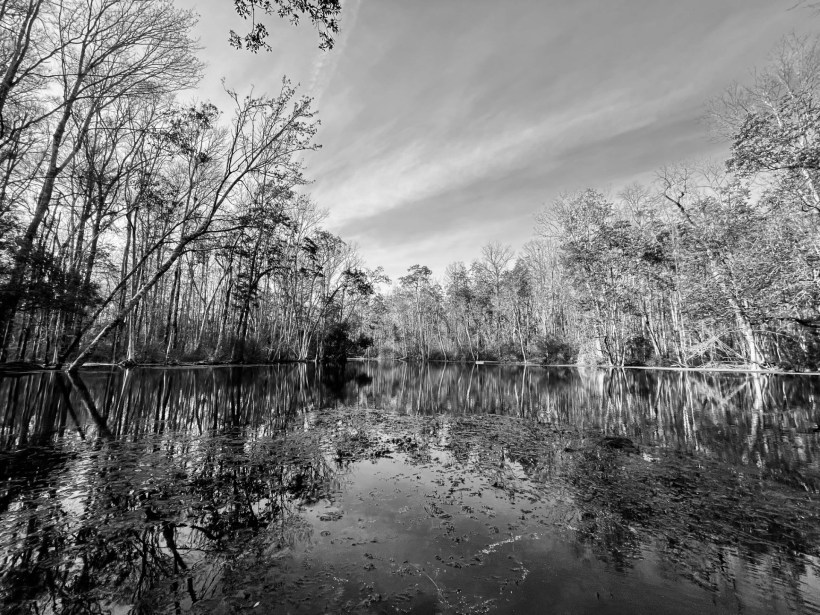
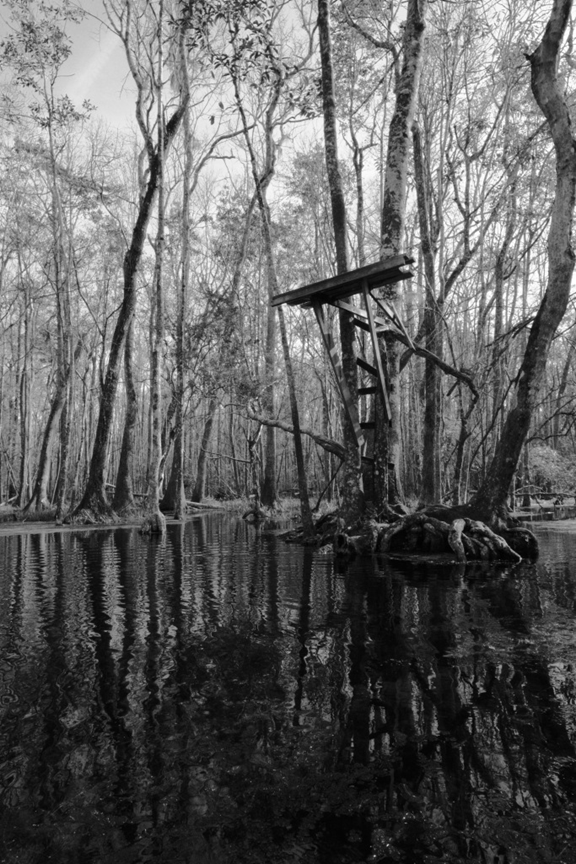
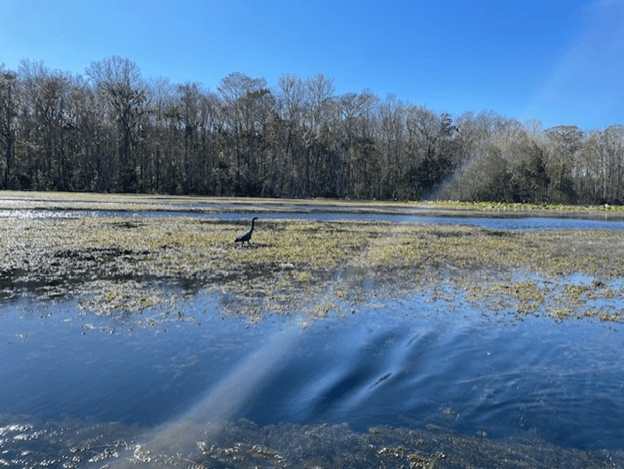
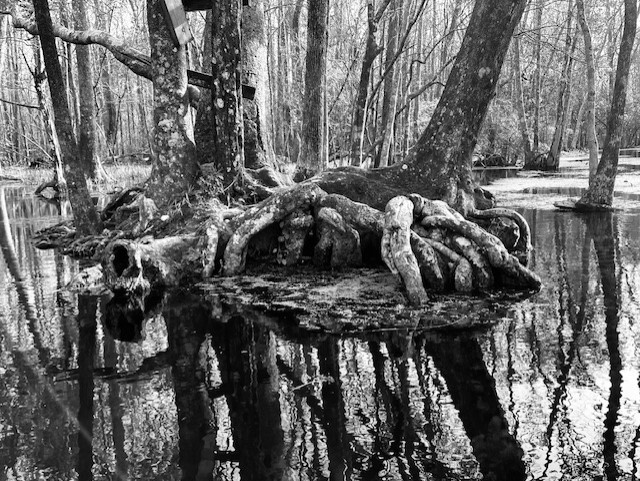
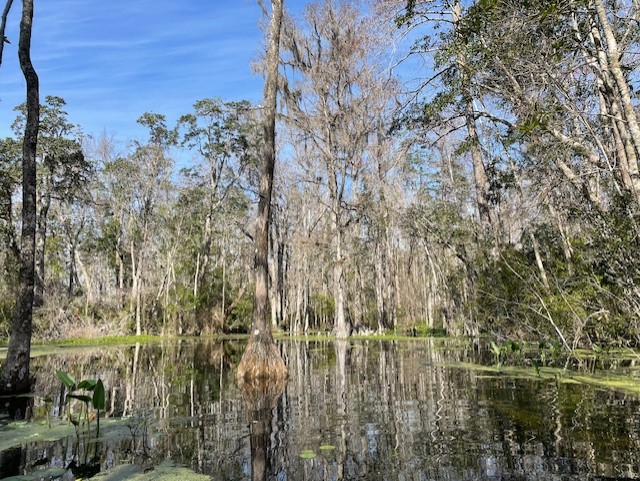
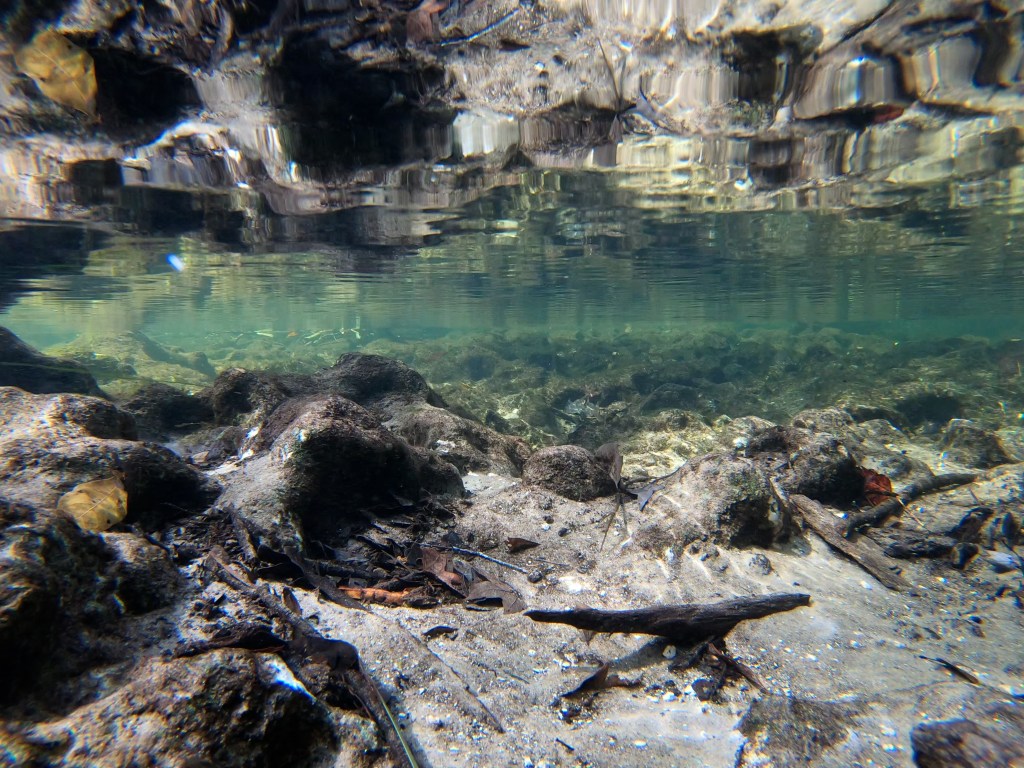
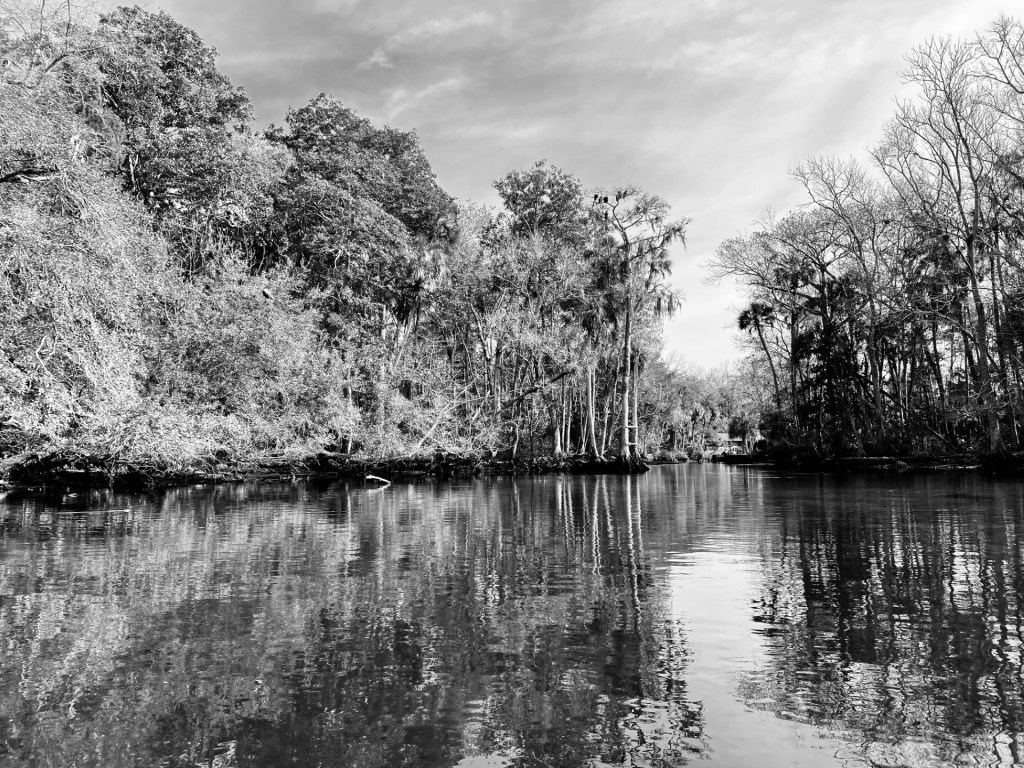
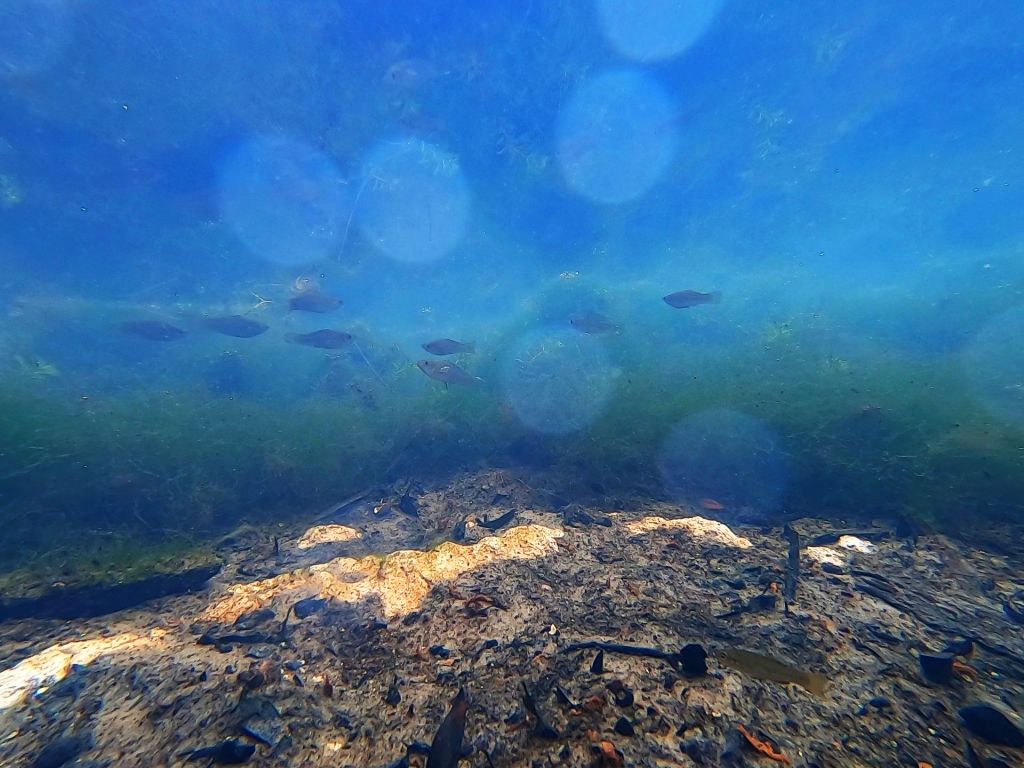
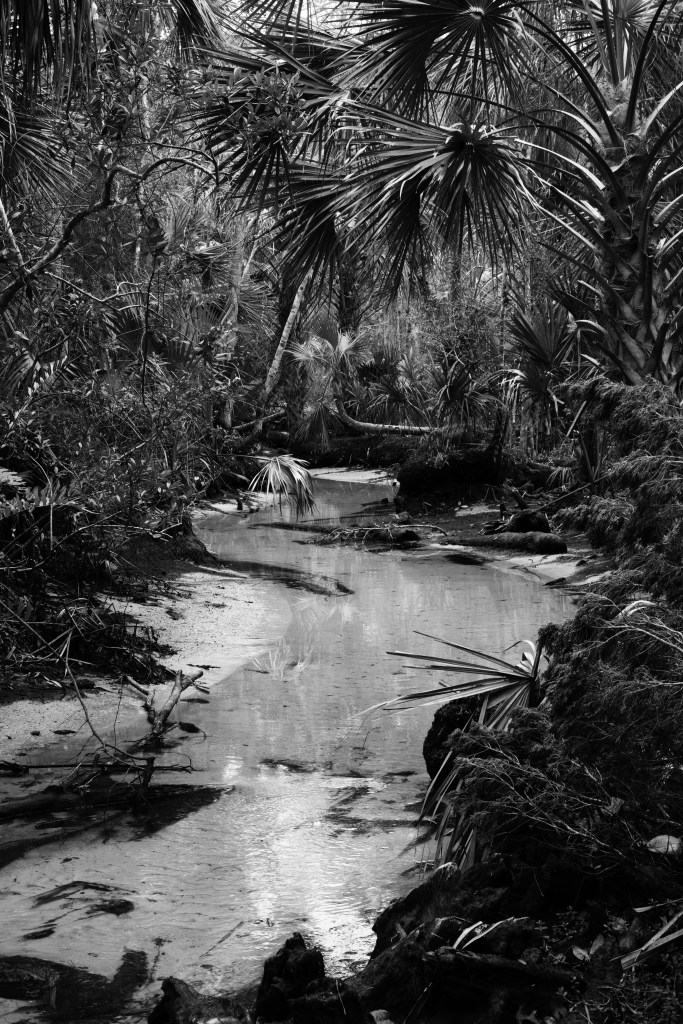
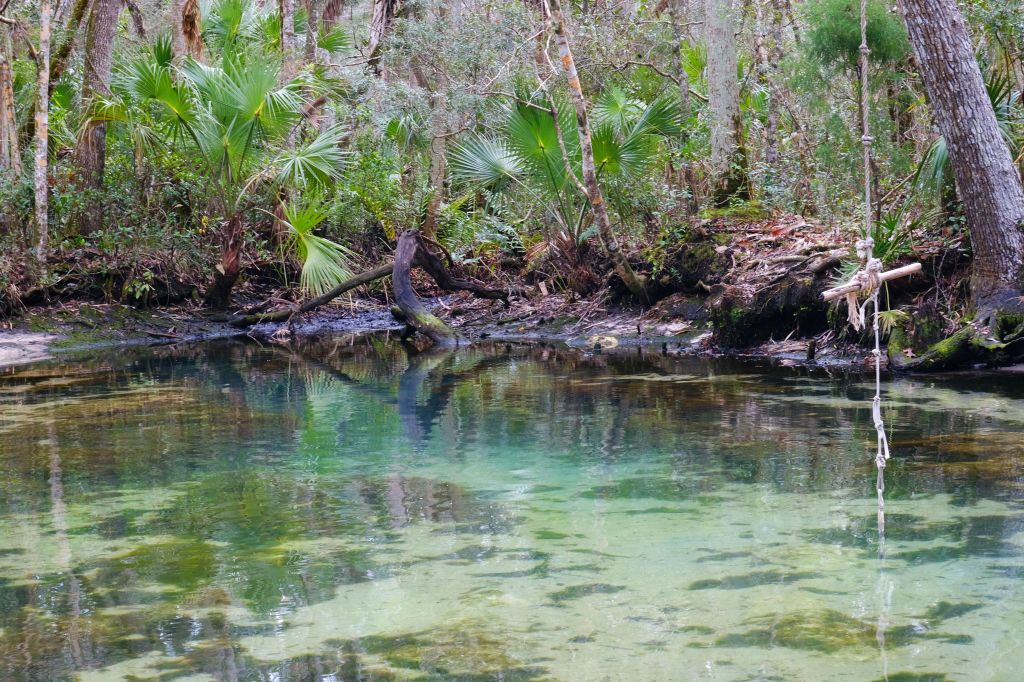
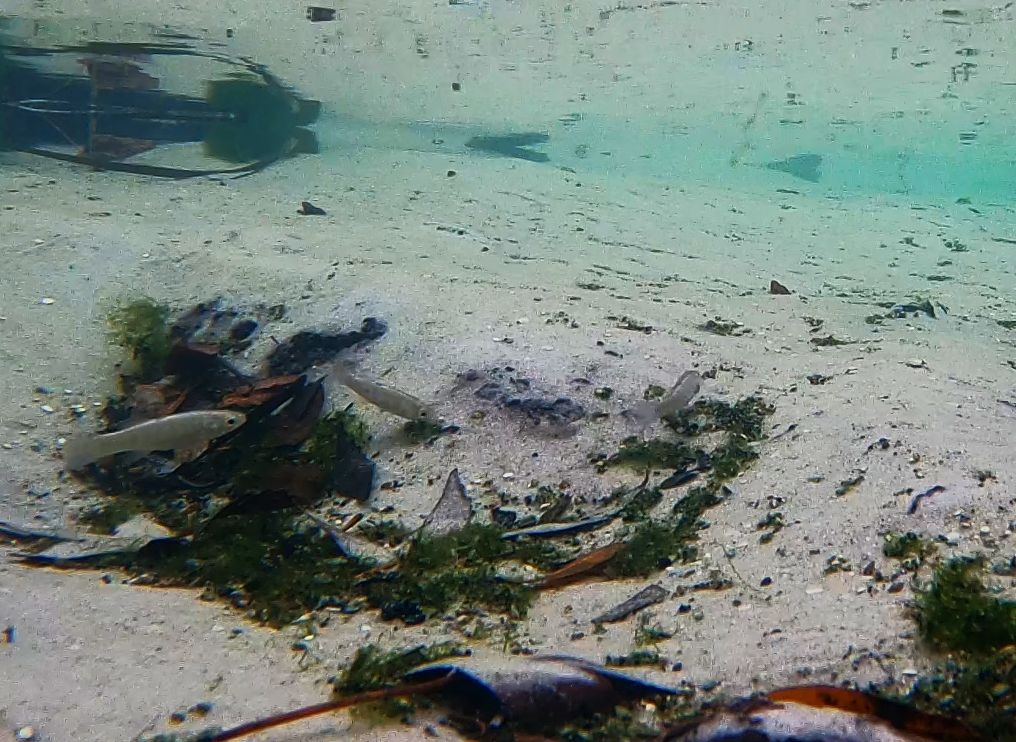
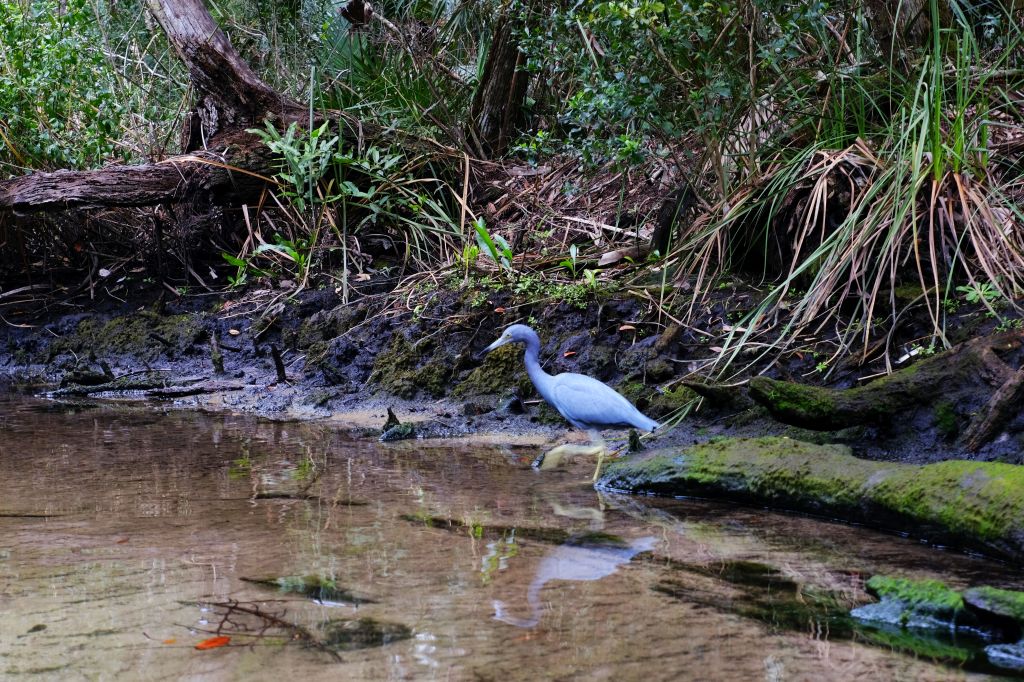
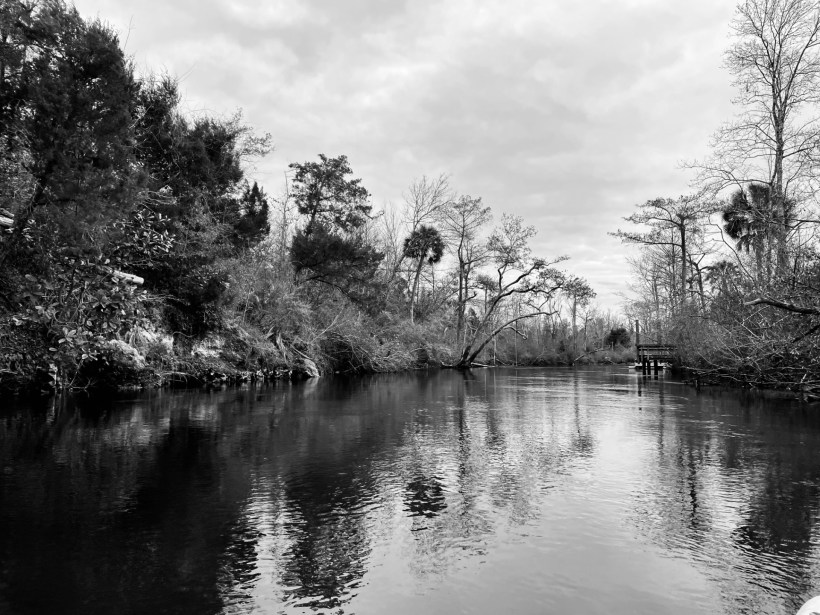
Pitt (above), Sylvan, and Williford springs are just upstream of the Gainer springs group on Econfina Creek. The region around Pitt and Sylvan Recreation Area hosts a cluster of springs that contribute to Econfina Creek, which flows into Deerpoint Lake and eventually St. Andrews Bay at Panama City. The region is agricultural to the east, water management area to the west, and a mixture of both upstream.

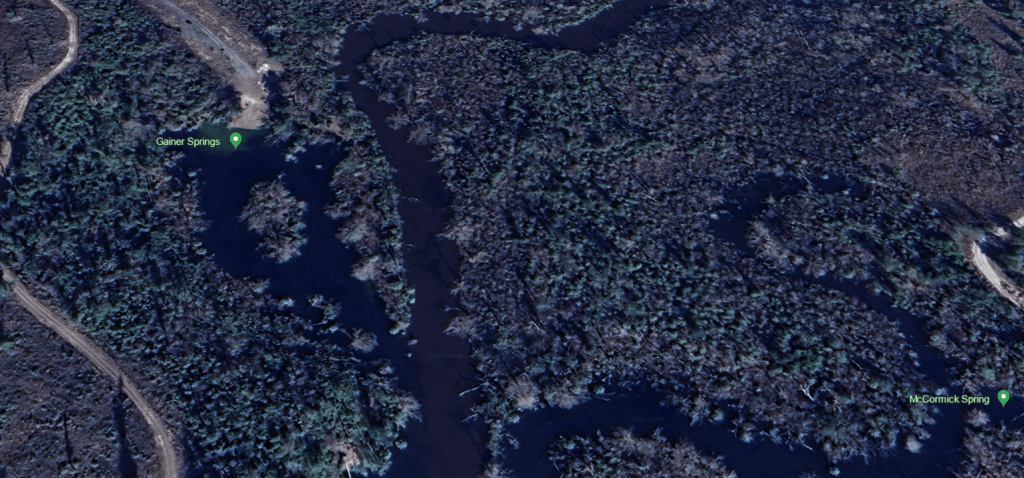
Map of the landscape around Pitt, Sylvan, and Williford springs (top) with a closer version showing some of the many springs in the vicinity (bottom).

Pitt Spring has a parking area adjacent to it, but walking trails connect with the other two spring systems. I raced to visit these springs before I ran out of light for the day. Because I had to use a boat to get there, I visited the Sylvan Spring system first. In my haste, I only found the spring system by the clear water flowing out into the flooding Econfina River. I paddled up the short run to a flat, sandy underwater plain that was largely covered with dead algae. Near the bank at the end of this plain, I saw a tell-tail sign of spring vents: circular rippling on the surface.

The three Sylvan vents at the surface.

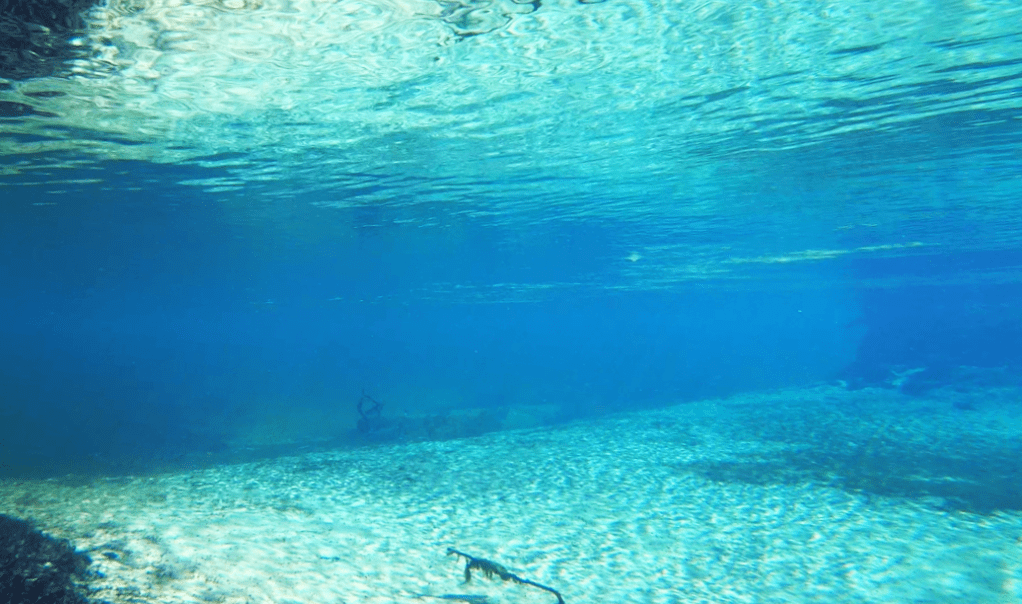
Underwater, the vents were obvious by the live, bright green algae waving in the flow.

Sylvan Spring vents underwater. Notice the fluttering green algae.

The dead algae-covered sand plain near the Sylvan vents.

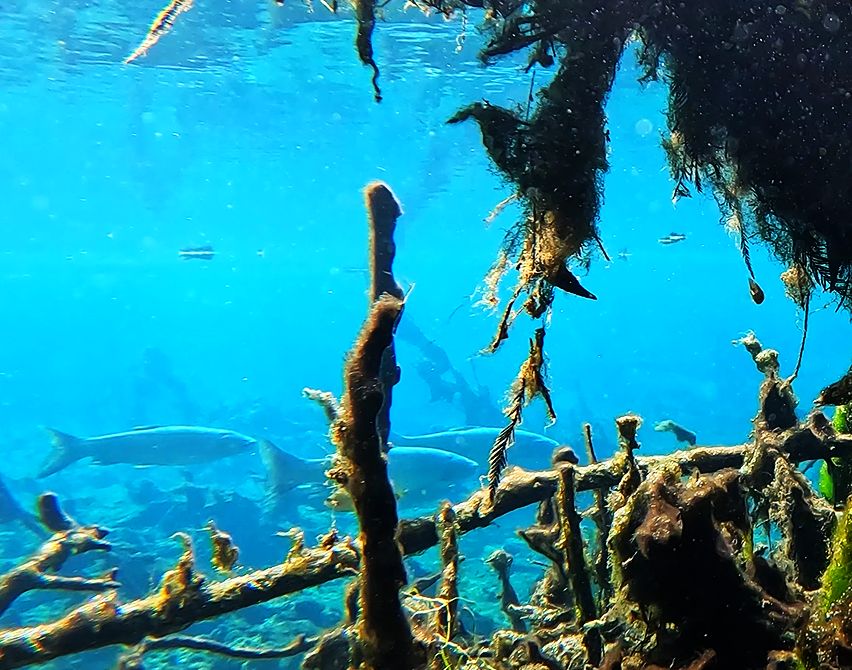
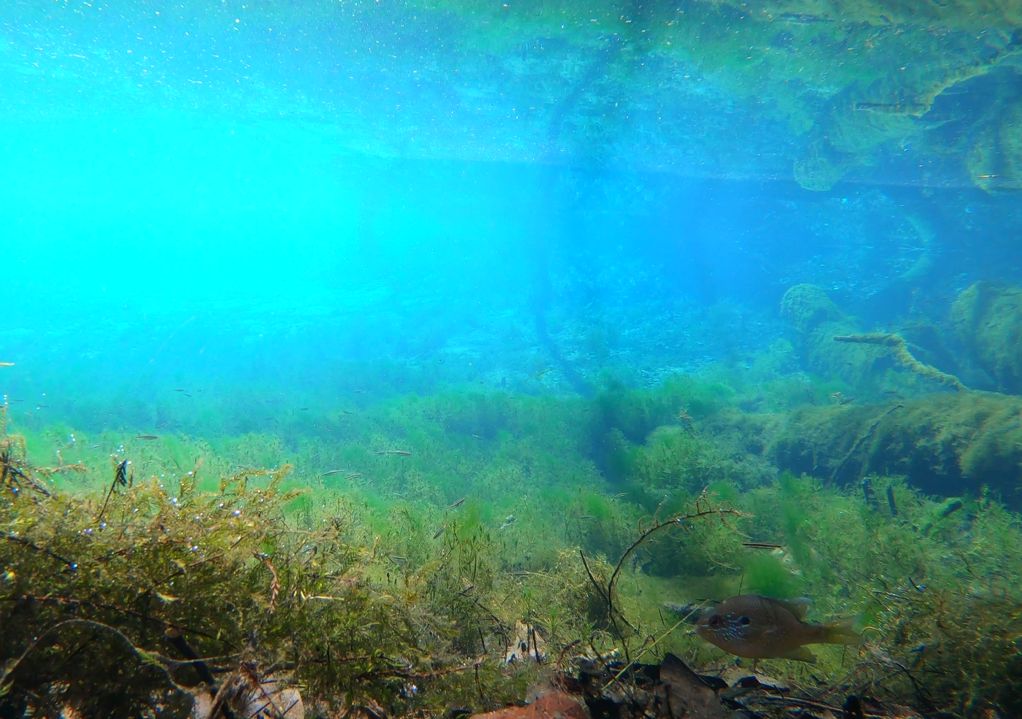
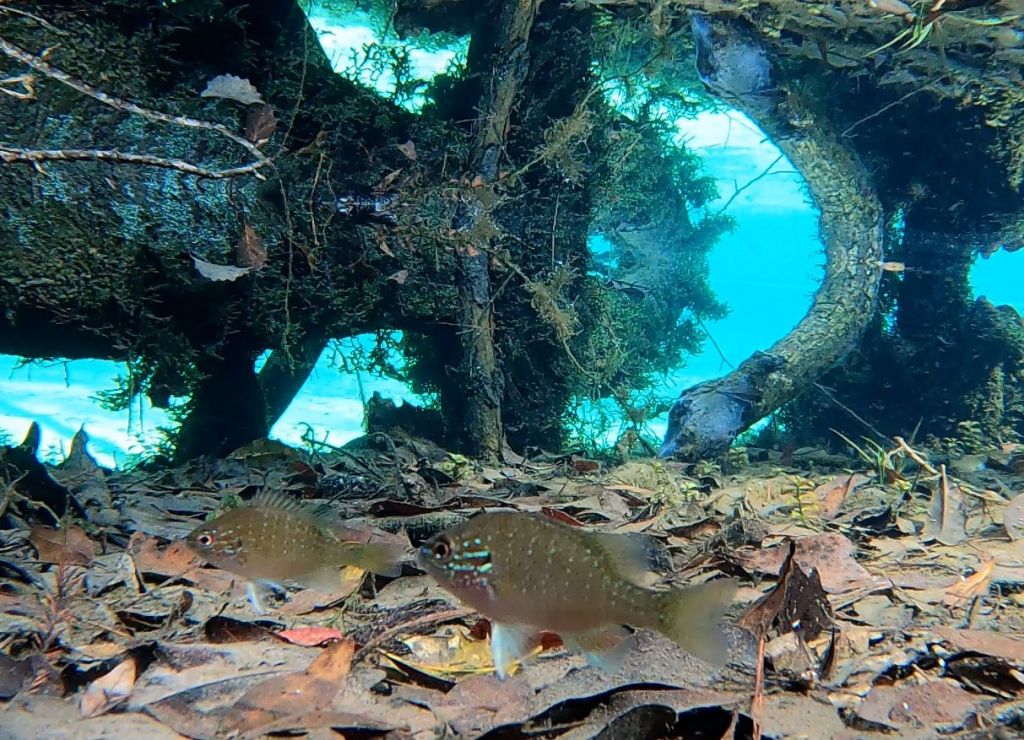
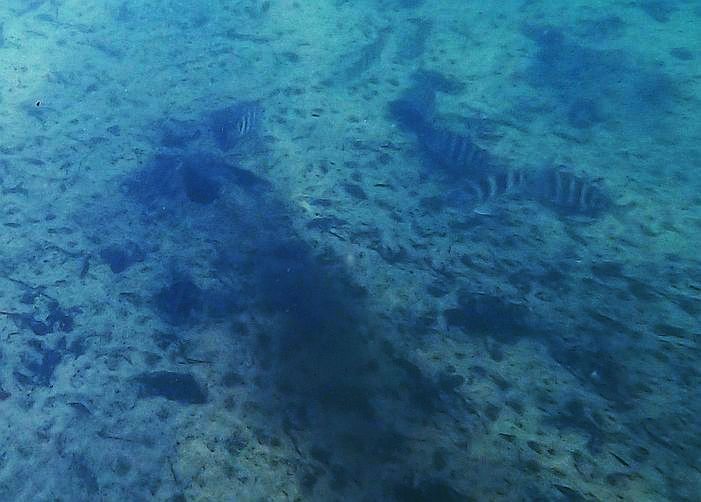
The fish density was quite low in this spring system and virtually all of the fish that I observed were sunfish of one species or another. I only observed larger numbers of fish, interestingly, at a spot where the water was murky with suspended material. Here, the bluegills were undoubtedly eating invertebrates from the decaying algae.

A spotted (Lepomis punctatus) and a longear sunfish (Lepomis megalotis) in clear water and bluegill (Lepomis macrochirus) in the murkier water.

Near the confluence, there were lots of snails covering fallen log, although I sadly did not pick any up to identify them. Next time.

Snails dotted all over a fallen log with a lone sunfish in the background.

The river was running fast due to the flooding and I flew back to the canoe launch.

Floating down the Econfina River to the canoe launch from Sylvan Spring.

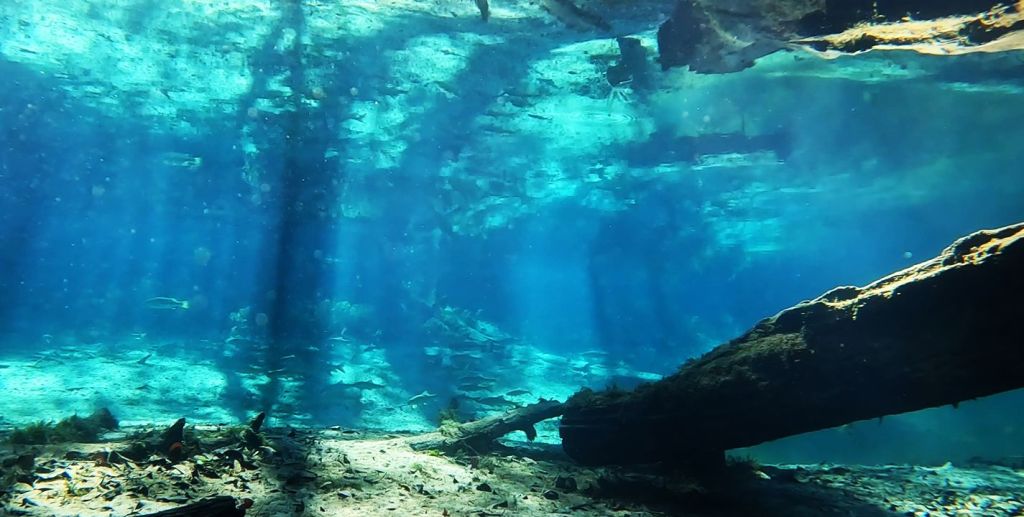
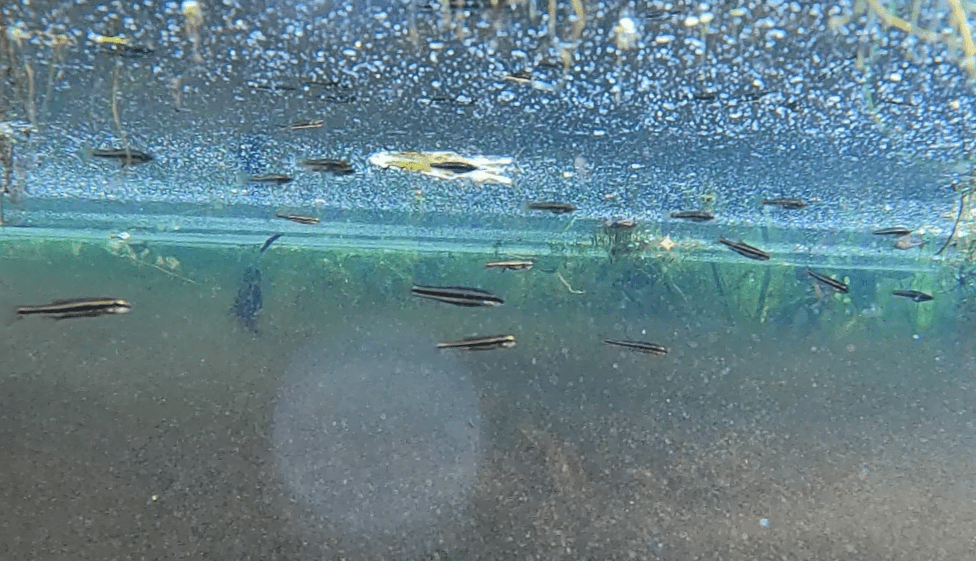
Once I pulled the boat out of the water, I visited Pitt Spring on foot as the confluence with the river was blocked. Pitt Spring was a contrast to the Sylvan system: lovely, clear and blue, with a large, round vent and almost no run. However, the fish diversity was low there as well. I thought that there were only shiners and sunfish, mostly bluegills (Lepomis macrochirus), but when I scanned through the extra footage, I discovered a fish new to me: a lovely little russetfin topminnow (Fundulus escambiae).

Shiners (top), bluegill (middle), and a russetfin topminnow (bottom) at the Pitt headspring.

After filming at Pitt Spring, I hurried up to Williford Spring by car. A trail leads to the spring from the Pitt/Sylvan parking lot, but I was running out of daylight. Had I had more time, I could have paddled up to it, but it was a bit of a trek, so I filmed on foot only.

The Williford Spring vent at sunset.

The fish density in Williford Spring also was low. I only observed mosquitofish (Gambusia holbrooki) and a few bluefish killifish (Lucania parva). I was rewarded, however, with a tiny juvenile musk turtle in one of the videos. I have seen an adult musk turtle (Sternotherus sp.) mistaken for a juvenile snapping turtle because they are so small; the juvenile musk turtle is barely bigger than a quarter.

Underwater views on either side of the Williford vent, with mosquitofish at the surface and a tiny juvenile musk turtle in the lower left hand corner of the bottom photo.

All three of these springs benefited from restoration projects between 2012 and 2015. Projects included bank stabilization and stormwater runoff reduction. I could not find specific water quality information for the springs, but nutrient concentrations for Econfina Creek have been generally low for the period of 2009-2020 (https://protectingfloridatogether.gov/water-quality-status-dashboard). Most data points have been in the ~0.2 mg/L range with periodic measurements up to 0.6 mg/L and a few high spikes up to 1.4+ mg/L (that would be considered quite high) during the period of the restoration. Phosphorus has exhibited similar trends with most points quite low (~0.01 mg/L), virtually all points below 0.03 mg/L and just a few points in the 0.035-0.045 mg/L range. My oxygen measurements were low for the headspring of each system (0.45-1.95 mg/L) and the measurements for the Sylvan run only reached as high as 4.72 mg/L for one sample. The conductivity was low 1330-1400 microS/cm for all samples.
Econfina Creek: Gainer and Bluff Springs

February, 2024

Like the Choctawatchee River, Econfina Creek is a hotspot for springs in the panhandle. Many of those springs, alas, are on private land, but fortunately, there are some springs accessible from public land.

The SR 20 canoe launch. I travel light.

Econfina Creek flows into Deerpoint Lake just north of Panama City. Although the area to the west looks a little like agricultural land, it is actually part of the Econfina Creek Water Management Area. It felt much more natural on the ground than it appears in the Google Earth image. It was a lovely drive over.

A few of the many springs on Econfina Creek.

During the planning stages of this project, I was told that the area was completely transformed by the loss of large riparian trees during Hurricane Idalia. Some large trees made through the storm, but clearly the area had been ravaged.

A Google Earth image from 40 m with some downed trees still visible (top), a photo from the river showing trees stripped of most or all of their branches (middle), and some trees that made it through the storm (bottom).

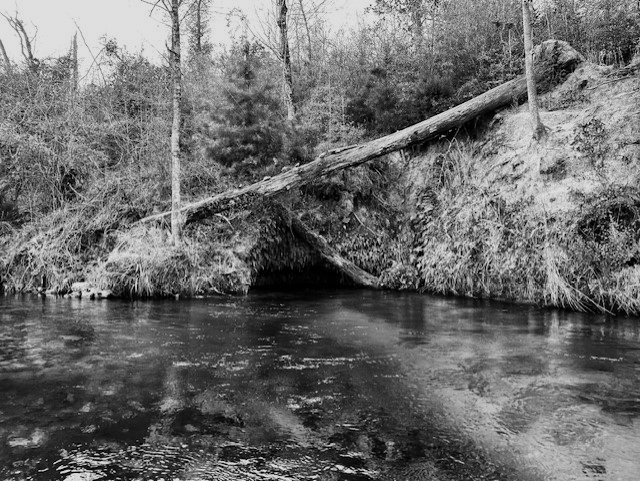
The creek was flowing very brown, turbid, and fast, so I flew down to the springs. Once there, though, the spring water was clear. Despite being the southernmost of the springs that I visited that day, I found Gainer #2 first. Gainer #2 Spring comes from a small cave in the pitted limestone wall along the edge of the river. The pressure from the spring water shot me backwards as I tried to photograph it.

The limestone banks of the river, just upstream of Gainer #2 Spring.

Gainer #2 Spring cave.

Not surprisingly, given the water flow, there were few fish to film. Next to the strong flow out of the cave, there was a little backwater area with a few shiners, but not much else. Fish aren’t stupid.

The cave and its outflow area (top) and the outflow area underwater (bottom). The pressure from the strong water flow from Bluff Spring blasted the sand clear of vegetation and detritus.

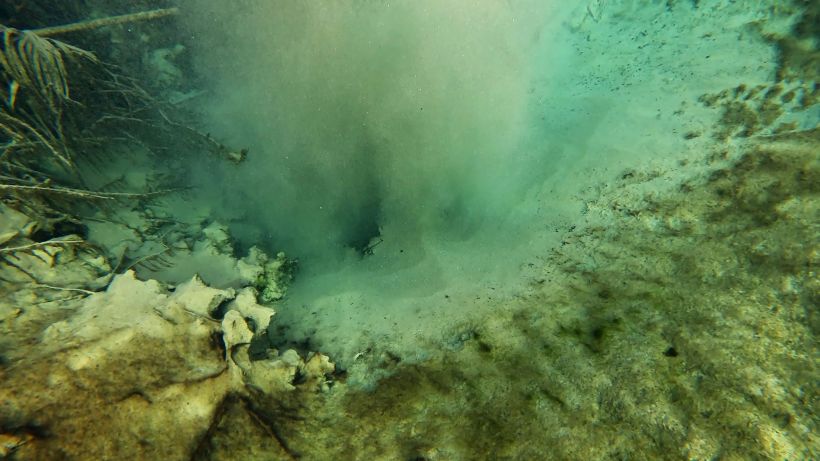
After Gainer #2 Spring, I paddled upstream a hundred meters or so into a little run to reach the Gainer #3 springs. Although the description of this system is Gainer #3, there were actually two springs up this run (and apparently, I missed a third), which formed a large pool with an island in the middle. The spring on the right side of the pool (facing upstream) was a large vent on the bottom and the spring on the left side of the pool came out of a cave in a limestone wall, like a smaller version of Gainer #2. The large vent on the bottom had been the real goal for the day because it is a first magnitude spring, discharging more than 150 cubic feet per second. I missed the spring coming out of the wall on my first visit, but I could not miss the main vent, which was blasting sand out in a plume. It was gorgeous.

Gainer #3 main vent blasting sand.

The caves that represent the other Gainer #3 vents (one on far left, another closer to middle, a third on right).

This system was much bigger than the Gainer #2 system and it supported a lot more fish, including some redear sunfish (Lepomis microlophus). I see this species often at Volusia Blue Spring, but I have recorded them only rarely on this survey of Florida western springs. I also recorded a warmouth sunfish (Lepomis gulosus), which I rarely see and is characterized by its large mouth and iridescent rays radiating back from the mouth on the opercula (gill covers). The bottom of the run was blanketed with a mixture of senescent and live algae, like so many other Florida springs.

Redear sunfish with the Gainer #3 vent in the background.

Bluegill sunfish (Lepomis macrochirus), largemouth bass (Micropterus salmoides), and redear sunfish in the Gainer #3 run.

A slightly banged up warmouth sunfish underneath a bluegill near the cave vents that contribute to the Gainer #3 run.

In addition to shiners, sunfish, and bass, I also captured some bluefin killifish (Lucania goodei), Florida gar (Lepisosteus platyrhinchus), spotted sucker (Minytrema melanops), and a few exotic grass carp (Ctenopharyngodon idella). This spring was the only location where I filmed any exotic fish in the panhandle or Big Bend area of Florida.

Florida gar that I scared floating down the run (top) and a spotted sucker (bottom).

Grass carp moving off into the river (bottom).

Racing against the coming end of the day, I also ventured up the Gainer #1 run. This spring run was the longest of the three and much narrower than Gainer #3. However, like the main Gainer #3 vent, it also was shooting out sand, although at a lower volume.

Gainer vent #1C pumping out sand.

The fish that I recorded in Gainer #1C were similar to the two other Gainer springs in the group, although I did not see the grass carp in this shallower spring run. I captured on video mosquitofish, shiners, sunfish, bass, and, in one video, bluefin killifish (Lucania goodei) males showing off their colorful fins in a display of aggression. I also picked up a turtle that passed behind a spotted sunfish (Lepomis punctatus) and a largemouth bass (Micropterus salmoides) in one of the videos taken in the run. The turtle was probably a yellow-bellied slider (Trachemys scripta) according to Terry Farrell, Florida herp expert extraordinaire.

Male bluefin killifish showing aggression.

Spotted sunfish, largemouth bass, and turtle.

Bluff Spring

On my first trip to Econfina Creek, I completely missed Bluff Spring, which was just downstream from Gainer #2. It was substantially smaller than most of the Gainer springs and, although it also had water issuing from small caves, it also had water shooting from underneath a limestone wall. This flow produced a small pool alongside Econfina Creek, which was obvious once I was on top of it by the clear water. All but two of the fish that I recorded here were sunfish; the other two were largemouth bass.

One of the caves releasing spring water (top) and water shooting out from under the limestone wall (bottom).

It is interesting that the springs of Econfina Creek were clear when a) the springs of the lower Choctawatchee were not and b) the creek itself felt like it was running fast enough to be flooding. I have a lot to learn about the hydrology of the panhandle.

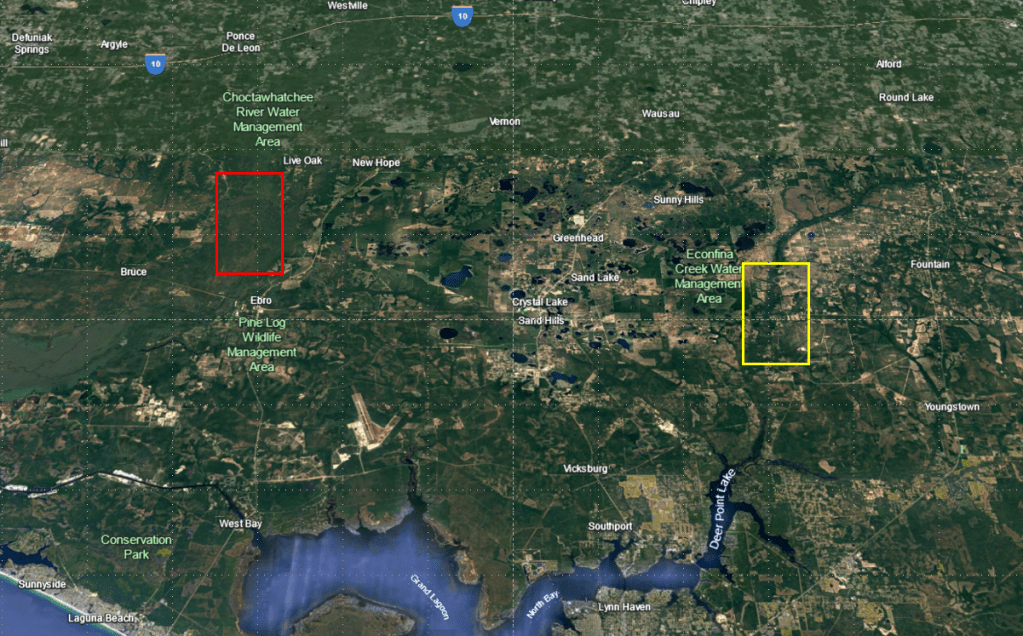
The clear springs of the Econfina (yellow) as opposed to the brown springs of the lower Choctawatchee (red).

There is a USGS publication that I regularly consult, called the Springs of Florida. It was originally published in the 1977 and it was updated in 2004. Along with lots of useful information about discharge and water quality from the 1960s, 1970s, and early 2000s, there are photos. I do not know when these photos were taken, but in these photos, the substrate of Gainer Springs is bare sand. In my photos and videos, the substrate is covered mostly in senescent and some live algae (the brown is senescent, dying or dead). In fact, in the Gainer vent #3 video, there is a little patch of the senescent algae that goes rolling down into the vent, exposing the sand below, after I apparently disturbed it with my paddle.

Alas, I can find no more current water quality data than what was reported in the Springs of Florida, but those data suggested that as of 2001, the nitrate concentrations were quite low (0.16-0.21 microg/L). I very much wonder what they are now. The temperature data that they reported (21.1-22.0 C) was similar to what I measured on my visit (21.7-22.0 C). Their reported dissolved oxygen (2.12-3.0 mg/L) was somewhat higher than my measurements (1.07 mg/L at the headspring of Gainer vent #1), which may be related to the senescent algae. Their conductivity, which is a measure of salts in the water, was low (82-142 microS/cm), as mine was (133-155 microS/cm). Clearly, these springs are not being tidally influenced by the Gulf, at least not in terms of salt.

Ponce de Leon Spring

February, 2024

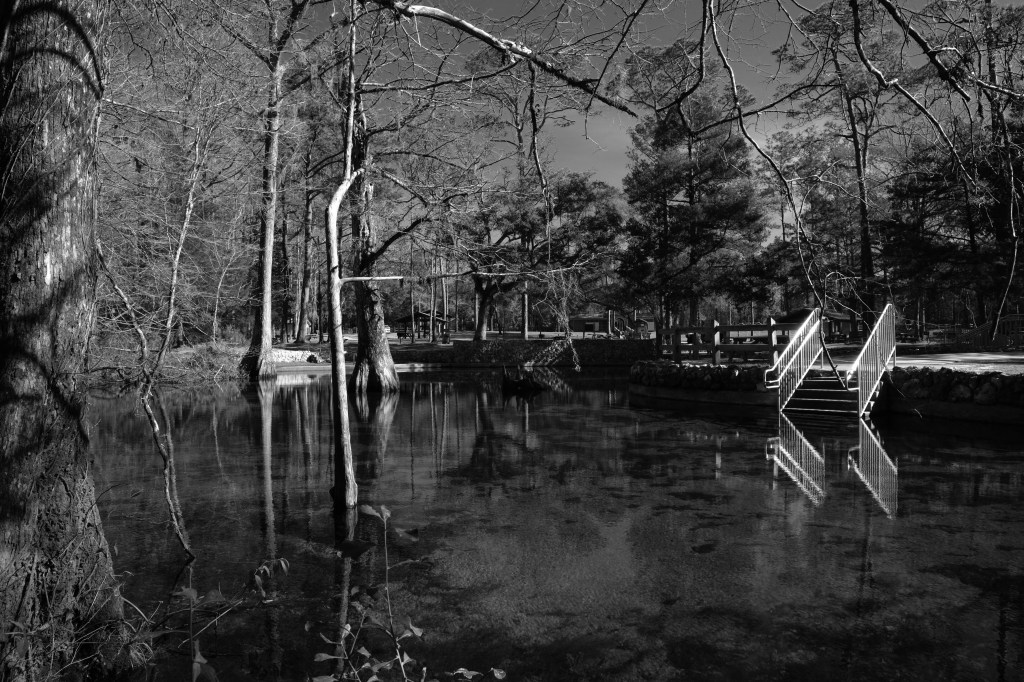
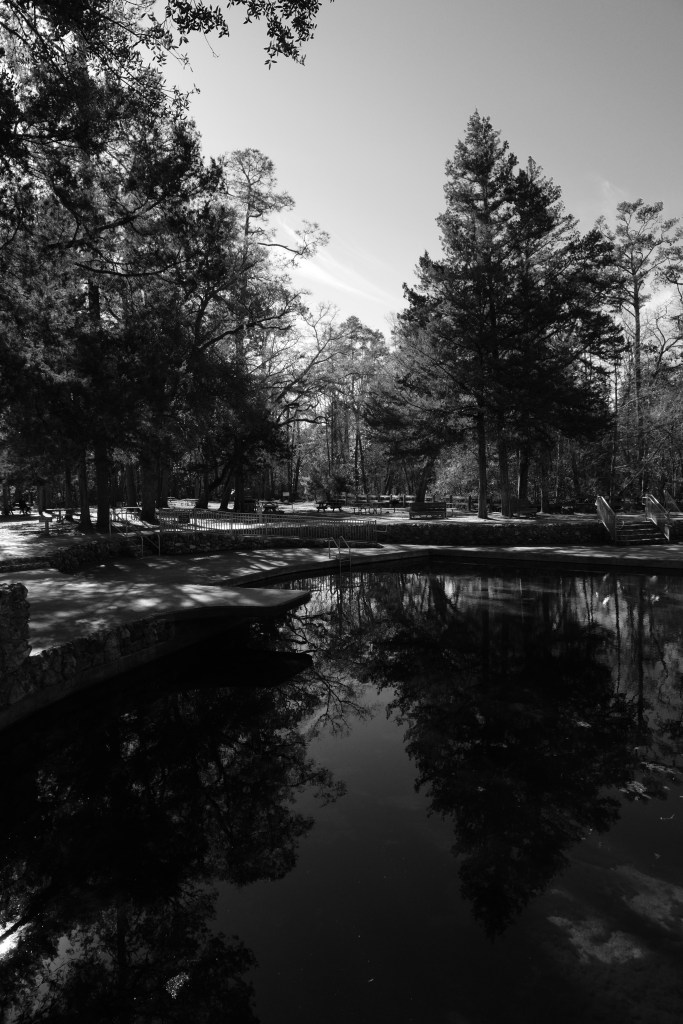
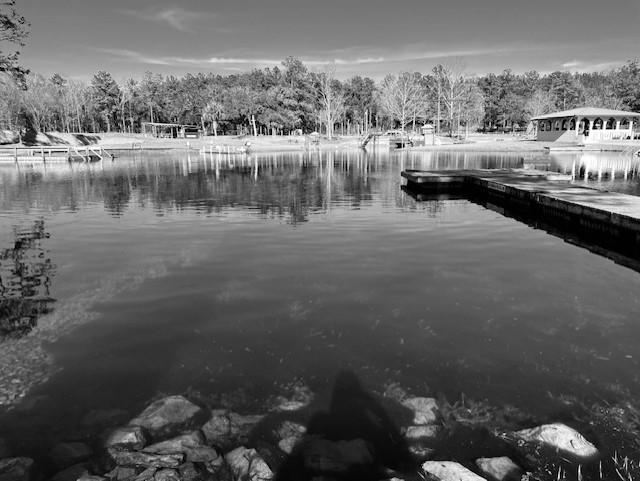
Ponce de Leon Spring was a visually mellow contrast to Vortex Spring. Personally, I find reflections in water compelling, so I liked how the reflections made a zigzag out of the stairs in the foreground and the light on the wall in the background.

Ponce de Leon Spring is in a state park several miles south of Vortex Spring and it flows into the same creek, Sandy Creek. The park sits in a swath of forest just south of the town of Ponce de Leon. Like Vortex Spring, the spring water ends up in the Choctawatchee River, via Sandy Creek, and eventually in the Choctawatchee Bay, which flows into the Gulf at Destin.

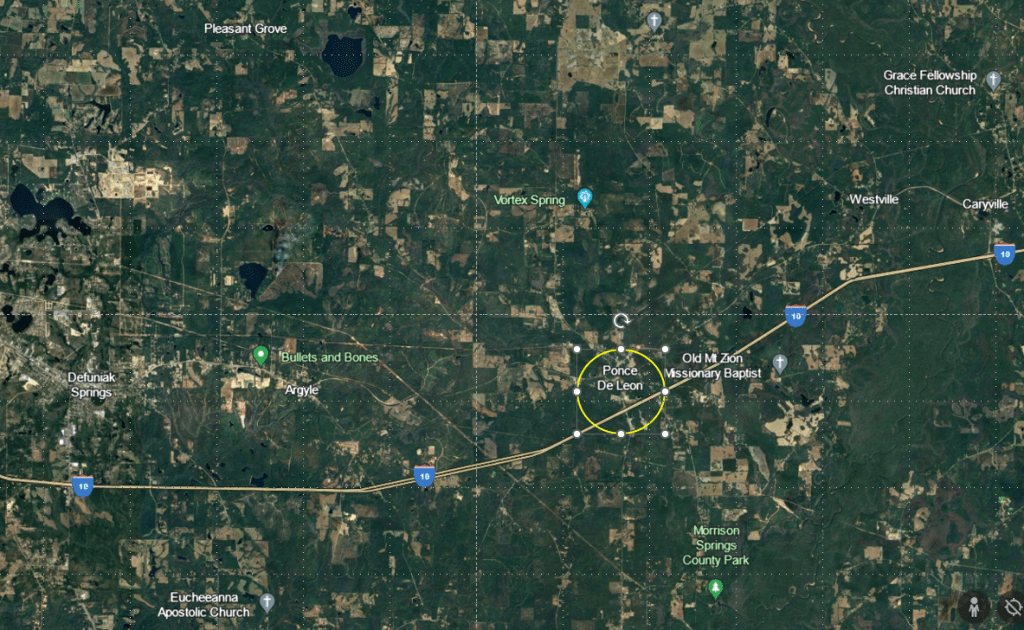
The location of Ponce de Leon Spring just east of Defuniak Springs and west of Tallahassee (top) and the forest matrix in and around the state park (bottom).

The headspring was developed as a swimming area with a large stone and cement wall along one side, complete with a diving board into its relatively deep vent. When I arrived on a chilly February day, no one was using this diving board, so photographing the lovely spring was easy.

The diving board into the Ponce de Leon headspring (top) and a color view of its lovely vent (bottom).

The spring flow coming out of the headspring was somewhat restricted by a weir to produce a pool for swimming.

The weir with a bridge across the run.

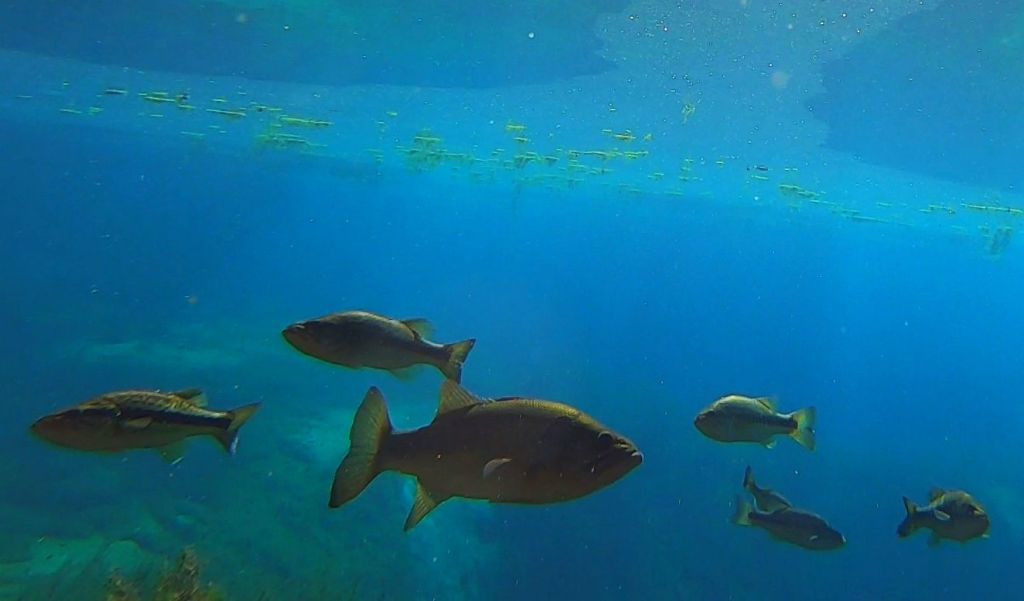
Despite this restriction, I recorded a lot of fish in the headspring area, including lots of shiners, some lovely iridescent dollar sunfish (Lepomis marginatus), and quite a few largemouth bass (Micropterus salmoides). Perhaps in part because of the restriction, the headspring was somewhat blanketed by algae.

Shiners, a dollar sunfish (lower righthand corner), and largemouth bass in the blue of the Ponce de Leon vent.

Below the weir, the run turned shallow and sandy with relatively little algae.

The sandy Ponce de Leon run below the weir.

In addition to the many shiners (including schools of larval shiners) and sunfish, I was lucky enough to catch a darter on camera. Given the distance and lighting, I can only suggest that it is probably a swamp darter (Etheostoma fusiforme).

A school of larval shiners moving (from the right) into a landscape of cypress knees and their reflections reminiscent of stalagmites and stalactites in a cave.

Dollar sunfish in the Ponce de Leon run.

A darter cautiously moving through the detritus and plants.

The Ponce de Leon run is fairly short and enters Sandy Creek, which is as brown as Ponce de Leon is clear and blue. And right above the confluence of the two, I captured a whole shoal of spotted suckers (Minytrema melanops) with one lonely largemouth bass that appeared to be moving in from the creek.

Like Vortex Spring, I had trouble finding a lot of data on Ponce de Leon Spring. However, The Springs of Florida USGS publication contained some data, one set from 1972 and another from 2002. Again like Votex, the temperature of Ponce de Leon was a little colder than the central Florida springs (19-20C vs. 21-24C). The dissolved oxygen was reasonable for a spring (~3 mg/L) and the conductivity was on the low side (~200 microS/cm). My real time measurements were similar, although my oxygen measurement at the headspring was a bit higher (4.7 mg/L), reaching 5.7 mg/L at the confluence with the creek. Probably due to the forested landscape, the concentrations of nitrate (0.14-0.24 mg/L) and phosphate (0.022-0.028 mg/L) were low in both 1972 and 2002. This nitrate concentration is an order of magnitude lower than some of the west central Florida springs in heavily agricultural areas.

Vortex Spring

February, 2024

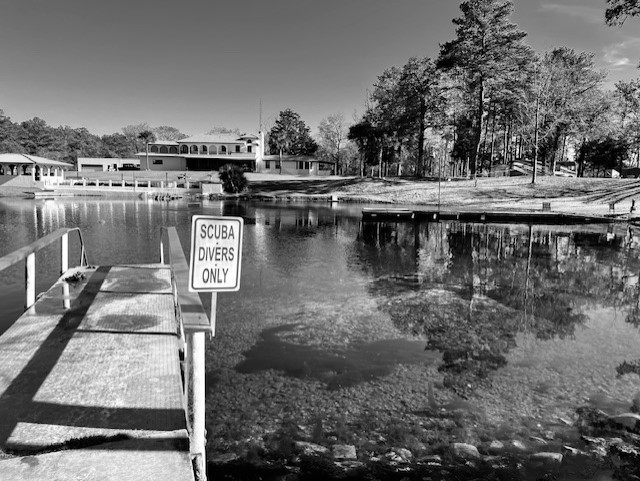
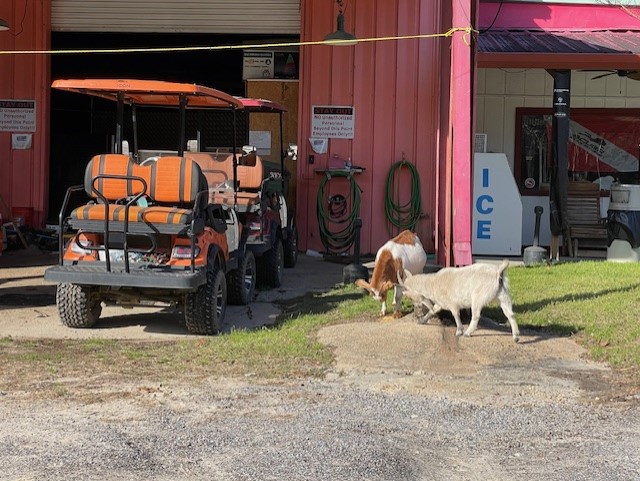
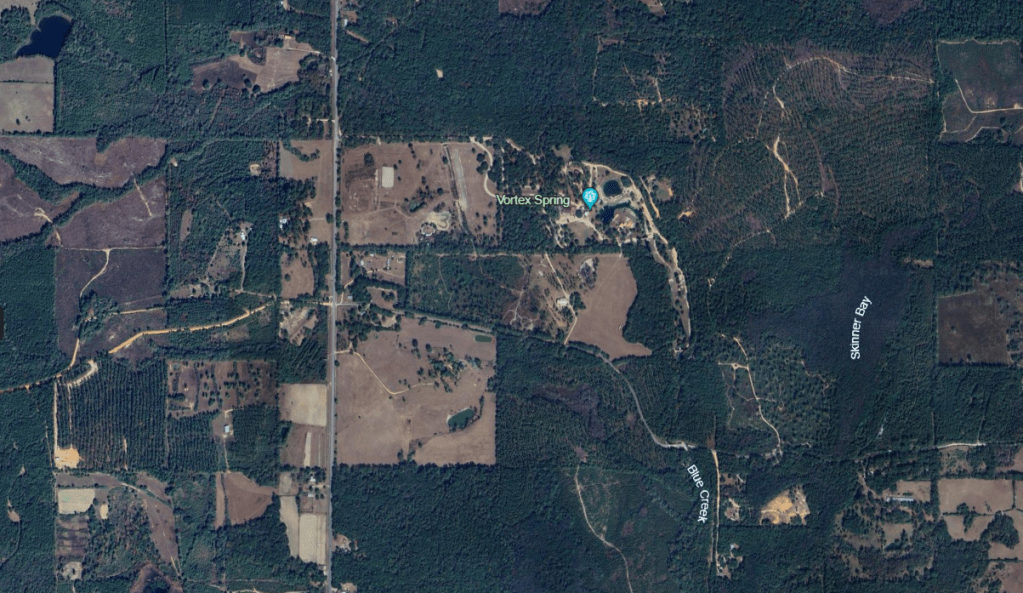
Vortex Spring, as the name would imply, was probably the most culturally unique spring that I visited. Reputed to be an energy vortex, this spring is an interesting mix of private dive school, military dive training facility, and water park. The facility included lodges and campsites, a store, and goats. They were very generous in sharing their park with me with essentially no notice (I got flooded out of some other sites that I had planned to visit that day).

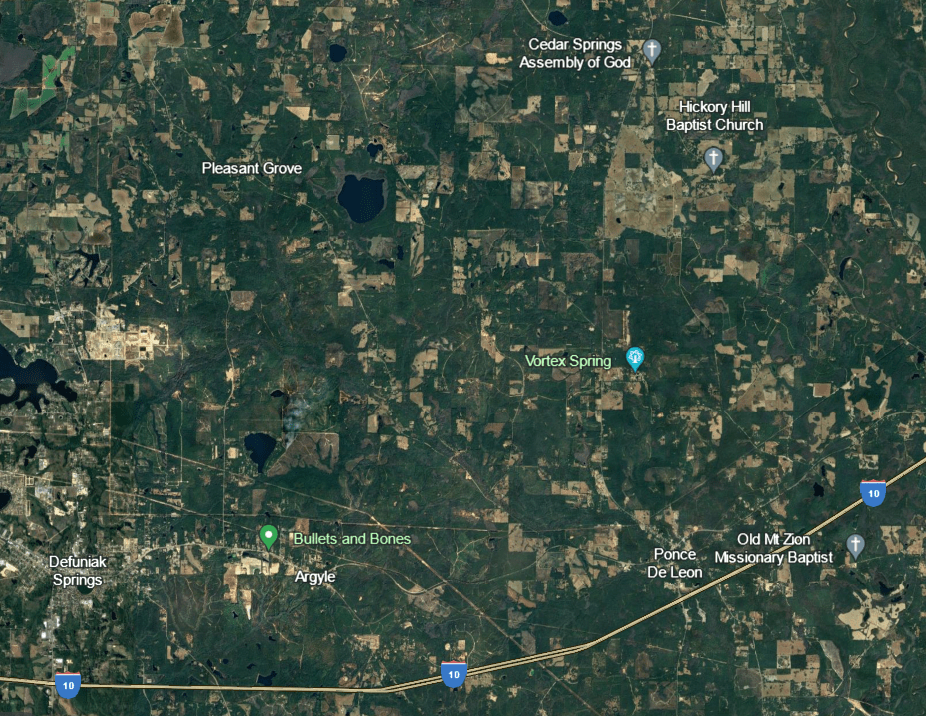
The spring is west of Tallahassee, well into the panhandle, in a landscape of uncut forest, silvaculture, agriculture and small towns.

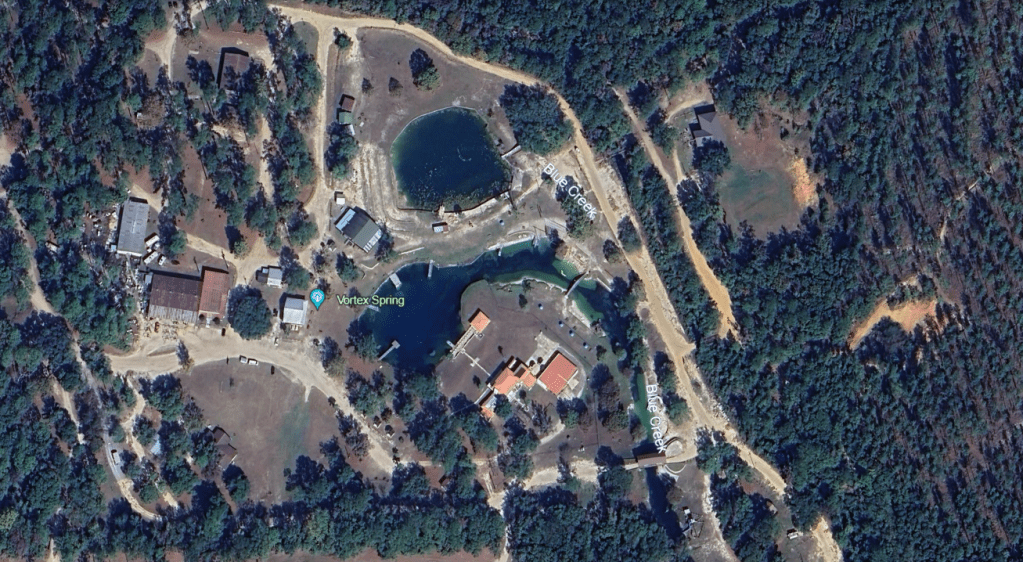
Google Earth images of the landscape matrix around the spring. At 4000 m, the town of Defuniak Springs is visible to the west (top). Zooming in shows the rows of trees in the silvaculture operations (bottom).

The spring at about 100 m up.

The spring run itself is called “Blue Creek” and flows eventually into the Choctawatchee River. The river flows into Choctawatchee Bay, the west side of which is open to the Gulf at Destin.

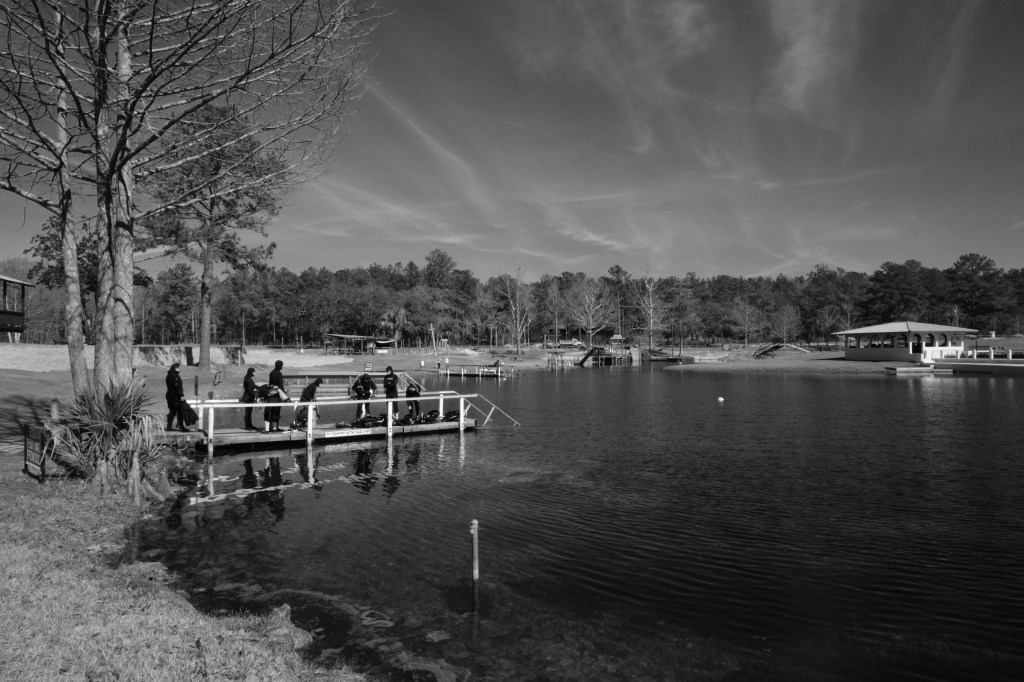
When I arrived, a small herd of pre- or early-teen kids jumped around in wetsuits on the dock awaiting their lesson, lovingly recorded by their parents on the bank.

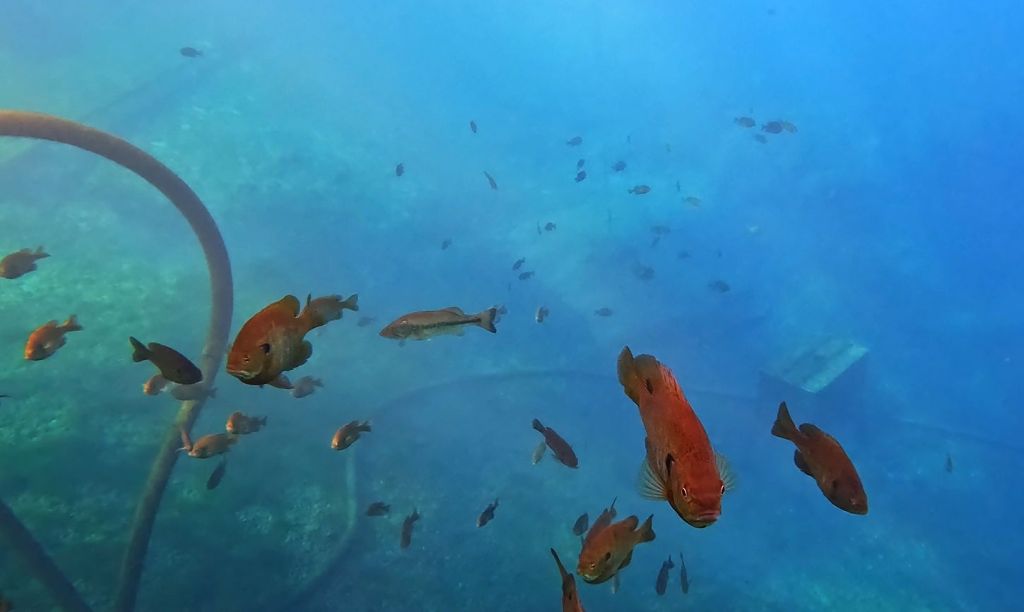
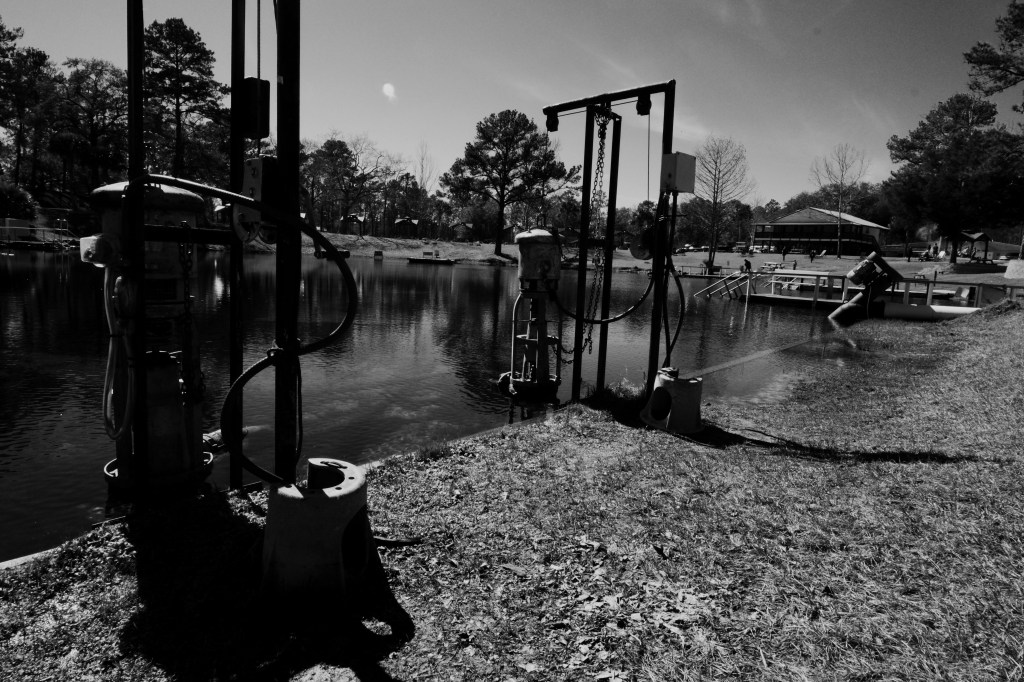
The park’s promotional material describes the spring as a “diving resort” complete with a sunken sailboat to explore. The area around and in the vent contained more gear, both above and below the water and obscure to the non-diver, than any other spring that I have seen.

Gear on bank of the headspring (top), a diver passing by box that I read was a “air bell” (middle), and sunfish and bass completely ignoring the pipes scattered around the headspring (bottom).

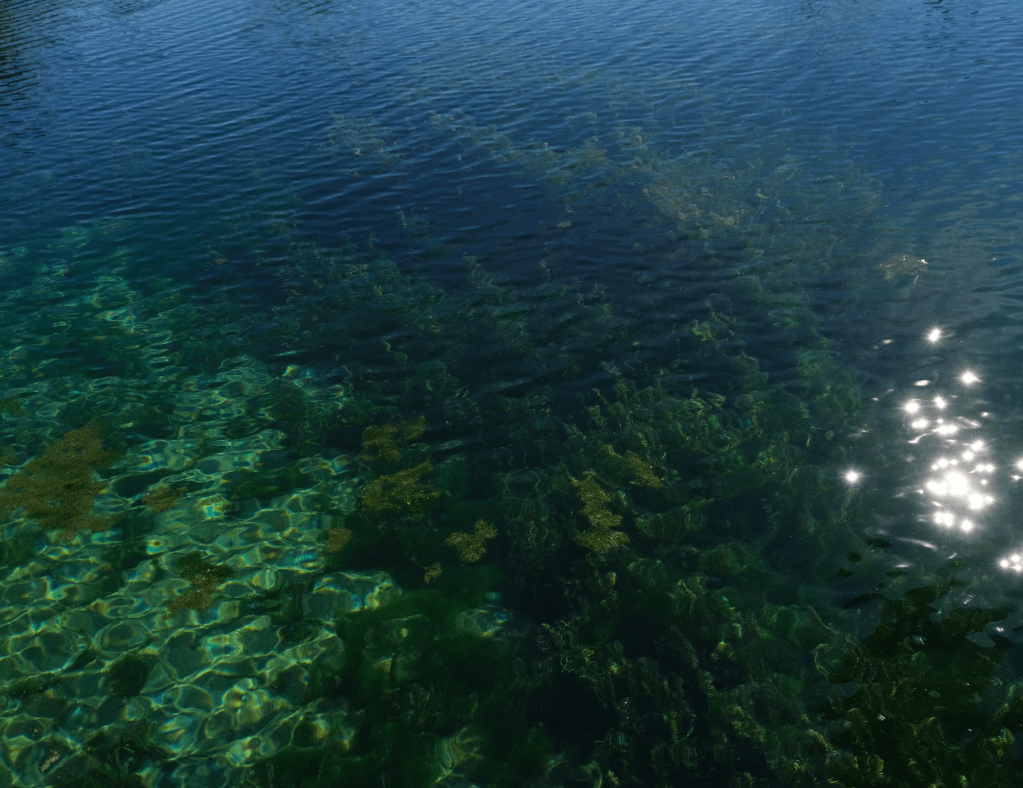
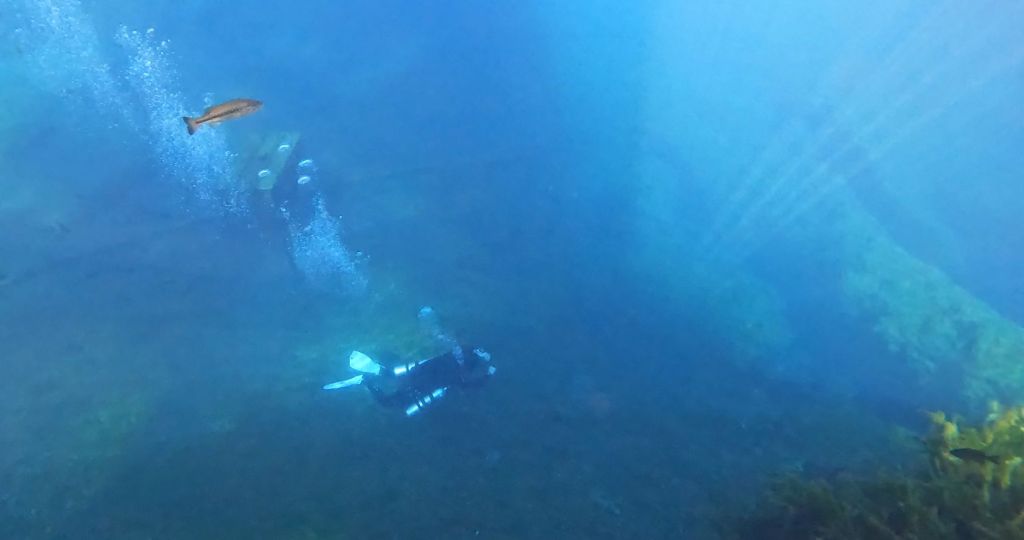
The large round pool drops off quickly to 58 feet, at which point a gate blocks the entrance to a cavern that reaches down to 117 feet, accessible only to experienced cave divers with the key. As advertised, the water was, in fact, “gin clear” and filled with fish, mostly shiners, bluegill (Lepomis macrochirus), spotted sunfish (Lepomis punctatus), and largemouth bass (Micropterus salmoides).

The clear water of the pool (top and middle) and a few of the very abundant shiners in the run just below the pool (bottom).

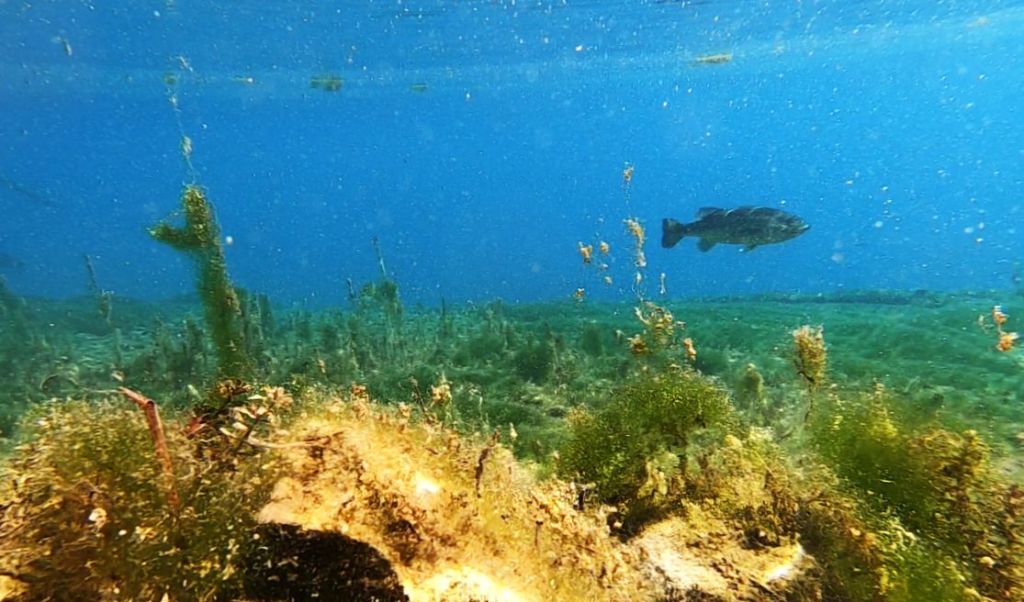
Some of the original sandy run remained, but much of it was covered with algae, as is true of a lot of Florida springs. It seems that shiners, sunfish, and bass are quite tolerant of algal-covered substrate.

A largemouth bass patrolling over an algae-covered sandy run. Lots of bubbles were being released, perhaps due to oxygen supersaturation from rapidly photosynthesizing algae. Supersaturation happens when the algae are photosynthesizing faster than the water can absorb the oxygen, producing bubbles.
Loads of snails littered the sand where it was exposed. Although I have not keyed them out, they appeared to be what the Florida snail expert, Fred Thompson, called “spring elimia” (Elimia sp.).

An Elimia sp. that I pick up off the sand.

As I moved downstream, the park seemed to shift from dive training to water park. Bridges, a jumping platform, massive inflatable alligators, a mock ship’s crow’s nest, and water slides hinted at the crowds of swimmers that undoubtedly visit in the summer.

Some of the summer accessories for the water park.

Past most of the water park equipment, the far bank was forested and the run looked a bit more original. Underwater, the run’s substrate shifted from sand and algae to hydrilla (Hydrilla verticillata) and algae. The water contained a little more particulate matter, probably due to the divers upstream. The fish were still a mixture of shiners, sunfish, and bass. It was kind of theme.

Oxygen bubbles being released from the hydrilla with a largemouth bass in the background.

My measurements of temperature (19.1C), dissolved oxygen (5.74 mg/L), and conductivity (221 microS/cm) at the headspring were in line with the only report that I found about Vortex Spring in my quick search. This spring is 2-5C colder than the springs in central Florida. The oxygen in the headspring was reasonably high and it got much, much higher as I moved downstream (over 10 mg/L), which accounted for the supersaturation bubbles. The conductivity was pretty low–no saltwater intrusion or tidal effects here. The only data that I could find on other water quality parameters were from one sample in 1972 taken by the USGS. Given the algal coverage that I saw, I suspect that the nutrients are higher than the 80 microg/L of nitrate reported for this sample.
Wacissa River (springs) January-February 2024

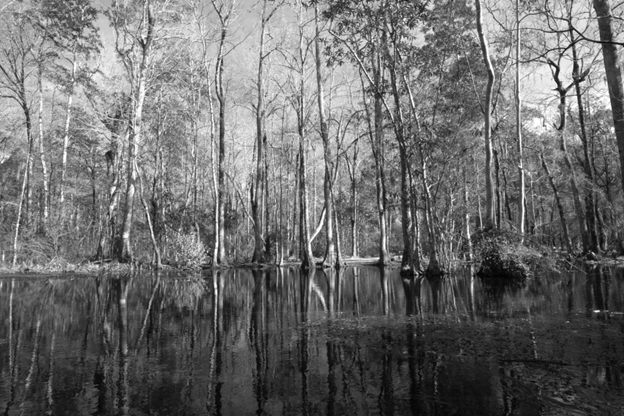
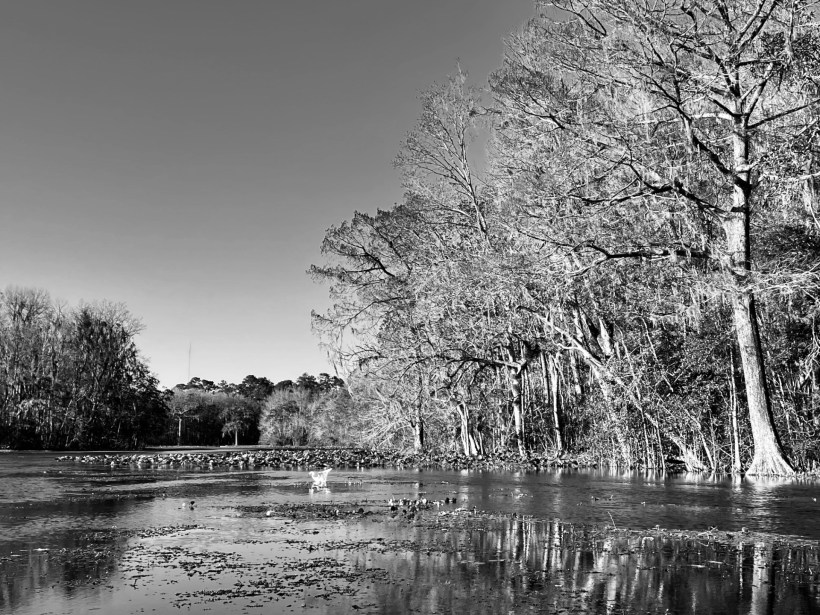
People say that Florida has no seasons, but this photograph says winter to me. The photo is centered on the homemade diving platform at Big Blue Spring on the Wacissa River. The trees, usually so lush, have few leaves, the shadows are long, and the swimmers have been gone for months. Winter on Florida springs is peaceful.
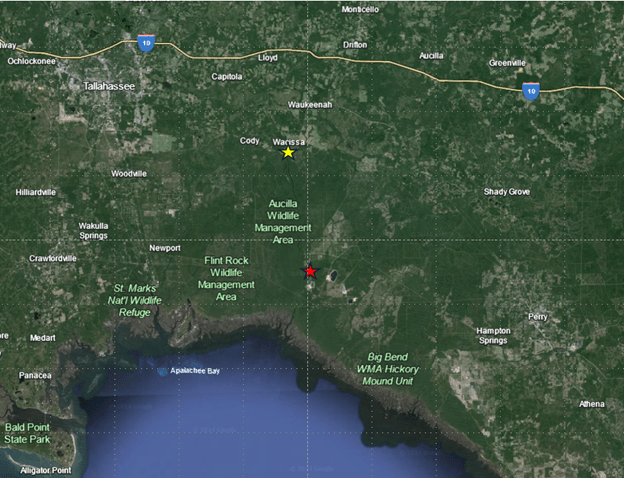
The Wacissa River starts east and slightly south of Tallahassee. It flows through the Aucilla Wildlife Management Area, passing between the Flint Rock Wildlife Management Area and the Big Bend Water Management Area. The drive out to the spring winds through forests or, if coming from Tallahassee, the occasional pasture. About 12 miles downstream from the start of the Wacissa, the river joins the Aucilla River to flow into the Gulf at Apalachee Bay. Together, these two rivers have been categorized as an Outstanding Florida Water.

A map of the Big Bend region that it is the home of the Wacissa River. The yellow star indicates the location of the river’s origin; the red star indicates where the Wacissa joins the Aucilla.

Like the Chassahowitzka, the Wacissa is a river made of springs. It, too, starts with a small spring that feeds into a wide run that meanders to the Gulf, although its meander is roughly 3 times longer. The small spring at the start of the Wacissa, Horsehead Spring, is narrow, somewhat brown, and thick with plants. At the headspring, I could not see the vent at the bottom. The spring seemed more like a hole in the plants than the rocky crevice that was undoubtedly underneath the dark water.

Map showing the location of the first two springs, Horsehead Spring (orange star) and the larger vent downstream at the start of the river proper (blue star).

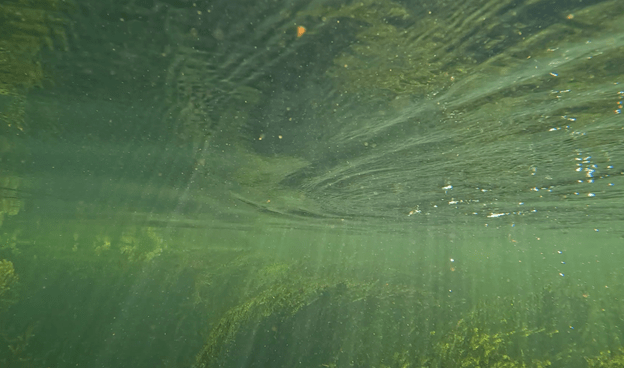
The headspring for Horsehead Spring (top) and light streaming down from the distortion made by my paddle at Horsehead headspring (bottom).

Once I left the Horsehead headspring, the trees converged over this lovely little spring run. The run was so filled with plants that I had to find holes in the plant cover to get a good enough field of view to film. Some of these plants were eelgrass (Vallisneria americana) and some were nonnative hydrilla (Hydrilla verticillata), as seen in the video below.

Shiners and bluefin killifish (Lucania goodei) streaming past the camera at the headspring of Horsehead Spring.

In this small spring, I was rewarded with a fish species new to me, the metallic shiner (Pteronotropis metallicus). Shiners are very hard to identify on film because many of the characters that are needed for a good identification are too small and obscure to see at a distance, but this species has a very wide black stripe on its side and a dark dorsal fin etched in white and orange on the outer edge. As they darted around the plants, the fish popped their dorsal fins up and down, inadvertently signalling to me their species.

Metallic shiners in Horsehead Spring run.

As soon as I floated out of Horsehead Spring, I found myself over a spring vent that I had not realized was there. It was large and dark, but provided substantial flow to the river. I noticed the spring as I floated over it because it, too, looked like a round hole in the plants. In fact, the whole river upstream was thick with plants; the plants were so thick that the birds were walking on them as if on land.

Eelgrass waving in the flow of the river (top) and a little blue heron (Egretta caerulea) standing on the thick hydrilla in the river (bottom).

This thick plant life, both native and nonnative, provided cover for small fish. In contrast to the Chassahowitzka, which had virtually no plants in the main river, lots of predators, and very few small fish, the Wacissa was teaming with small fish. Every video showed some combination of 30-50 shiners, killifish, and livebearers like mosquitofish (Gambusia holbrooki). Large predators, like largemouth bass (Micropterus salmoides) or longnose gar (Lepisosteus osseus) were relatively rare in the videos of either the main river or the many springs that fed into it along its upper length.

A rare group of three largemouth bass patrolling (top) and a largemouth bass scaring shiners into the vegetation (bottom). The shiners wink back into view after the bass moves along.

Flooding back into the forest also provided cover for fish. Hurricane Idalia passed over the area in August 2023 and the flood waters still had not completely receded in February 2024. Florida is so flat, its water table is so shallow, and there often is so much precipitation in the rainy season that floods can last a very long time. When the water penetrates back into the woods, the cypress knees and shrubs can provide extra cover from predators for small species.

The homemade diving platform above this knot of tree roots on Big Blue Spring suggests that it is likely on dry land in the summer when the floodwaters recede.

After I finished filming in the main river, I moved into some of the many springs that contribute water to the main flow: Big Blue, Little Blue, Buzzard Log, Garner, and Minnow.

Flooded forest (top) and duckweed (Lemna sp.) so thick that my kayak made a trail (bottom) in Minnow Spring.

I have been thinking lately about how small side springs and flooded forest might contribute to the overall diversity of larger systems. When I filmed back in the side springs of the Wacissa, many of the fish that I observed were the same species as in the main stem of the river. However, I also found some unique assemblages and species. Back in the side springs, I observed more least killifish (Heterandria formosa), our smallest fish species in Florida, than I have ever observed together. The specific epithet of this species references the family name of ants, Formicidae, undoubtedly because of their small size. I also observed a chain pickerel (Esox niger), a large predatory species that I have only caught on camera once in all of the video that I have collected to date.

Tiny least killifish above the slightly larger shiners at Minnow Spring (top) and a chain pickerel at Garner Spring (bottom). The camera at Minnow spring was back in the flooded forest and there was a lot of dissolved and particulate “stuff” in the water. The camera a Garner Spring captured a lot of live and dead algae and plants.

And much to my surprise, I also caught an entirely new type of organism for me: an eastern newt (Notophthalmus viridescens). This animal has a relatively unique life history, with a juvenile aquatic stage, followed by a juvenile terrestrial stage, and finally an adult aquatic stage (https://nationalzoo.si.edu/animals/eastern-newt). Given that I collected the video of this species at two different locations (right off the boat ramp and in Big Blue Spring), it is likely that there are a lot of newts in the system.

Eastern newts in Wacissa River springs.

The fact that the Wacissa River flows through Wildlife Management Areas likely contributes to its good water quality. The nitrate concentrations published by the US Geological Survey are among the lowest that I have observed for Florida springs (0.16-0.33 mg/L). The dissolved oxygen concentrations they published are relatively high (4.9-8.3 mg/L) and my measurements were in a similar range. The conductivity of the river and its springs, both published data and my data, are much lower (0.26-0.30 mS/cm) than what I measured in some of the Chassahowitzka springs (5-10 mS/cm), undoubtedly due to the greater distance between the Wacissa springs and the Gulf. Conductivity is a measure of ion concentrations in water, kind of the freshwater version of salinity. Salinity is a measure of sodium and chloride, whereas conductivity encompasses the broader range of ions typical of freshwater. To give some context, the conductivity of sea water is 3-6 S/cm, so several orders of magnitude higher than in the saltiest springs that I have measured. It is likely that the lower conductivity and the greater distance to the Gulf explains the exclusively freshwater assemblage that I observed on the Wacissa in contrast to the Chassahowitzka.

Chassahowitzka River (springs), January 2024

The springs that produce the Chassahowitzka River provided a perfect start to my new spring survey: springs that flow into the gulf, either directly or indirectly.

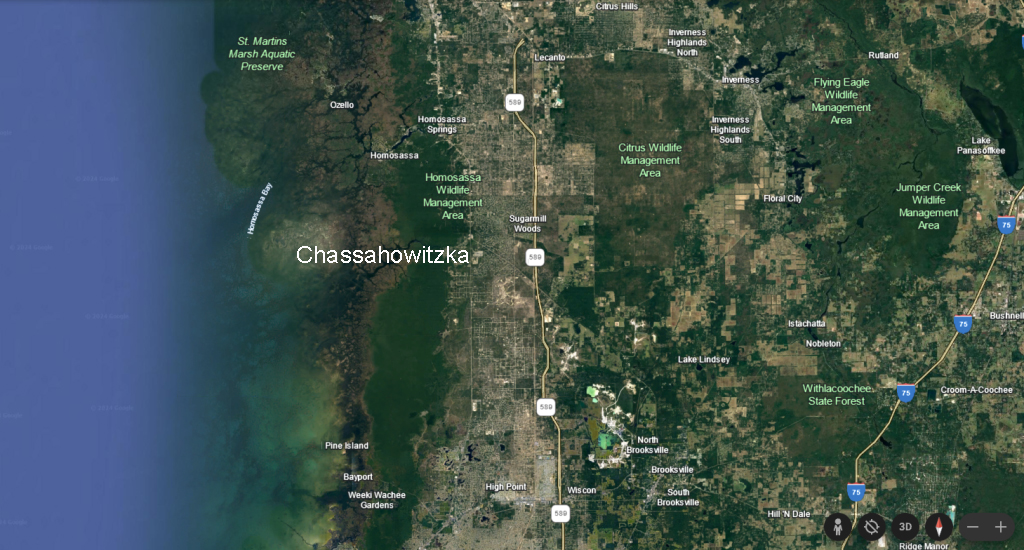
Chassahowitzka is situated on the “Nature Coast” between Homosassa Springs to the north and Weeki Wachee to the south, both of which are probably more famous to people from outside of Florida (posts on those two spring systems later).

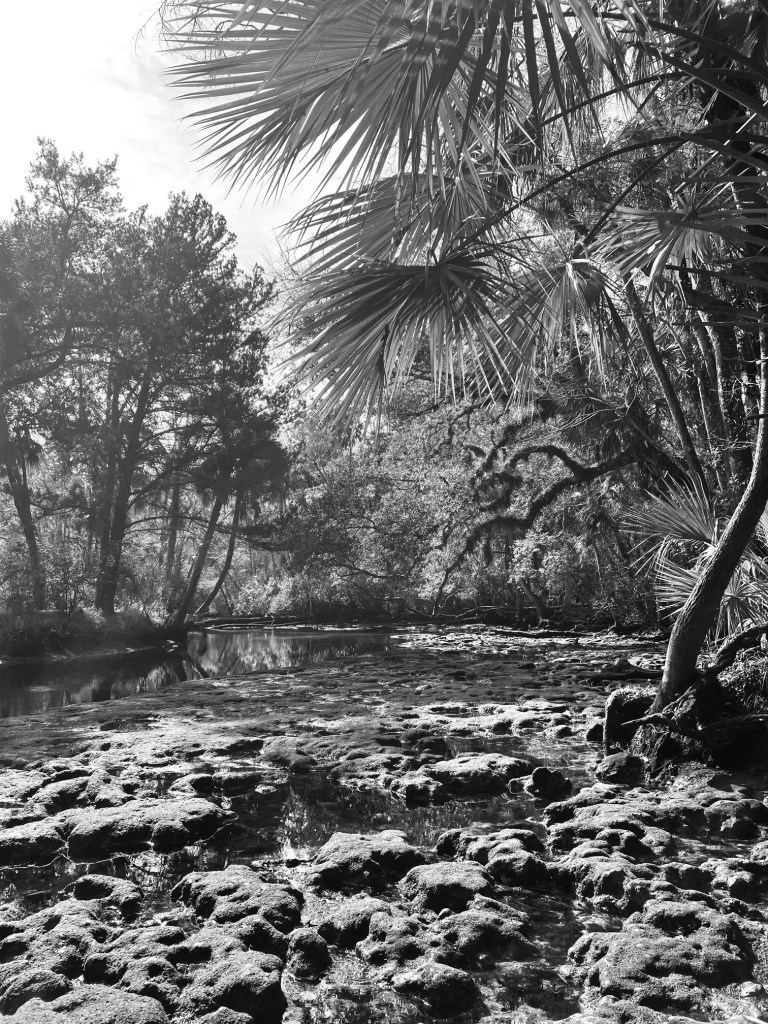
To locals, however, the Chassahowitzka is famous for Seven Sisters Springs, which is a cave system near the start of the river. These seven interconnected caves are startlingly blue holes in a small landscape of rounded black and grey exposed limestone. Like the other springs of Florida, the limestone eroded unevenly over time to produce these “solution” holes.

The first of the seven sisters and, although I did brighten this photo, they really do look this blue.

The limestone rock formation that forms the Seven Sisters. I took this photo looking down the run from the cave in the first photo.

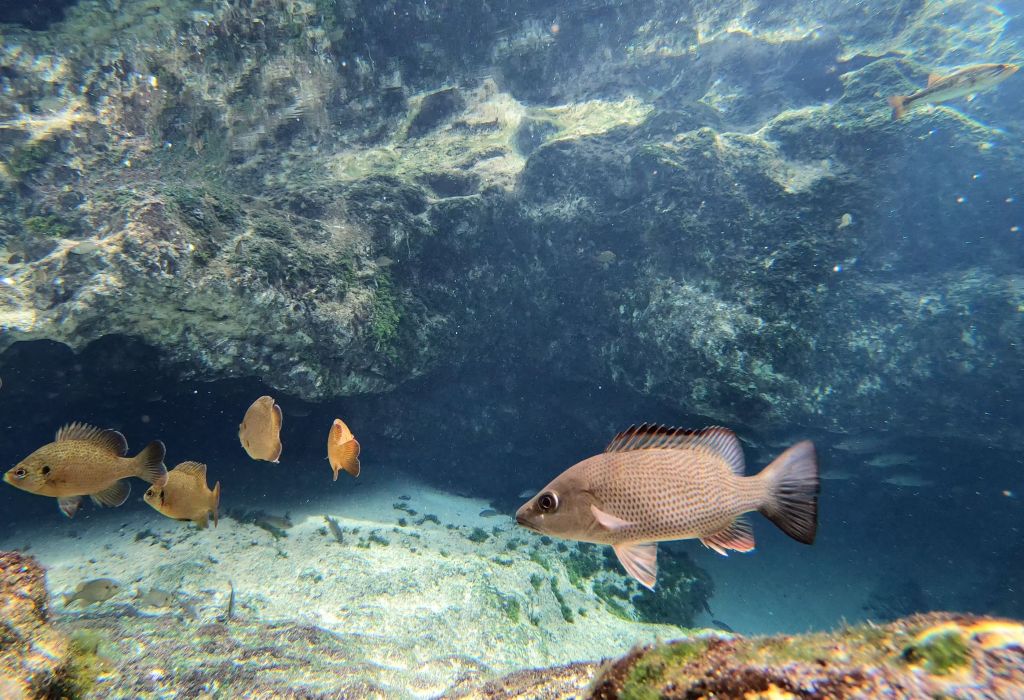
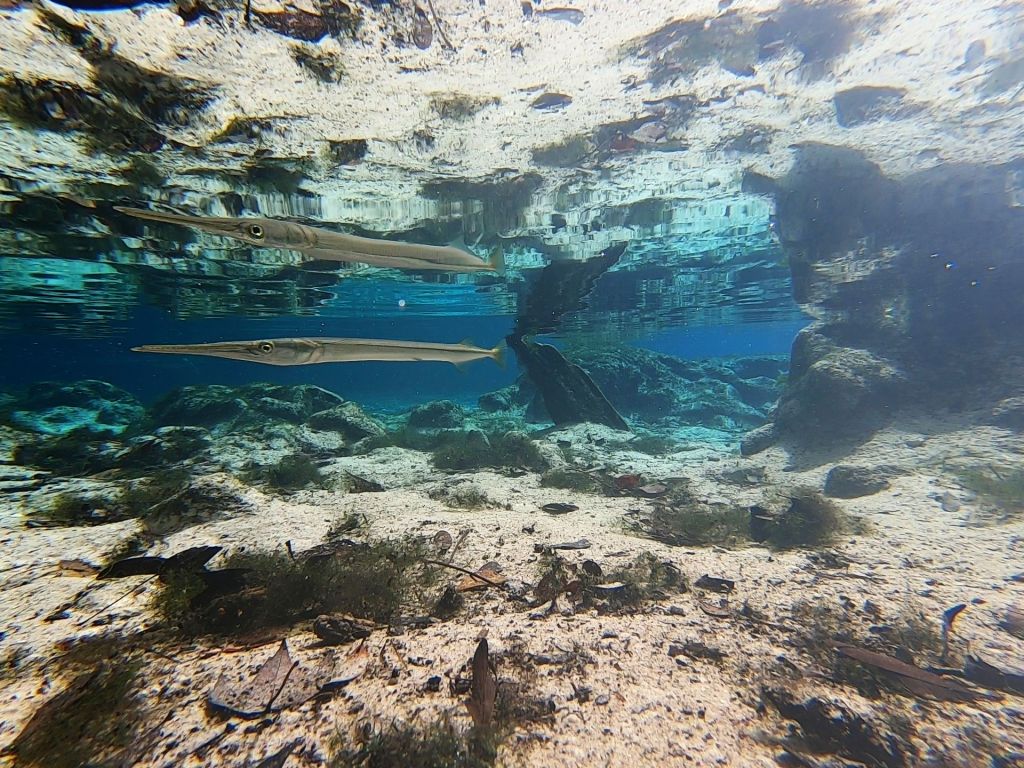
The Seven Sisters caves are home to a variety of freshwater and salt tolerant fish, such as spotted sunfish (Lepomis punctatus), grey snapper (Lutjanus griseus), and Atlantic needlefish (Strongylura marina).

Spotted sunfish (left) and grey snapper (right) with more grey snapper under the overhanging wall of the cave.

A needlefish in front of one of the caves. Needlefish were among the most prevalent fish in the survey of Chassahowitzka springs.

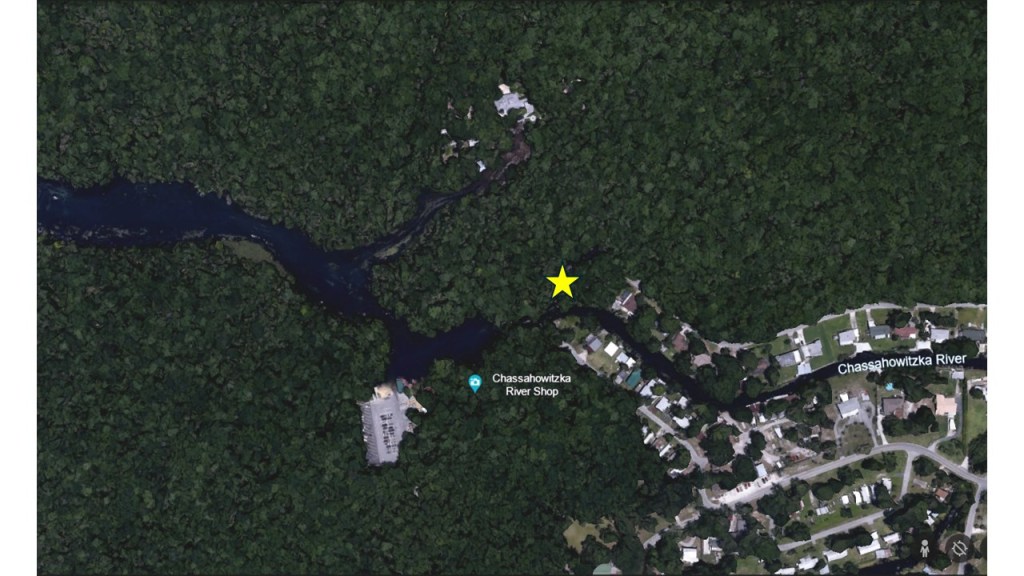
Although the Sisters are the most famous feature of the spring system, the flow actually starts in several spots.

This zoomed in map shows the multiple water sources that produce the Chassahowitzka River. The star shows the location of the Seven Sisters.

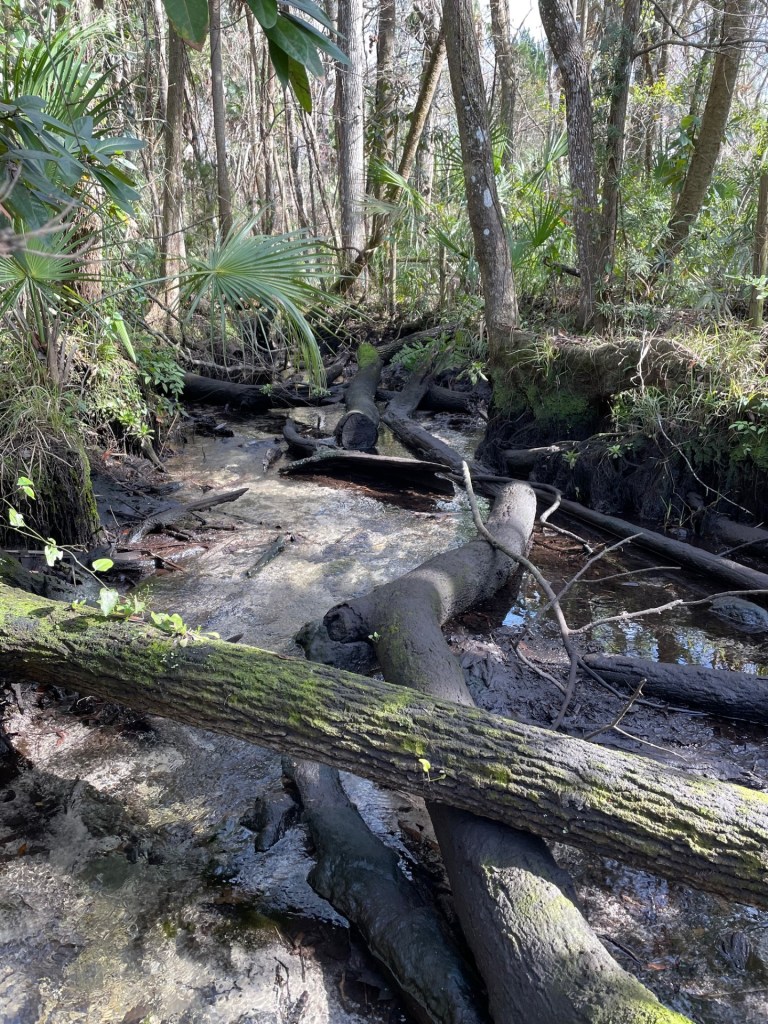
First, a beautiful little creek flows into the Seven Sisters. I tried to paddle up it with a friend a few years ago when the Seven Sisters was covered in brown water, obscuring them. During the rainy season, the water level can rise and the clear water can be covered tannin-stained runoff water. We did not get very far because it is blocked by many fallen trees.

The creek that flows into Seven Sisters, both above (top) and below (bottom) the water level.

A second source source of water to the river is a neighborhood of canals. A third source of water is the big main vent just downstream of the confluence of the Seven Sisters run and the canals. This big vent is just off of the boat ramp.

The view looking upstream from the vicinity of the public boat ramp. The first house in the neighborhood is just visible and the Seven Sisters is around the corner to the left.

The water flowing out of the neighborhood was very turbid, so water clarity was much lower and it was very hard to make out this large vent. However, I could just barely make out Crevalle jacks (Caranx hippos), sheepshead (Archosargus probatocephalus), needlefish, more grey snapper. These fish are all salt tolerant, but I also saw largemouth bass (Micropterus salmoides) and more spotted sunfish. Alas, my photos from the vent are not great due to the turbidity.

Crevalle jacks (top) and sheepshead (bottom) in and around the big main vent at the start of the Chassahowitzka River.

The warm water issuing from these three water sources attracted many manatees, which were all resting in the shallow water across from the boat ramp in the morning.

The last source of water to the start of the Chassahowitzka River is Crab Spring. The spring run was very shallow and the water flowed so fast that after paddling and not gaining ground, I got out and pulled my boat for part of the run.

Crab Spring run.

Unlike the other upstream areas, this run was loaded with plants and when I got to the headspring, the plants were covered in rusty deposits, probably iron. Surprisingly, the large headspring was loaded with fish: sunfish, bass (big ones!), and more needlefish.

Bass in Crab Spring with rusty algae below.

As I floated back downstream, I took a minute to film in a little hole in the plants at the side of the run and was rewarded with some of the few small fish that I observed on the river.

Sailfin mollies (Poecilia latipinna) near the surface and a rainwater killifish (Lucania parva) near the bottom. This shot is not amazing, but it was interesting how scarce the small fish were other than in this little protected area in the algae.

After leaving Crab Spring, I floated downstream towards Baird Creek and “The Crack”. Along the way, I stopped in the “Snapper Hole”, which is a little pool along the Chassahowitzka run. It had even lower water clarity than the main vent, so I decided not to video there. However, as I floated in the middle of the pool, I realized that I was surrounded by manatees. It was a peaceful little interlude to the work.

My last stop on my Chassahowitzka survey was Baird Creek, given my love of sandy creeks with tree canopy, it was a highlight, for sure. It is pretty right off the River, but it gets much more special up near “The Crack”.

The lower run of Baird Creek (top) and the upper portion near “The Crack” (bottom). It started raining a little as I paddled and the spring started steaming.

“The Crack” itself also was a bit murky, but I was happy to see some different fish there: tidewater mojarra (Eucinostomus harengulus) and gulf killifish (Fundulus grandis). I also saw more sunfish, bass, sailfin mollies, and of course, needlefish.

“The Crack” with a rope swing to jump into the vent.

Tidewater mojarra (top) and gulf killifish (bottom)

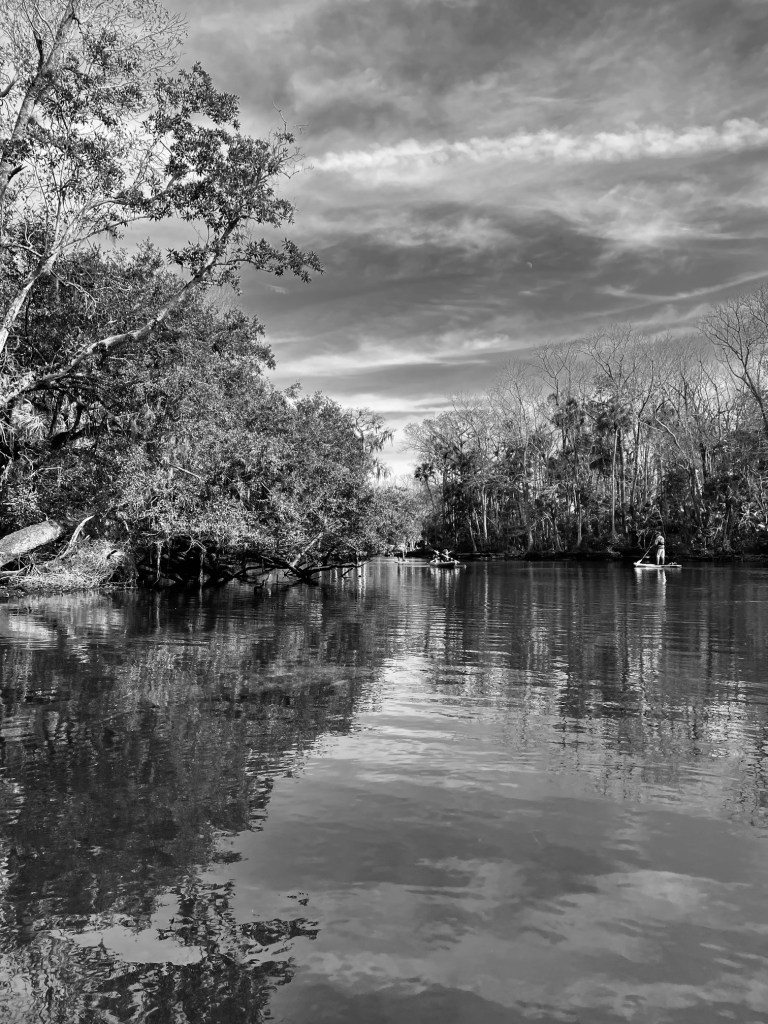
In addition to the manatees and fish, I was also joined on this trip by a variety of other animals. I got a few shots of fun birds on the trip, although the only photo that I actually liked was this little blue heron (Egretta caerulea).

Now I will make a note about the water quality. First, the goal of this study is to learn about how saltwater connections affect spring fish assemblages. I definitely recorded many salt tolerant fish in this spring system, which was fun and gratifying. However, the pattern of conductivity (a measure of the number of ions, including NaCl salt like in the ocean) is not clear to me. The ion concentration in the vicinity of the Seven Sisters and the main vent was very low, typical of freshwater, but the ion concentration at Crab Spring was 1/5 of seawater. The Crab Spring vent was only on the order of 100 m away from Seven Sisters, so I have some research to do about the “plumbing” underneath the Chassahowitzka. The conductivity of Baird Creek was even a little higher than that of Crab Spring.

The patterns of conductivity are interesting to think about and not necessarily related to human intervention. The turbidity coming out of the neighborhood of canals upstream of the main vent is much more likely to be related to those houses and other development to the east of Chassahowitzka. Although the land to the west of the springs is preserved as wildlife management area, outstanding Florida water, etc., the land to the east is thickly developed. The turbidity is likely a combination of inorganic particulates (just look at all the stuff floating past the manatees) and algae. Based on USGS data, the nitrate concentrations are not super high, roughly on the order of 0.5 mg/L, which is above background for many springs, but not nearly as high as I have seen on some other springs. I also looked for changes in discharge and salinity. It appears that over the period of record (1997 to now), discharge has increased slightly, in contrast to many other big springs in the center of the state. The influence of the proximal Gulf likely affects the pressure in the aquifer under Chassahowitzka, keeping the discharge high. The period of record for salinity was super short (2016 to now), but there was a negative relationship between discharge and salinity over this really, really short record. More to come…