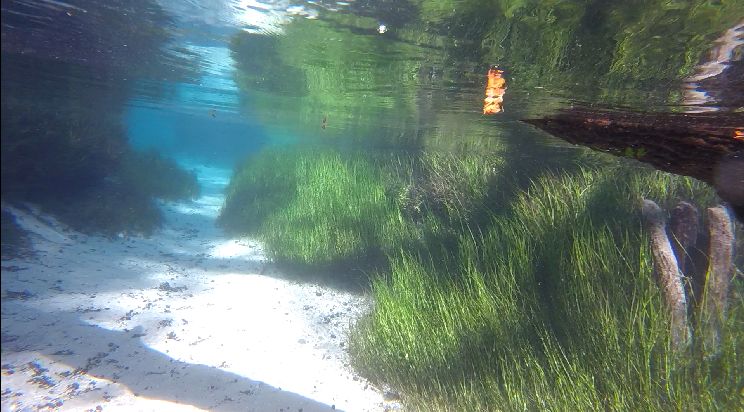
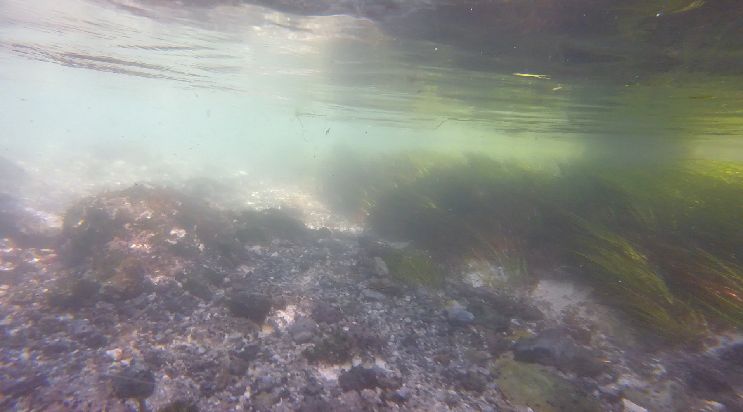
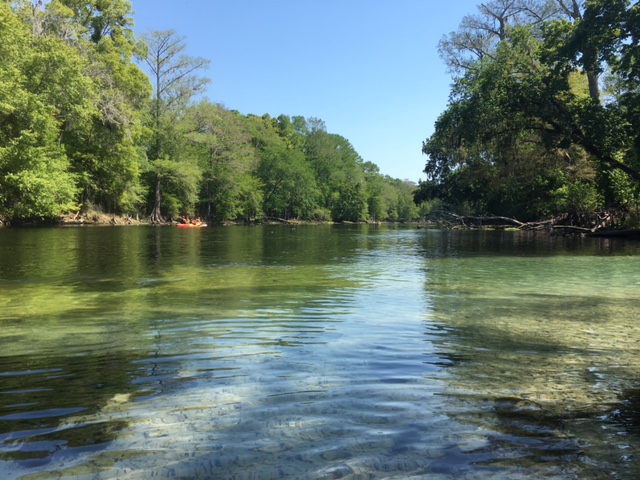
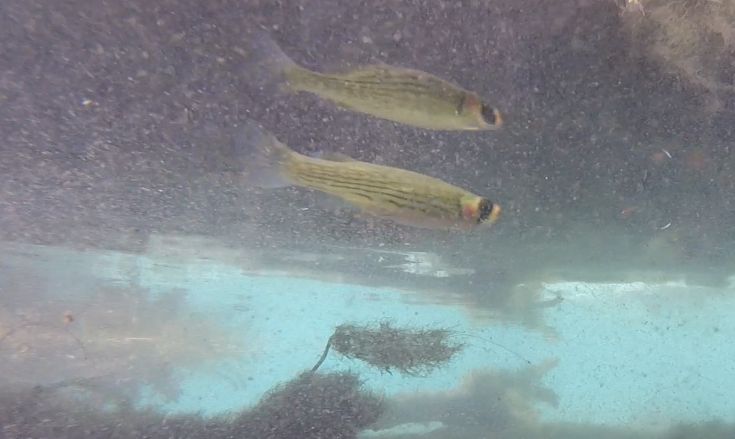
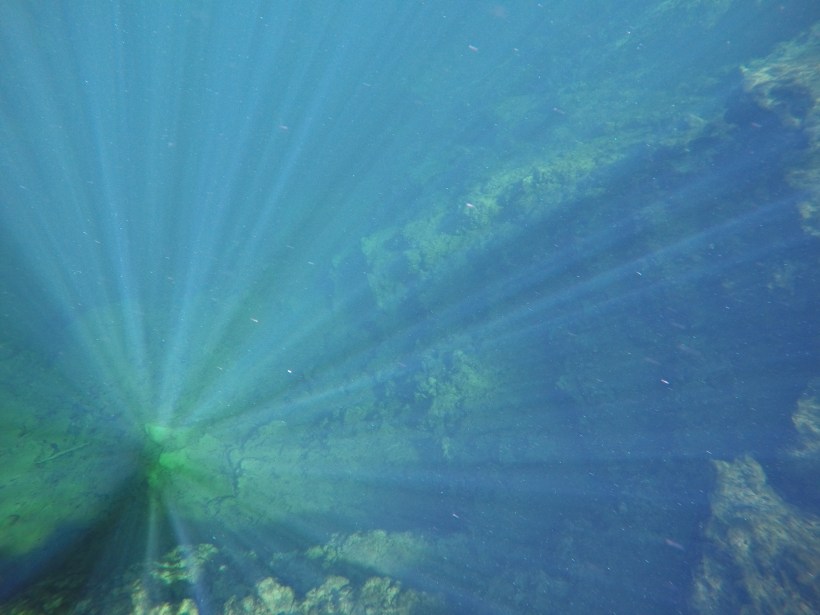
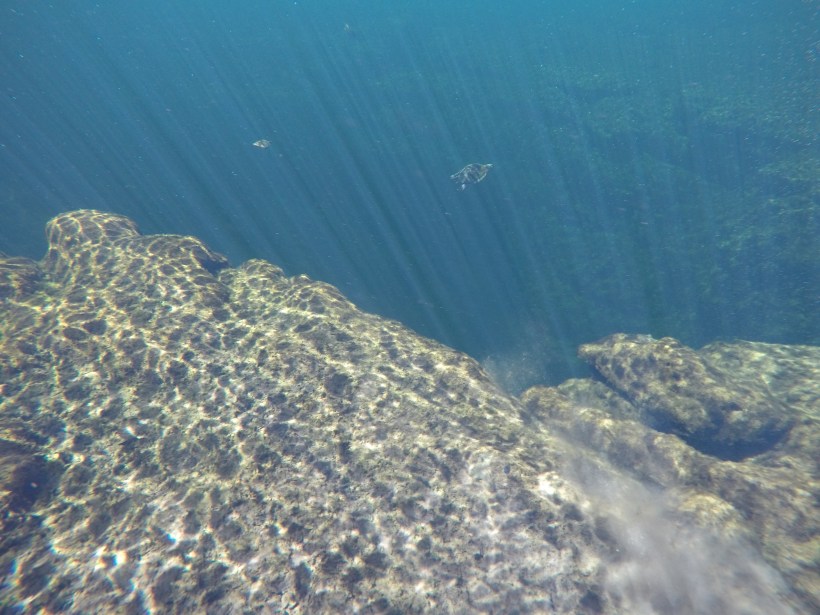
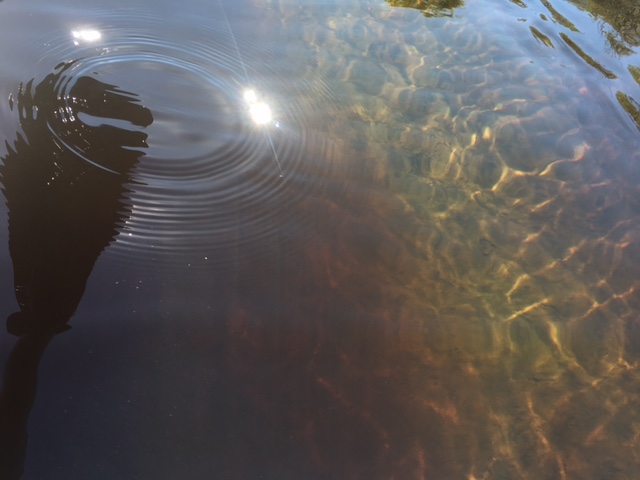
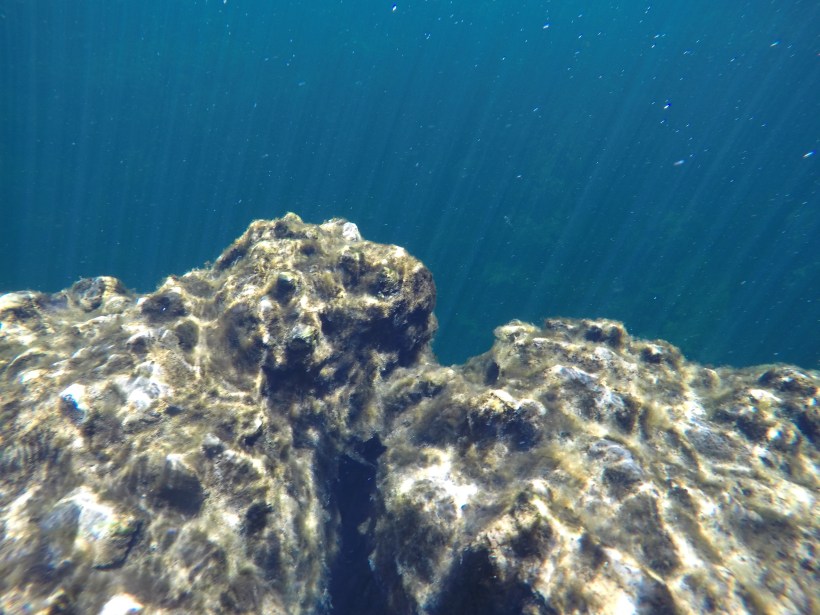
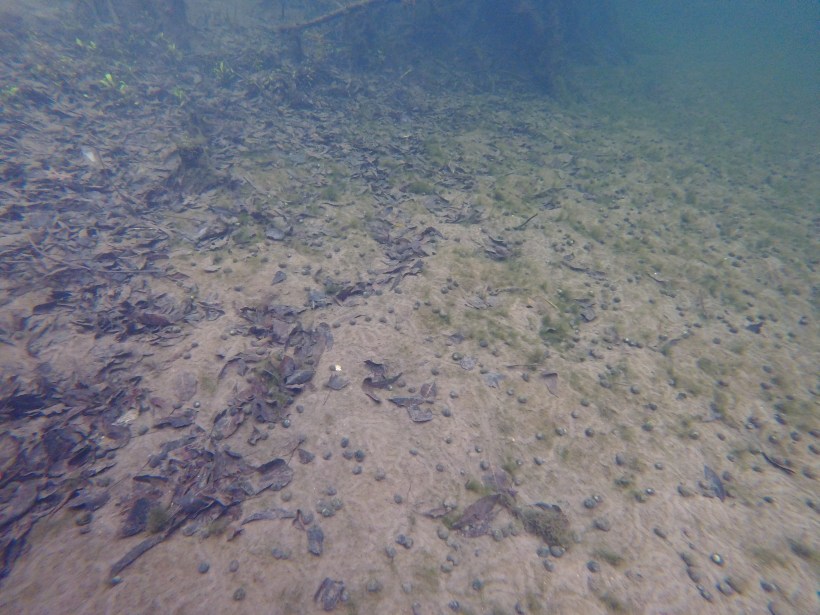
Volusia Blue Spring, Volusia County, March 2017

Volusia Blue Spring is like home.  I have dodged happy, tube-wielding swimmers in summer and overly-friendly manatees in winter.  I have seen the sunlight stealing into the boil over the trees along its edge in the early morning and the long rays of the setting sun streaming up the run from the direction of the river at dusk.  I have seen the spring steaming in winter; winter is actually my favorite time in the spring.  I have watched rain hitting the water from under the surface; rain drops look like diamonds hitting the water.  I have looked up through the iced tea-colored St Johns River water as it slips over the spring water in the fall when the river is full from the fall rains and the river water is warmer than the spring water.  Probably anyone who has worked on Florida springs has had similar experiences. I have seen impossibly small newborn least killifish (Heterandria formosa) and surprisingly large longnose gar (Lepisosteus osseus).  I have seen more blue tilapia (Oreochromis aureus) and exotic catfish (Pterygoplicthys disjunctivus) than I ever wanted to see.  After visiting all of these other springs, I realized how much I value Volusia Blue.
IMG_4217

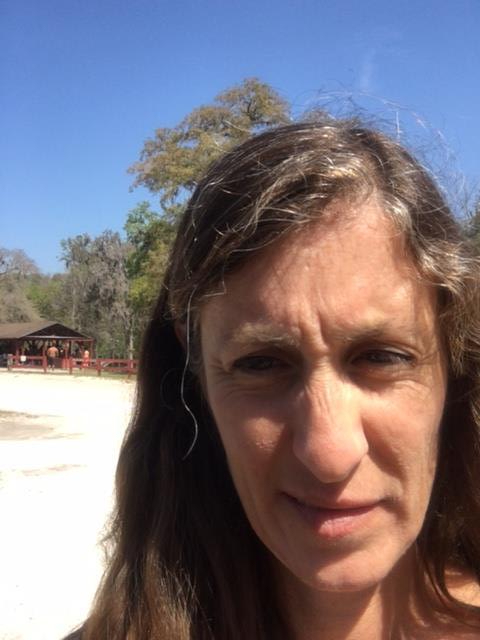
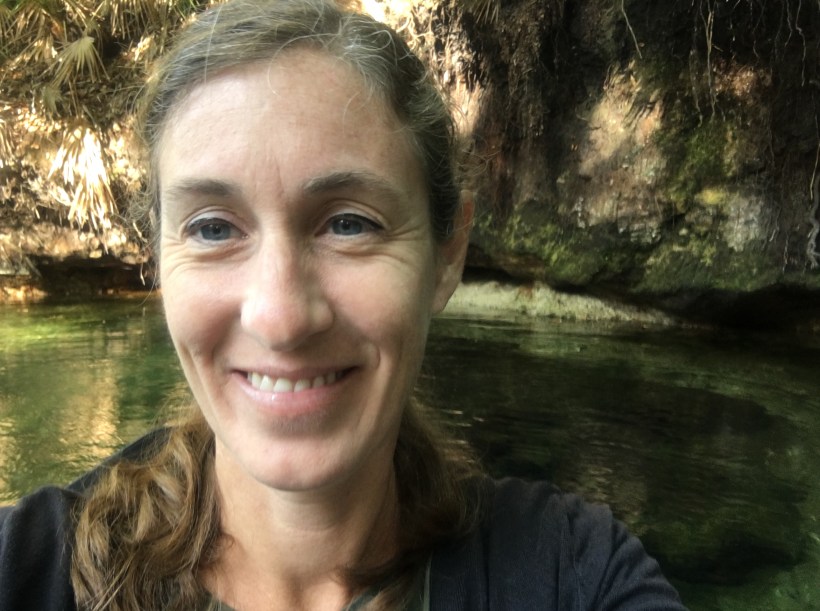
My happy selfie at the boil of Volusia Blue Spring.
IMG_4158

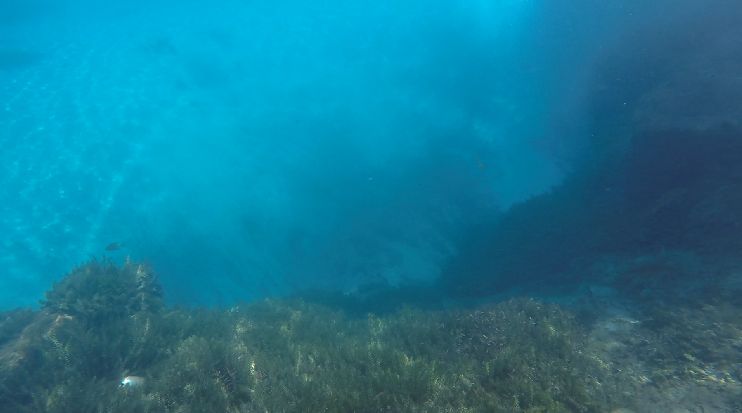
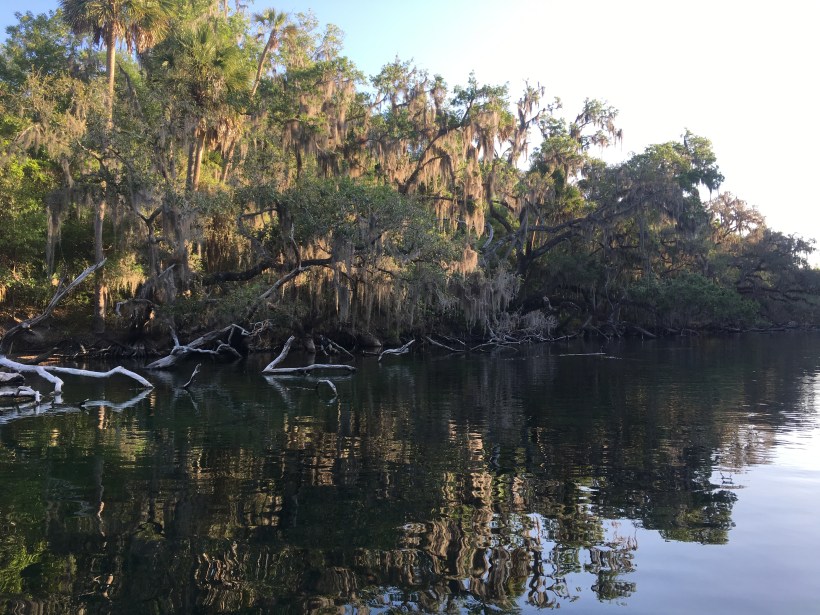
Volusia Blue Spring run, looking up from the St. Johns River early in the morning.
IMG_4211

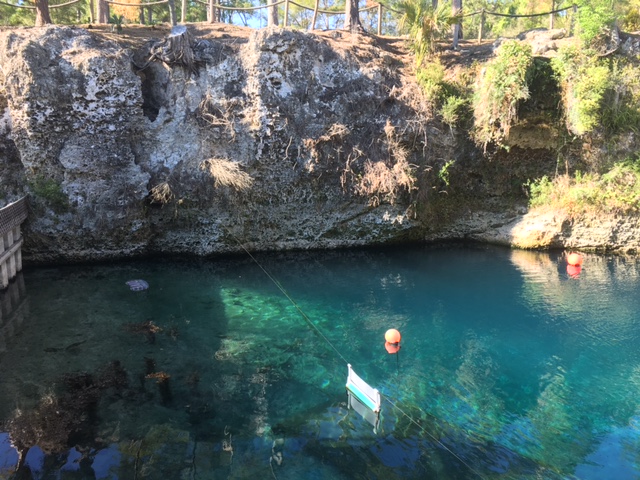
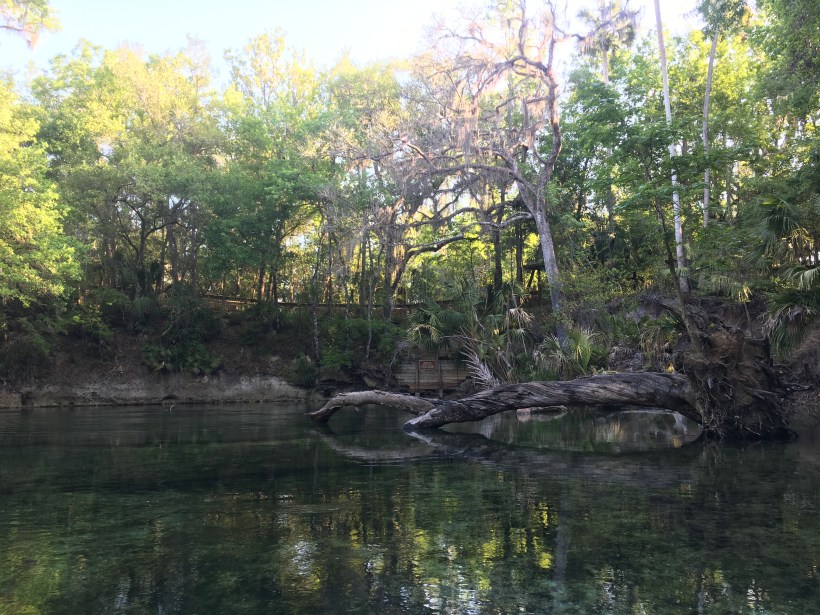
The Volusia Blue Spring headspring with a large tree that fell into the run a few years ago.  The vent itself is just past the tree.

IMG_4208

Another shot of the headspring with a little blue heron (that I probably started) flying over to the bank on the left side of the photo.

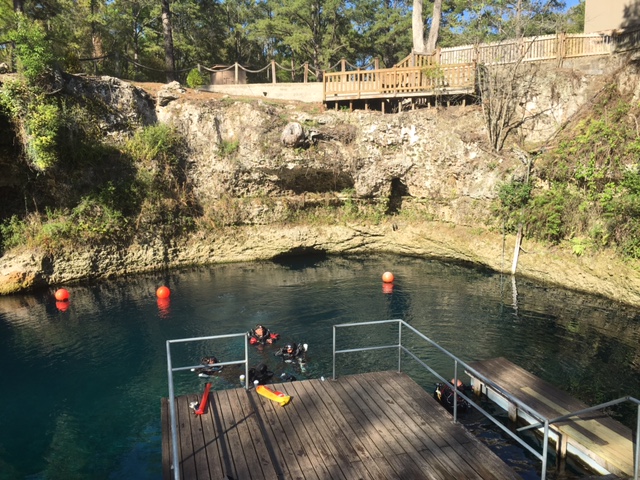
Volusia Blue Spring is the largest spring on the St. Johns River with a historical average discharge of 157 cfs (its discharge is a little below that now).  Like many of the springs of Florida, it supports a lot of tourism, but the only permanent human elements that intrude on the spring are a set of stairs near the headspring and a big metal swim dock a little more than halfway down the run.  It is managed for swimmers and picnickers in the summer, for manatees in the winter, and for divers year round.
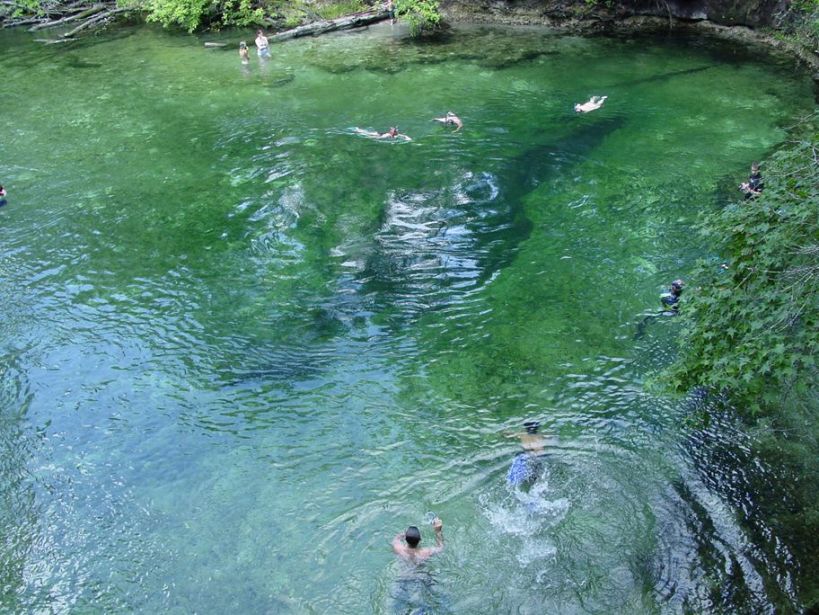
boil

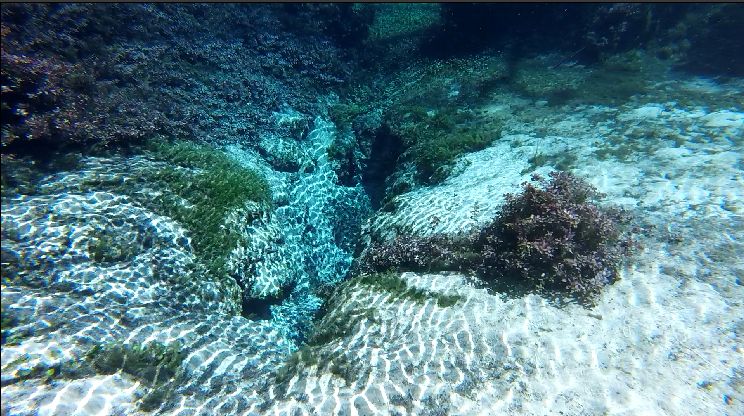
The vent.  I took this photo years ago, but it shows the long, thin vent.  The big springs on the Suwannee, Manatee, Fanning, and Troy, have more circular vents.  In the summer, there are many more swimmers than shown in this photo.
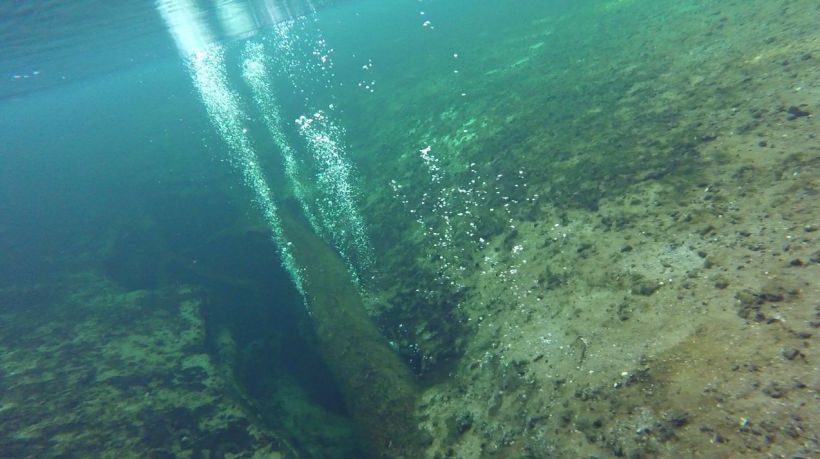
divers' bubbles

Bubbles from divers in the cave streaming around the tree in the vent at Volusia Blue Spring.  As the divers move through the cave, the bubbles will sometimes seem to come from nowhere, from the sand on the side of the headspring, because the cave travels horizontally so divers can be under foot even when you’re not over the vent.  In this photo, the divers were coming up so there were a lot of bubbles coming out of the vent itself.

Video of the vent with divers’ bubbles.  I thought that that they were prettier in motion than in the still.

Like most of the St. Johns River springs (and probably springs all over Florida), municipal and agricultural water use threatens the maintenance of the discharge for the spring.  It seems like the balance of those two uses differ in the St. Johns River and the Suwannee River springs; I think that the St. Johns springs are more threatened by municipal water use and the Suwannee springs are more threatened by agricultural water use, given the landscapes around the springs.  To protect the discharge in the St. Johns River springs, the SJRWMD (St. Johns River Water Management District) has set a minimum flow level for Volusia Blue Spring that matches its historical mean (the other St. Johns springs minimum flows have been proposed for up to 15% reduction of their historic means) to maintain critical habitat for the Florida manatee (Trichechus manatus).  And manatees flock to the spring in ever greater numbers; this past year the short and wide spring run (~30 m x 650 m) hosted 533 manatees with 50 calves (http://www.savethemanatee.org/cam_manatee_reports.html).  Unfortunately, the other springs on St. Johns River do not have the protection of a large, noticeable, popular threatened species.

These juvenile manatees nursing on their mother made it to the “cutest twin animals” page for the Daily Rattle (http://www.dailyrattle.com/cutest-twin-animals-15-images/).  Too bad that they’re not twins!  The one on the right is clearly older; manatees stay with mothers for one to two years, so the one on the right was probably last year’s calf.  It does not appear that that individual has been in the run for very long; the exotic armored catfish (Pterygoplichthys disjunctivus) usually clean them off by grazing on their backs pretty quickly and that one clearly has algae on its back.

Although the discharge target for the minimum flow was set for its historic mean, the spring is not there yet; the last year for which I had a complete data set (Sept 2014 – Sept 2015), the discharge was ~142 cfs.  According to the MFL (minimum flow and level) program, the target was not supposed to be achieved until 2024.  Hopefully, we will get there.  The nutrient concentrations of Volusia Blue Spring also differ from the Suwannee River springs, which tend to be extraordinarily high for nitrate, but moderate for phosphate.  Volusia Blue, on the other hand, has moderate (although increasing) nitrate concentrations (~0.8 mg/L) and slightly high phosphate concentrations (~0.075 mg/L) than the Suwannee springs, according to SJRWMD (http://www.sjrwmd.com/springs/blue-volusia.html).  The difference may be due to the landuse around Volusia Blue, which tends to be municipal rather than agricultural.
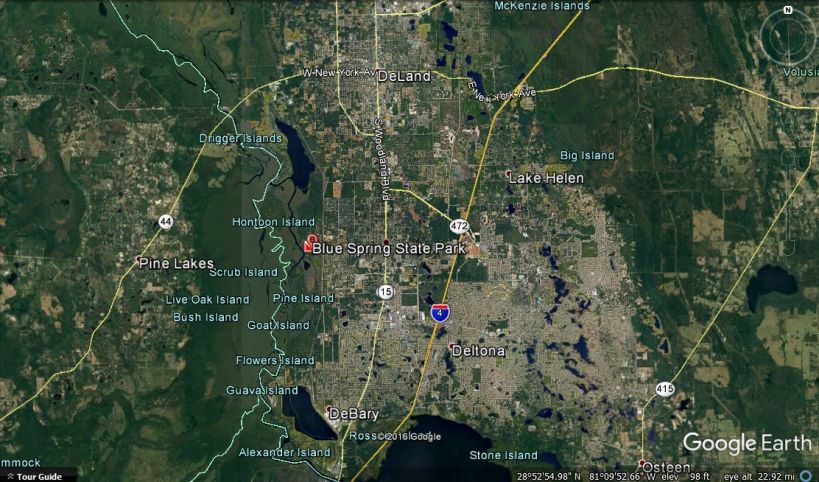
blue spring aerial

Google Earth image of the landscape around Volusia Blue Spring.  Although there are large green spaces along the St. Johns River to the west and in the lower lying areas to the east, the springshed is comprised of the lower half of DeLand, Orange City, and most of Deltona rather than these green spaces.  The springshed sits on the “DeLand Ridge”, which is high ground and great for building, hence the location of our towns.

Algae can grow pretty thick in Volusia Blue at times, but I have now seen many springs on the Suwannee that support much larger algal populations–even in winter.  Last winter, I tried to get some algae for a student project in Volusia Blue and I was unable to find much of anything.  No doubt the 500+ manatees affected the algal population size, if only by sitting on it, but still.  The exotic armored catfish (P. disjunctivus) and blue tilapia (O. aureus), both of which can be much more abundant than manatees, also likely reduce algal population sizes, as do people. In the spring, I can always tell when they open the swimming area after manatee season because there is a strip of sand down the middle of the run from people’s feet dislodging the blanket of algae where they walk most often.
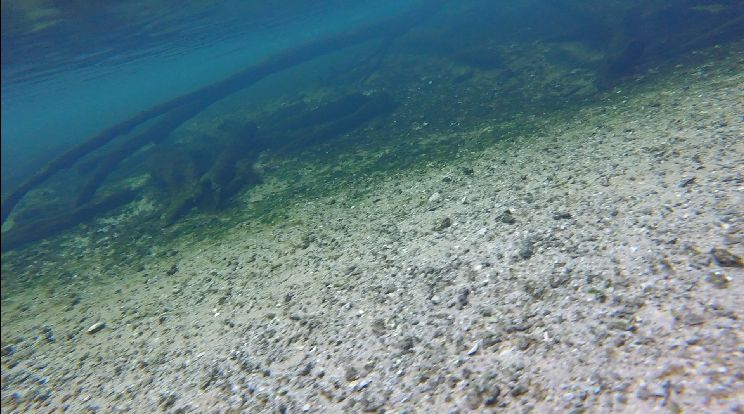
The stripe

The edge of the stripe that forms as people walk on the bottom of the spring.  It forms each year after the park opens the spring to swimmers.

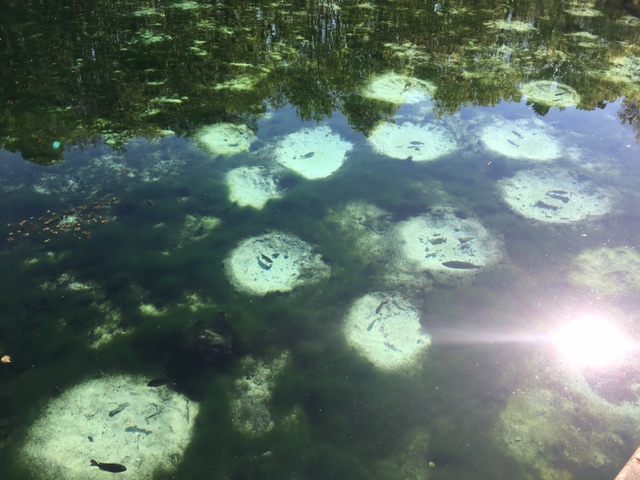
I always thought that it was funny when I heard people say that there weren’t any fish in Blue Spring (you overhear all kinds of things while sampling) because there are millions of fish if you look.  There are gradients in fish abundances along the length of the run, from the headspring to the St. Johns river, following the oxygen gradient.  At the headspring, the oxygen is incredibly low; the dissolved oxygen in the water coming out of the vent is 0.1 mg/L, which is essentially nothing.  As a result, most of the fish at the headspring are the small mosquitofish (Gambusia holbrooki) and sailfin mollies (Poecilia latipinna) that can breathe at the air-water interface where the water is more oxygenated.  During our surveys, we often observed some scattered sunfish (Lepomis sp.) in some bushes on the bank of the headspring where some algae accumulates, but not really anywhere else.  However, in the videos I discovered fish that were in more open areas, but working really hard to breathe.

Video of sunfish breathing at the headspring.  When they were not breathing at the surface, it appeared that they were working really hard, holding their opercula (the flaps over their gills) out farther than normal and moving them faster.  I’m not sure when I’ve seen fish work so hard to breathe.  Mosquitofish and sailfin mollies are breathing at the surface in the background.

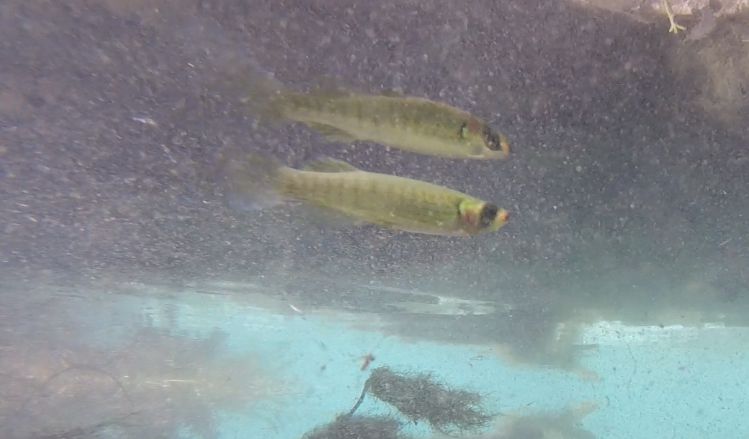
A little further down the run near the diver entry, the oxygen concentration is typically a bit higher (it was 1.15-1.32 mg/L when I visited in the morning) and the small fish diversity typically increases to include more killifish (Lucania spp., Fundulus spp.), shiners (Notropis spp., Notemigonus crysoleucas), and sunfish (Lepomis spp.).  Occasional largemouth bass (Micropterus salmoides) pass through.  However, I discovered a large number of juvenile sunfish breathing at the surface.  Up until then, I did not even realize that that was a sunfish behavior.

sunfish surface breathing

Sunfish (bluegills, Lepomis macrochirus, and redear, Lepomis microlophus) downstream of the headspring of Volusia Blue Spring.  These sunfish appeared to be interested in the camera, but those in the background are breathing at the surface.
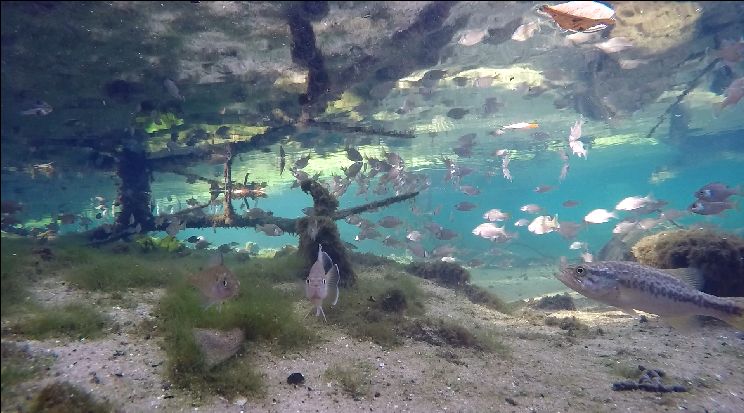
largemouth at site 2

The same location with a largemouth bass cruising through an aggregation of sunfish and seminole killifish (Fundulis seminolis– not apparent in this still, but in the footage right before the bass comes in).

Further still down the run in the refuge, the sunfish get larger and longnose gar become abundant.  The gar can be so large that they can be almost as long as Missy Gibbs is tall (she’s not short), which is how I evaluate how big they are while snorkeling with her.  Mullet (Mugil cephalus) and blue tilapia cruise up and down the run.  In the winter, small tarpon (Megalops atlanticus) invade the run.  Whereas the gar literally just hang there while we swim past, the tarpon are very skittish and freak out when we approach (and then sometime follow us, which is a little creepy).  Alas, there were no tarpon on the day that I visited the spring with cameras.

Video of gar and armored catfish in the refuge below the swimming area.  The armored catfish usually stick close to the bottom, but this one appeared to be following the gar.  The spring is much deeper in the refuge, so the footage appears blue.

The most dramatic event of the trip, after I had downloaded the footage, was the discovery of a cichlid that was not reputed to be in the St. Johns River drainage basin.  Given that I found this black acara (Cichlasoma bimaculatum) in 14 minutes of footage, there are likely to be many others.
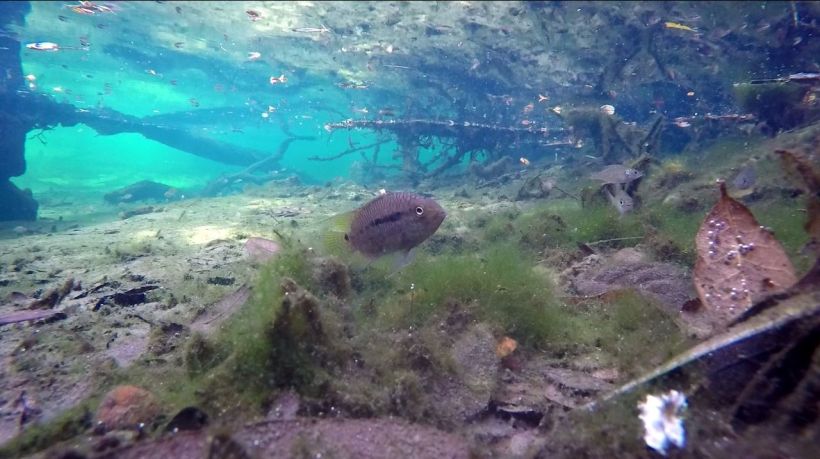
black acara

A black acara near the small spring that enters the run about 1/3 of the distance from the headspring to the St. Johns River.
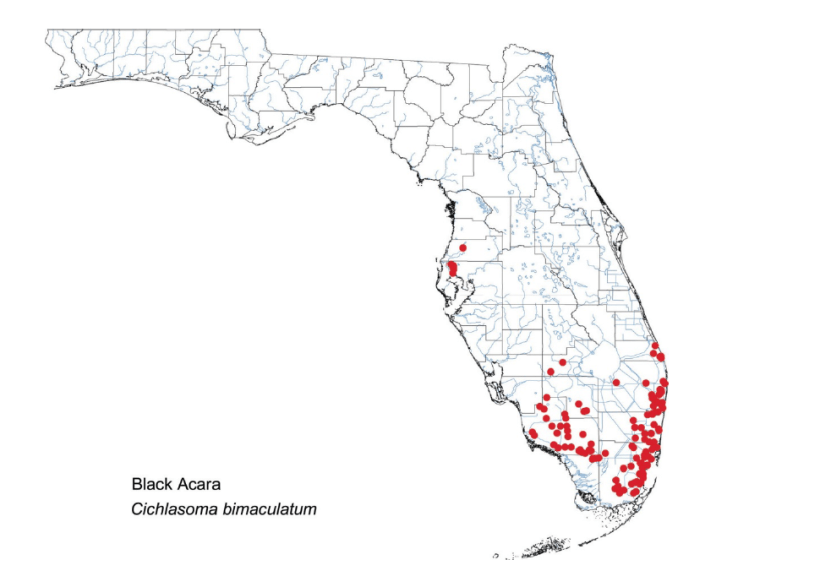
acara map

The distribution of the black acara in March 2017 (it goes farther north now, alas).

In addition to potential reductions in discharge, increases in nutrient concentrations, and invasions of exotic species, Volusia Blue Spring has an erosion problem.  This problem, at least at the headspring, is largely human-made.
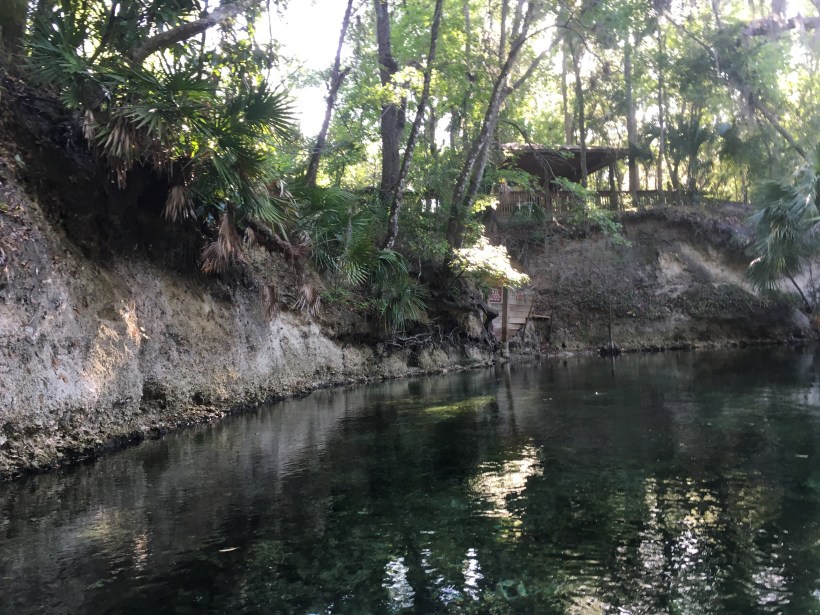
IMG_4226

This bank was not nearly as steep when Missy Gibbs and I started working here in 2000.  The park had to move the overlook in the background further back in the early 2000s because the previous one was going to fall into the spring.  Kids climb the bank and jump off.  Enough said.
IMG_4238

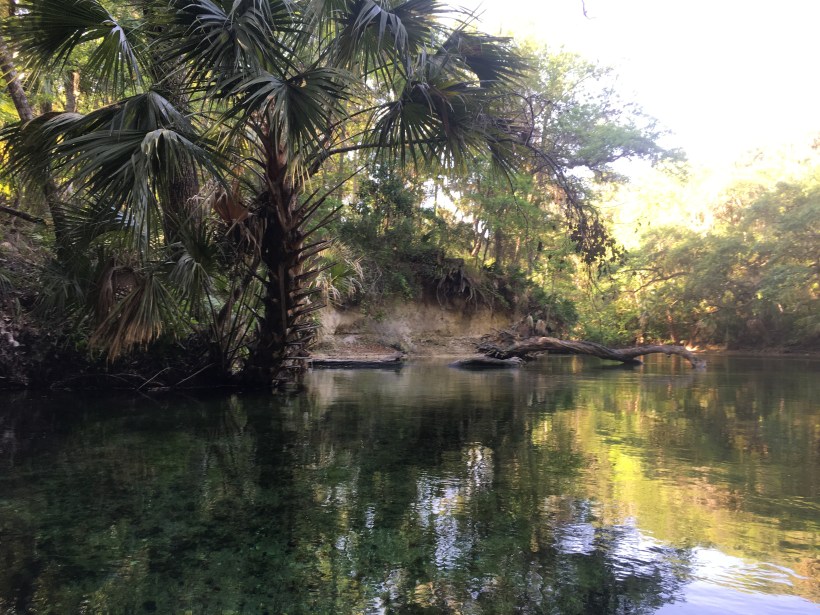
That palm tree was not that far out into the headspring years ago (if I remember correctly, it was on the bank!).  The tree that protrudes across headspring in the background fell in due to erosion.  Kids like to sit on it now.  The eroded bank is visible behind the tree.  That bank, like the bank under the overlook, has been falling in for years.  Sigh.
Hornsby Spring, Alachua County, March 2017

Hornsby Spring (near High Springs on the Santa Fe) was one of the most unusual springs that I visited, although I am afraid that I might have missed the best part (more on that later).  The spring was not originally on my list of springs to visit, but the Director of Camp Kalaqua, which surrounds the spring, graciously allowed me access to the spring on short notice.

boil

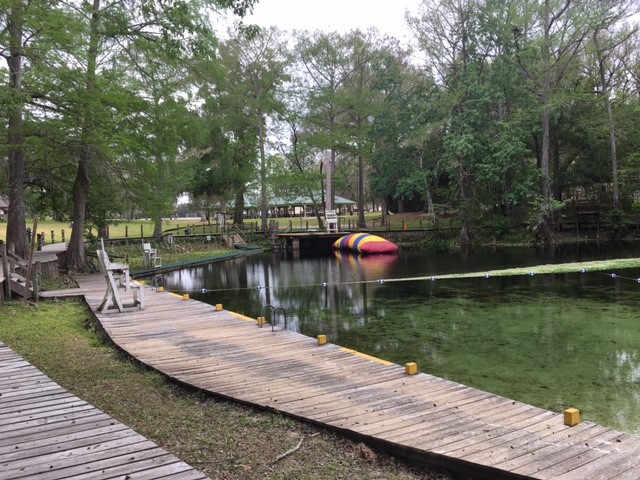
The headspring of Hornsby Spring.  The large jumping pillow is on the right side of the vent.

I decided to visit it after one of my colleagues told me that I should see it because of its unusual history.  Even now, I do not know the full story of the spring, but Craig Pittman, the springs’ advocate and outspoken Tampa Bay Times reporter, mentioned Hornsby Spring at the outset of his 2012 article on vanishing springs (http://www.tampabay.com/news/environment/water/floridas-vanishing-springs/1262988).  According to the article, people flocked to the spring in the 1950s to dive down into its 80 foot-deep boil.  However, in the 2000s the flow declined until it stopped flowing, the water level dropped until the boil was only 50 feet deep, and the camp built a water park to give the campers an alternative swimming spot.  As I drove through the well-kept and extensive camp, I was expecting no flow, no fish, no snails.  Once I got there, however, there was flow, albeit low.  I downloaded SRWMD data on historical flow for Hornsby to get a better picture of its flow history:

hornsby discharge

The discharge history of Hornsby Spring.  The discharge has been highly variable even as far back as the 1970s, but the spring stopped flowing for extended periods in 2001, 2002, and 2012.

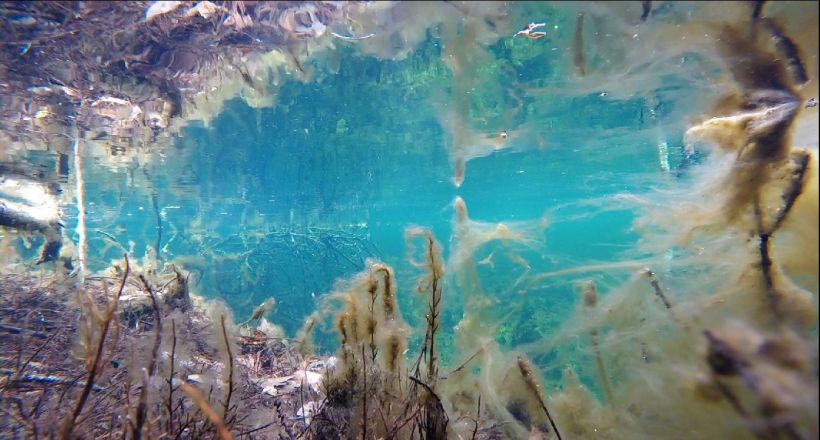
The entire vent area of the spring was blanketed with algae, much of it dead and decaying so that it came apart in my hands.  I did not notice a boil, which would be obvious at a discharge of 250 cfs for that size of a vent (250 cfs is higher than any of the springs that I visited with the exception of Rainbow Springs).  Although the nitrate concentration was only 0.51 mg/L the last time that it was measured by SRWMD (http://www.mysuwanneeriver.org/portal/springs.htm) in January 2017, which fairly low, the phosphate concentration was 0.07 mg/L, which is a pretty high.  The high phosphate may be the culprit in the algal accumulation.


The Hornsby headspring.  It was overcast that day and the combination of no direct sunlight and algal coverage made the vent inscrutable from above.  It is a bit clearer on the underwater footage.  This spring also looked like a good candidate for a sea monster coming out of the depths.

dead algae

Dead algae on the edge of the headspring. When I tried to pick some up, it came apart in my hand.

algal mat just down from headspring

An algal mat just below the headspring.  This algae also looked dead, but I did not try to pick it up.

However, once I left the headspring, the run was shallow and the water velocity was appreciable.  When a volume of water is forced through a smaller cross-sectional area (like moving from a deep headspring to a shallow run), the velocity of the water increases.  And, although there was a lot of algae downstream as well, a significant proportion (much more than I expected) of the spring run substrate was covered with native plants waving in the flow instead of algae.  Oddly, this spring is one of the only springs at which I have seen this plant (possibly Potamogeton) and it was all over the place.


Plants in the Hornsby Spring run.

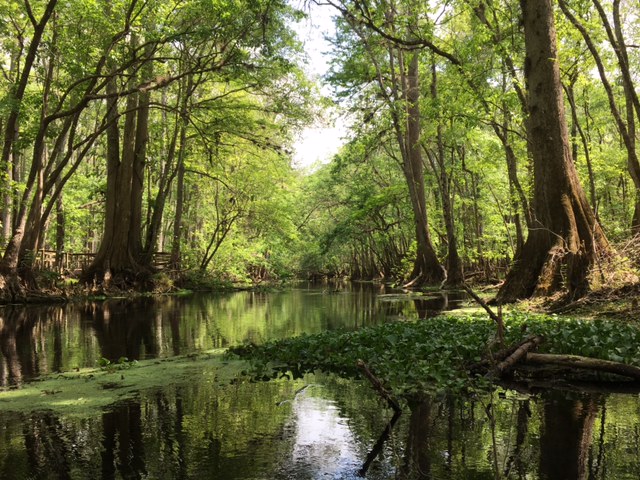
Perhaps my introduction would suggest that I did not enjoy my trip to Hornsby and, in truth, I did not really expect to enjoy it.  However, the spring run has a stark beauty.  I tend to gravitate to narrow runs with a lot of tree cover and Hornsby Spring has both of those characteristics.  The spring is lined with cypress trees and it is lovely.

hornsby17

The Hornsby run.  I was not expecting the beauty of this run.

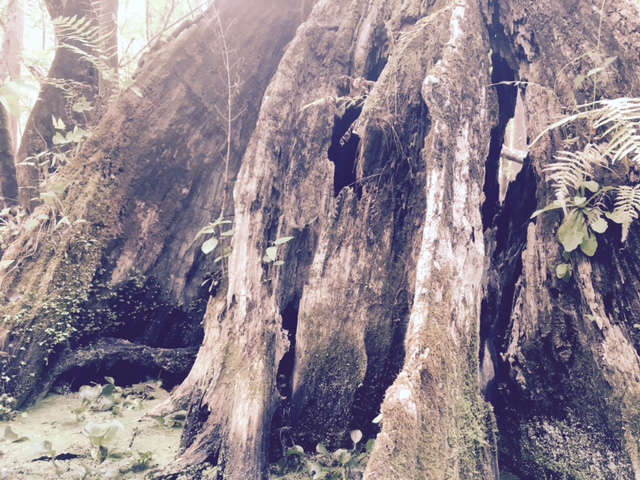
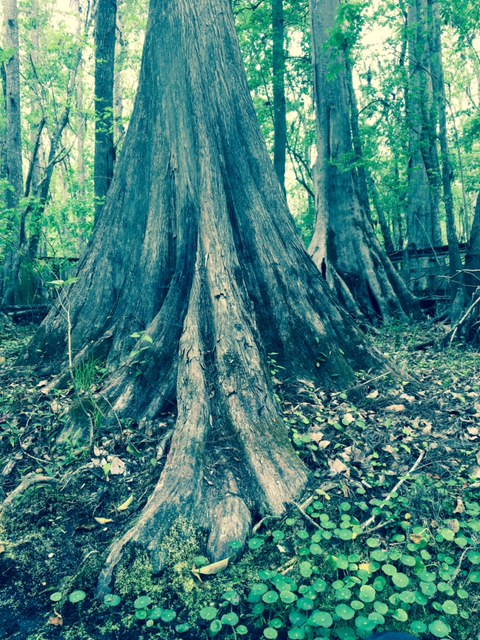
Ah, but why did I call it stark beauty?  The photo above just looks beautiful.  However, a closer look at the trees reveals that the bases of the cypress trees were somewhat disfigured and many were leaning awkwardly.  There also were a surprising number of downed trees, not as evident in this particular photo.

hornsby2

The knobby base of a cypress tree with its leaning partners.  Many trees along the banks were leaning or had fallen over (more than other, similar springs?).

hornsby30

A close up of the irregular surface of the base of a cypress tree.

hornsby32

The roots of this tree were rotted and I could see through it.

I floated downstream in this somewhat ghostly-feeling run (due to all the leaning and downed trees) until I reached this fallen tree house.  Strangely, I was thinking of childrens’ stories as I floated.  The knobby and rotted cypress trees made me think of a forest of elves from the Lord of the Rings.  This fallen tree house made me think of Robinson Crusoe or some weird Peter Pan.

hornsby7

A fallen tree house about half or 1/3 of the way down the run.

Alas, just on the other side of this tree house, which was on a little island that divided the flow in the run, there was a float line (the type used to designate swimming areas).  Exotic water hyacinth had built up along this line and I could not get my kayak through it, try as I might.  I considered portaging around the blockage because a) I wanted to get to the Santa Fe and b) I am just that compulsive, but when I climbed out and walked around the blockage on land, it was peppered with cypress knees and I decided that it would be a miserable portage.  Oddly, most of the cypress knees that I stepped on by accident bent under my feet, further contributing to my feeling that I was in a ghost forest.  Instead, I thought that I could go out to the Santa Fe and paddle upstream to the blockage so that, in that way, I could see the whole run.

When I turned around to do my tripod filming, I discovered that, indeed, there were fish.  There were a lot of largemouth bass (Micropterus salmoides) and sunfish (Lepomis sp.) around debris from the tree house at the blockage.  On the other bank, there were loads of mosquitofish (Gambusia holbrooki), sailfin mollies (Poecilia reticulata), and bluefin killifish (Lucania goodei).


Bass and sunfish around debris from the collapsed tree house.


Small fish on the bank opposite the collapsed tree house.  The float line clogged with water hyacinth obstructed the surface flow producing eddies in the trapped water.

And, while waiting for my camera, I also discovered that there were loads of tiny snails in the run.

DCIM100GOPROGOPR0620.

Hydrobiid snails dotting the algae in Hornsby Spring run.

In the end, I captured 14 species of fish on video, which is comparable to many other springs that have a healthier history, and 29 individuals per video segment.  This number also is comparable to many of the other spring runs that I have visited.  I was really surprised (pleasantly).

Once I finished my filming, at least as far as I was able to go with the obstruction, I went back to the camp office and spoke with the very helpful security guard.  In the course of a conversation about whether there was a boat ramp that would let me access the spring from the river without a day-long paddle, he told me that Hornsby Spring has a whirlpool just downstream of where I was stopped by the water hyacinth.  The prospect of a whirlpool really cemented my desire to see the rest of the run, so I drove down the road and put in on the Santa Fe River.  I paddled upstream for an hour, both into the current and into the wind, but alas, the most that I found were two impassable beds.  I suspected that one of the two non-flowing outflows was Hornsby Spring.  Perhaps all of the discharge went down the whirlpool…  Sigh.  At least it only took my half an hour to get back.
impassable spring

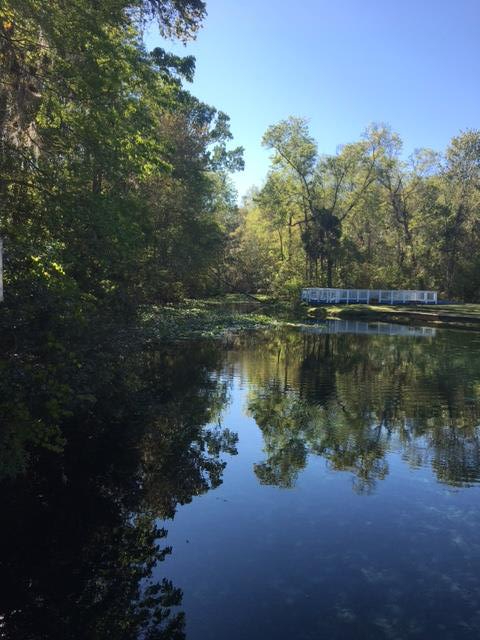
Perhaps the outflow location of Hornsby Spring on the Santa Fe River.  I so wanted to find that whirlpool…


Poe Spring, Alachua County, March 2017

Poe Spring is in a fairly large Alachua County park (looks great for gatherings) and the boat ramp is just downstream from the spring on the Santa Fe River.  The Santa Fe River is home to loads of tiny springs, some along its banks, but many in the river itself.  As I paddled up to Poe Spring, I came across this little one pumping out water so fast that it looked like it was boiling.  Awesome!

Once I reached Poe Spring, I discovered that its discharge was so low that I would have to portage to get into it.  SRWMD discharge measurements have ranged from about 35 cfs to about 55 cfs over the last couple of years.  It reached its highest measured discharge of 93 cfs in 1973, but it also has virtually stopped flowing at times; in 2012, the discharge was 0.25 cfs in the spring (in the dry season).  The last measurement for January was 48 cfs (http://www.mysuwanneeriver.org/portal/springs.htm), which is clearly a lot higher than 0.

Poe run

The Poe Spring run.  The water was low and I had to drag the kayak upstream, but not very far.

poe boil2

The Poe Spring boil.  I suspect that the large steps allow a lot of people into the spring in the summer, but it was very peaceful on a morning in March.

I read on a website that Poe Spring nitrate concentrations were currently about 0.11 mg/L after having been an order of magnitude higher in the late 1990s.  I must admit that I assumed the nitrate concentration in that report was a typo and further evidence of the problem of relying on the internet for data.  However, I found internet-published SRMWD data for nitrate from 1997 to the present and, in fact, the most recent data point from January 2017  was 0.202 mg/L (http://www.mysuwanneeriver.org/portal/springs.htm).  I am fairly astonished.  I will have to learn more about this spring.  The phosphate, on the other hand, was on the high end (0.08 mg/L) the last time it was measured in 2013, perhaps explaining the abundant algae in the spring.  I have definitely seen thicker algae, but its presence was felt.

Poe algae

The substrate was a patchwork of algae and sand.

The spring vent was blanketed with algae.  Apparently, algae does not deter turtles as I saw several.

The passage into the spring would be difficult for a fish as well as a kayak, I think, and I saw few fish in this spring.  In fact, this spring supported the fewest species and the fewest individuals of any spring that I have sampled so far.  However, I thought that the fast flow was pretty.  Even the bright green algae is pretty flowing in the fast current.

Flow in the shallow run of Poe Spring.

Poe algae2

Algal growth at the boil, both on the bottom, streaming up to the surface, and blanketing the surface near the bank (on the right side of the photo).  The fish in this photo, mosquitofish (Gambusia holbrooki) and bluefin killifish (Lucania goodei) are both super tolerant species and they occur pretty much everywhere.


Gilchrist Blue Spring, Gilchrist County, March 2017

Also called High Springs Blue Springs, Gilchrist Blue is one of my new favorite springs.  My visit, unfortunately, was timed badly as I did not think to check the Alachua County Schools schedule.  The school children were on spring break, so when I arrived at the spring, there was already a high school-age party going on.  I suspect that my data is not amazing because there were a lot of feet on the substrate while I was trying to sample.  Even so, it was a lovely trip.

me before getting in

This is my “oh no, what do I do now?!?!?” face.  The outermost folks at the party under the pavilion are visible in the background.  The music was pumping.  There was dancing.

The spring begins at a large and lovely vent, then travels through eelgrass beds to the Santa Fe River.  The spring is shallow with great vegetation and nice tree cover.  A boardwalk accompanies the run along its length down to the Santa Fe River.

blue spring boil

The Gilchrist Blue Spring vent.  Water clarity was a bit low due to all the feet around it.

boil

People watching jumpers into the Gilchrist Blue Spring vent.  Earlier there was a lot of throwing going on.  People were definitely having a good time.

blue run

The Gilchrist Blue Spring run at a rare moment when I was alone.

macrophytes

Vegetation in the Gilchrist Blue Spring run.  A lot of feet go down this run; the open sand may be partly a function of feet dislodging plants.

suspended material in run

The Gilchrist Blue Spring run further down.  The run gets rockier downstream, but there are still large beds of plants.  I included this photo to show how water quality declines with foot traffic.  There was someone walking just upstream of where I took this photo.

Gilchrist blue plume

And finally, the plume of Gilchrist Blue Spring as it enters into the Santa Fe River.

Slightly less than halfway down its short run, the main spring run is joined by another spring run with two vents.

One of the boils on the second, smaller spring run.   The other boil is depicted in the photo in the heading of this entry.

Although the water quality of the spring does not look great in these photos due to the suspended material, the algal load looked relatively low and the spring looked fairly healthy.  I could not find current data, but the Springs of Florida (Scott et al. 2004) reported that the nitrate load was 1.7 mg/L, which is fairly high (about 2x Volusia Blue), but the phosphate was 0.034 mg/L, which is fairly low.  Current data indicate that nitrate concentrations have increased to more like 2.2 mg/L (http://www.mysuwanneeriver.org/portal/springs.htm), but that phosphate has remained low.  In 1998, the discharge was about 80 cfs, which places it high in the second magnitude category, and the most recent measurements from summer 2014 indicate that it still discharges about 80 cfs (http://www.mysuwanneeriver.org/portal/springs.htm).  Like the other springs in the Suwannee and Santa Fe watersheds, Gilchrist Blue is surrounded by agriculture (and dairy) and a narrow band of green.

blue spring aerial

Probably not surprisingly due to the heavy foot traffic, the total number of fish that I observed in Gilchrist Blue Spring was pretty low.  At this point in this project, I have only observed fewer fish at Poe Spring, for which the discharge was so low that I had to portage into it.  However, I did get to add a new fish to my list of spring fish: lined topminnow (Fundulus lineolatus).  These fish are actually quite dramatic in person with red snouts and “ears” and black eye smudges like raccoons.  Given that I had never observed them in a spring before, it was interesting that they were in 80% of my videos for Gilchrist Blue. I wonder what else I might have seen if I had been there on a less popular day.

female lined topminnow

Female lined topminnow.  The image is a little blurry because I took it off the video.

male lined topminnow

This male lined topminnow was chasing the female in the photo above, but he was a little slow, so they do not occur in the same frame.  There is a difference in the color pattern between females and males; the females have longitudinal stripes, whereas the males have vertical stripes.

Blue Grotto, Marion County, March 2017

Blue Grotto is more of a cavern than a spring and it is a divers’ haven, so I did not sample it, but I wanted to see it anyway.  The cavern itself is stunning, even with the large business around it, which is an impressive operation with accommodations, dive sheds, a pool, a basketball court, etc.  I was happy that the staff generously let me just show up and take photos.  The limestone hole that makes the cave clearly has been modified somewhat, but it was not clear to me exactly how much.  In addition to the staircase leading down to the water, there was what appeared to be a retaining wall holding back soil on the bank.

blue grotto3

The Blue Grotto cavern.  The retaining wall is in the upper left of the photo.

old grotto

The Blue Grotto website posted this photo from 1962 (http://www.divebluegrotto.com/).  The water level looks much, much higher, but it may be that the photo was taken from the perspective of looking back toward where the retaining wall is now.  I have not yet found any data on its water level.

Levy Blue Spring, Levy County, March 2017

This spring also was not on my sampling list, primarily because it was not on the Suwannee, Santa Fe, or the St. Johns and I restricted my visits to those watersheds for the most part.  I stopped by this one on my way home from Troy Spring so that eventually I can say that I have seen all the Blue Springs in Florida (there are a lot).  This spring is in a county park and there were only a couple of other visitors there that day, late on a Thursday afternoon, although the park manager mentioned that kids had been swimming in the morning.

Levy Blue Spring

The headspring of Levy Blue Spring.

Levy Blue run

The run of Levy Blue Spring.  The run looked lovely, although I am not sure if it was passable.

The spring was very green and yet impressively full of fish, sunfish (Lepomis sp.), largemouth bass (Micropterus salmoides), lake chubsuckers (Erimyzon sucetta), Florida gar (Lepisosteus platyrhincus), and probably many small fish as well.  Sunfish and bass were nesting over much of the sand on the north side of headspring and the redbreast sunfish (Lepomis auritus), in particular, were defending their nests aggressively.

Sunfish defending their nests.

Levy Blue bass on nest

A close up view of a female largemouth bass (M. salmoides) in courtship with a male.

I may have to revisit this spring with my gear because it is in the heart of a preserved area, presuming that I can get a kayak down the run, and fish seem to like it.  It flows into the Waccasassa River.

levy blue aerial

Little River Spring, Suwannee County, March 2017

What a beautiful vent!  I did not sample this spring because I only heard about it after I had made all my requests for sampling permission.  Furthermore, the day that I was there, children were playing up and down the run and there were divers in the vent.  I decided that any fish that had been present in the morning were long gone by the time that I got there that day.  However, I am glad that I went because it is so pretty.  I was told that it is insanely busy in the summer.

little-river-spring-vent.jpg

The vent of Little River Spring.  I just managed to sneak in a photo when the divers and swimmers were out of the photo.

Little River Spring run

The run of Little River Spring.  The run is short and, like Troy, appears to have little vegetation.  I think that the rock piles are not natural.

little-river-spring-plume.jpg

The plume of Little River Spring into the Suwannee River (the edge of the spring water, where it meets the tannic river water, is visible in the center of the photo).  For the large springs, the plume extends way out into the river, but for the small springs, like Little River, the plume can sneak down along the edge.

Troy Spring, Lafayette County, March 2017

I think that at the end of it all, Troy Spring might be one of the most memorable springs that I will have visited.  The spring did not have particularly high discharge, nor did it have many fish, but it had a truly massive vent and tons of turtles.  It was very cold (for Florida) the morning that I showed up to sample Troy, so it was just me, the giant hole, and the turtles.  As I paddled around the giant hole and startled turtles from their resting places on the edge, it looked like they were swimming off into space.

DCIM100GOPROGOPR0574.

Turtles swimming off into the giant hole that is the vent of Troy Spring.  If there ever was a spring with a giant sea monster in it, it would probably be Troy.

I think that part of the reason that the giant vent was so startling was that the run was shallow and exceedingly short.  I really did not do it justice in the photos that I took that day because I was just so mesmerized by how big the vent was.  Paddling around the edge of vent, it appeared that it went down forever (it is 70 feet deep).

spring boil and run

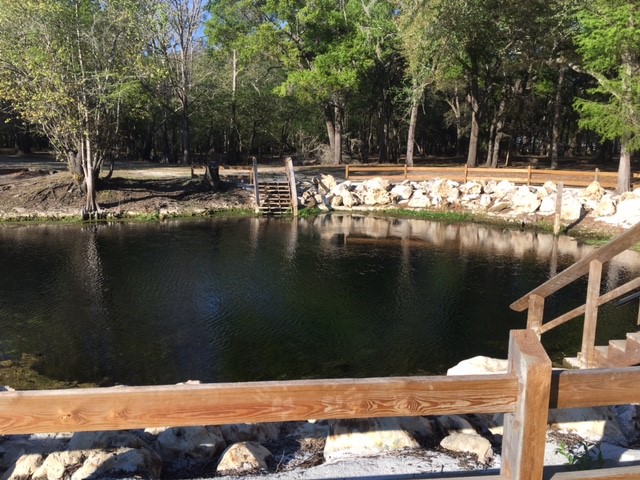
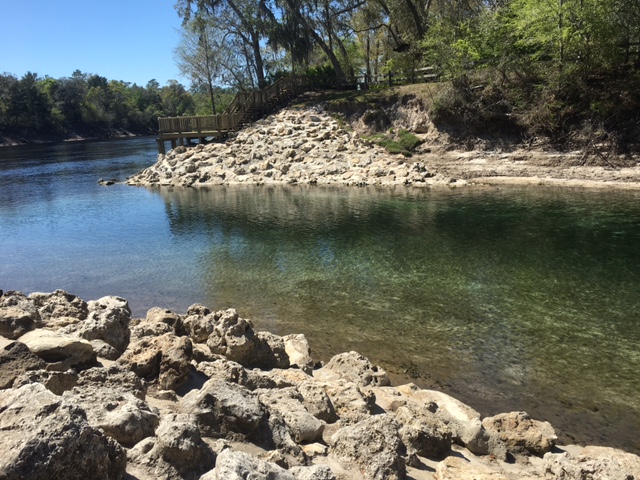
The edge of the vent (I am almost on land the spot where I took the photo) looking down toward the Suwannee River.  The float line represents the border between the run and the river.

I had expected that its discharge would be really high because the vent seemed so massive, but in actuality, the discharge may have been a little over 100 cfs.  The Springs of Florida (Scott et al. 2004) reported a high discharge of 202 cfs in 1973, but a low of 106 cfs in 2001.  SRWMD data from 2014 ranged from about 100 to about 170 cfs.  Thinking back, I suppose that this discharge should not be surprising because the plume from the spring did not penetrate into the river very far.  With most Florida springs, the plumes are quite easy to see because a) the river water is so stained with tannic acid and b) the river water and the spring water do not mix easily.  There is typically a density difference between the spring water and the river water, either due to a temperature difference, a difference in dissolved salts, or more often both.

edge of plume

The edge of the Troy Spring plume, with tannic Suwannee River water on the left side of the photo and clear spring water on the right side.

Troy Spring definitely had algae growing on its rocks and sand, but not in the abundance that I might have expected given its nutrient concentrations.  USGS reports that in the week of 17-24 April 2017, Troy Spring nitrate concentration ranged from 2.05 to 2.40 mg/L (https://waterdata.usgs.gov/fl/nwis/uv?site_no=02320250).  These concentrations are about 2-4 times the concentrations of Volusia Blue Spring and well into the eutrophic zone for freshwater.  Springs of Florida (Scott et al. 2004) and SRWMD (http://www.mysuwanneeriver.org/portal/springs.htm) reported similar concentrations of nitrate, but only 0.02-0.03 mg/L of phosphate, which is low.  Unlike the nitrate concentration, the phosphate concentration would put the spring in the oligotrophic range (the lowest nutrient category).  As I have mentioned in previous posts, the ratio of nitrate to phosphate is as important as the absolute values of the nutrients and phosphate can be a limiting nutrient, keeping algal growth low.

DCIM100GOPROGOPR0536.

Algae growing on the rocks at the edge of the vent.

Troy Spring sits in a corridor of green along the Suwannee River, nestled between agricultural and silvacultural (tree farming) land, so high nutrient concentrations are not surprising.   However, a large area of preserved land sits to the west of the river; it would be interesting to know the direction of flow of the water in the aquifer in vicinity of Troy Spring.  I suspect that the flow is not coming from far enough west to originate in the preserve area.

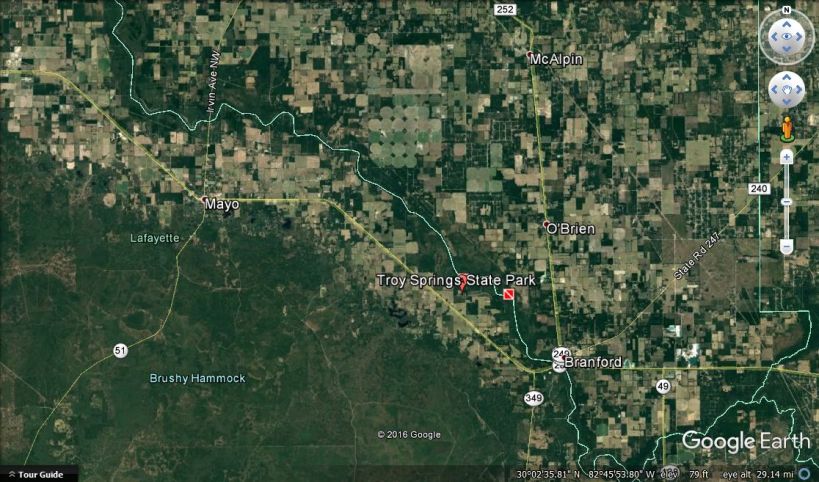
troy aerial

Other than the giant hole, the substrate diversity of Troy Spring was one of the lowest that I have found so far (although it was somewhat similar to the springs in Ginnie Springs park).  I usually try to put the cameras in areas with some vegetation or other structure and I had a hard time finding good spots in Troy as most of the bottom, even up to the bank, was just sand or clay.

troy substrate

One of the few areas in the run that had some structure.

Undoubtedly because of the low structural complexity of the run, I recorded very few fish along the banks of the run or in the middle of the run.  In the end, I only recorded two species, on average, for each video that I took.  However, there were a bunch of fish right on the edge of the plume.  I was really hoping for (although not expecting) a sturgeon, but it was mostly mullet (Mugil cephalus) and spotted suckers (Minytrema melanops), alas.

Suckers, mullet, and a gar that I scared back into the Suwannee River as I paddled past (they came right back because I scared them in again a little while later).

Perhaps the morphology of the spring is part of the low diversity and density of fish in the spring; it was kind of like a shallow bathtub with a giant drain at one end.  With such a short run, small fish would be very exposed to predators–but this is just a hypothesis.

As I floated in the run, waiting for my cameras, two guys who were camping their way up the Suwannee River paddled up to view the spring.  They were jealous that I was on the other side of the float line; I was jealous of their river adventure.  The Suwannee is big and bold near Troy Spring.  Perhaps because it was March before all the trees had leafed out, the river at that point almost didn’t look like Florida to me, with its exposed sand banks and slightly bare trees.  At a glance, I almost felt like I was back in Oklahoma or somewhere similarly arid.

Suwannee at Troy

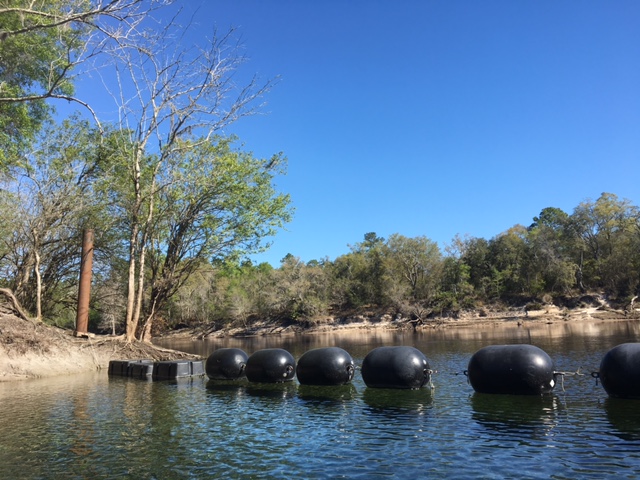
The float line demarcating the border between Troy Spring and the Suwannee River (looking toward the Suwannee).

Otter Springs, Gilchrist County, March 2017

Like Hart Springs, Otter Springs is upstream from Fanning and Manatee Springs (it’s actually between Hart and Fanning) on the Suwannee River.  It has a narrow, shallow, sandy run that is really quite lovely with a canopy of trees meeting overhead for most of its length.

tree hallway3

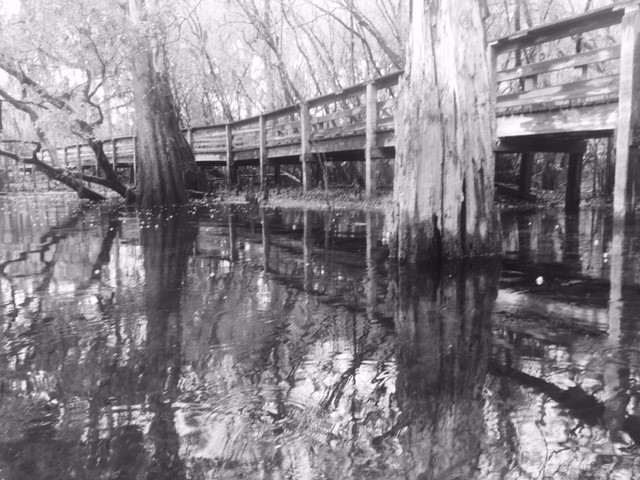
The tree hallway of Otter Springs run.

There are two areas that look like they might contain spring vents, but if so, only one was flowing.

boil

The Otter Spring boil with a lot of algae.

Near the headspring, there also were some areas that looked like seeps.

seep

A small seep right near the boil; the campground is in the background.

Although both Hart and Otter Springs are narrow and sandy, Otter Springs has a much lower discharge (10 cfs); it is actually the lowest discharge of any spring that I have visited to date.  It was exceptionally shallow and supported a lot of algae, so my camera kept getting fouled or knocked sideways.  In terms of water chemistry, Otter Springs is quite similar to Hart (1.1 mg/L of nitrate and 0.07 mg/L of phosphate); both springs have fairly high nutrient concentrations, although not as high as Fanning or Manatee.

Due to the abundant algae, Otter Spring wasn’t super photogenic below water.  It’s beauty was above water.

start-of-run.jpg

The run just downstream from the headspring.

tree hallway2

tree hallway4

tree hallway to the river

river

Views of Otter Spring run.  The last two photos show the confluence of the run with the Suwannee River.

Otter Spring also was good for birds; I saw at least ten species of birds, including many, many egrets (Ardea alba) and ibises (Eudocimus albus).  The egrets and ibises provided great contrast to the brown and green of the vegetation.

egret2

An egret fishing in the shallow water of Otter Spring.

limpkin

A limpkin (Aramus guarauna) with a snail in its mouth.

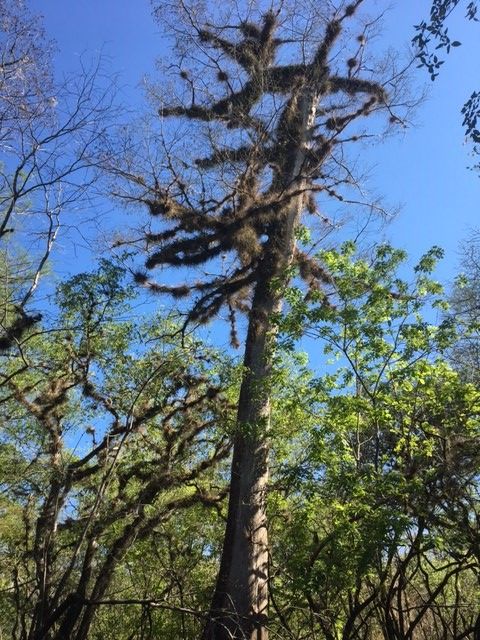
I thought that this tree looked interesting; it had so many epiphytes that it looked fuzzy.

fuzzy tree

Tree with epiphytes.

Otter Spring had a lot of small fish (shiners, mosquitofish, etc.), but relatively few sunfish and even fewer large fish.  It really was quite shallow.  I did, however, see a golden topminnow (Fundulus chrysotus), which is one of my favorite of Florida’s small fish.


Golden topminnows.  They don’t look like much in the light of this video, but when the light hits them right, there are gold flecks that flash down their sides.  And when they’re breeding, the flecks turn red, as does the tail.  I guess that you have to be able to appreciate the small things in life to appreciate them.


More golden topminnows.  Photos by Missy Gibbs and http://www.plantedtank.net/forums/21-fish/1124282-cool-water-stream-fish.html.

I also got some nice footage of golden shiners (Notemigonus crysoleucas).  I guess that it was gold day.


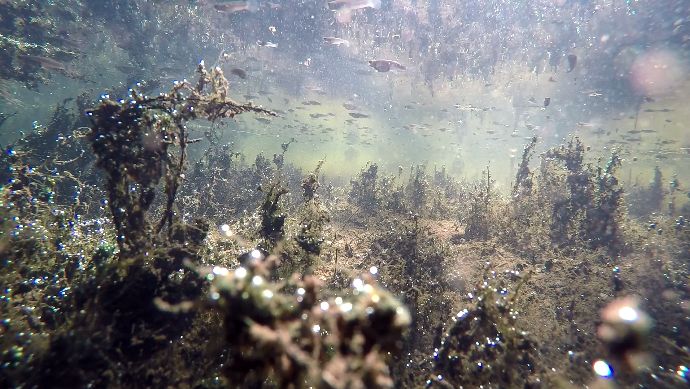
Golden shiners in a landscape of algae.

Otter Spring also boasted the biggest pregnant mosquitofish (Gambusia holbrooki) that I’ve seen in a long time.

fat mosquitofish

A million mosquitofish swimming through the field of view; the fish in the top center is a very pregnant female.  The bubbles all over the algae represent supersaturation; the algae is photosynthesizing faster than the water can absorb the oxygen.  This situation happens when algae is really abundant (often under conditions of high nutrients).


Hart Springs, Gilchrist County, March 2017

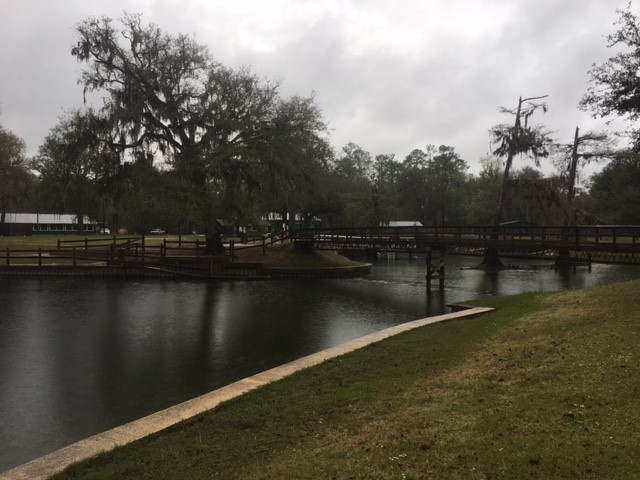
Hart Springs is very different from both Fanning and Manatee Springs, even though it’s just upstream from both.  Although its discharge is comparable to that of Fanning, it has several noticeable differences.  First, Hart Springs is a county park rather than a state park.  It appears that many private/county parks have less tree cover around the boil and that they are more likely to have cement reinforcement along the edge than most state parks.

park

Second, apparently Hart Springs is one of those unique Suwannee springs that reverses flow so that brown Suwannee water occasionally comes out of the vent.  I was told when I arrived that the water had just cleared up.  I also read that the discharge of Hart Springs had been restored by divers who removed some debris that had fallen into the main vent (http://hartsprings.com/2016/01/26/gainesville-sun-article-about-diving-at-hart-springs/).  I’m not sure if the higher stage (as evidenced by the water over the “island”) was a function of the increase in discharge or just seasonal variability.  Apparently, the spring is often much clearer than the day that I visited.

island

Third, it does not appear to have the massive vents that the other two springs have.  Instead, it has at least three vents, and perhaps a fourth that was not flowing (there was a side arm that looked like it might have a spring in it).  However, given the murky water, it may be that the middle vent really is as big as Fanning or Manatee, but I just couldn’t see it well enough.
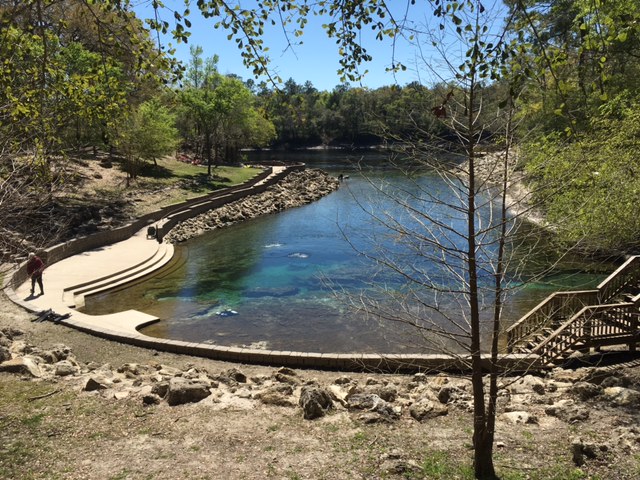
This video really stinks because the water clarity was so low, but this vent appeared to be the biggest of the three.  I also managed to knock the camera off kilter and get the leash in view.  It was rainy and cold–oh well!
This video also stinks because I couldn’t see what I was videoing, so view isn’t great, but this is the smaller vent next to the large one.  It was the vent nearest to the entrance to the park.

I only found this vent because the surface of the water was disturbed.  Again, the view isn’t great because I couldn’t see!

I liked the run; it was longer and more intimate than either Manatee or Fanning.

run

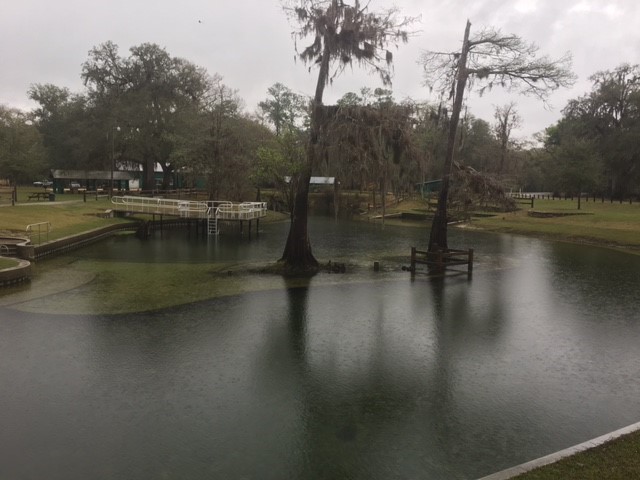
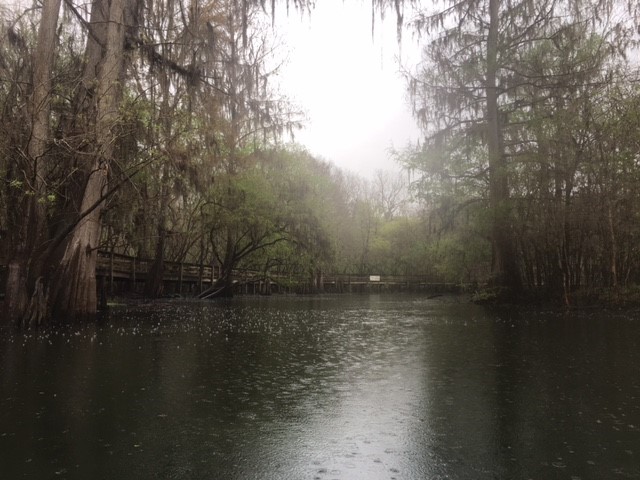
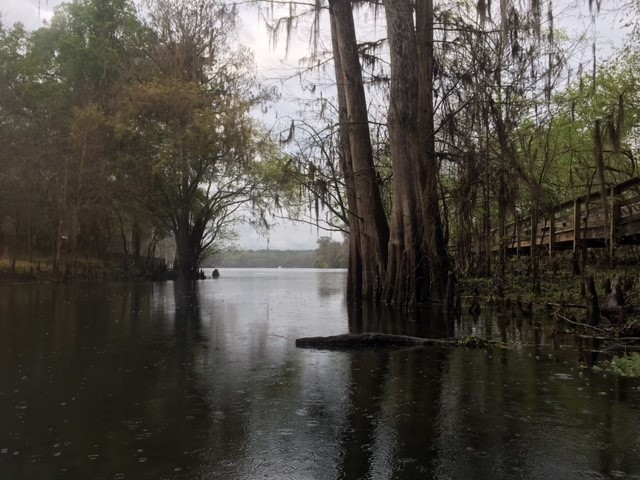
The Hart Spring run in the rain.

Hart Spring had a much smaller entrance into the river than Manatee or Fanning, even though it had similar discharge to Fanning (75 cfs, according to Scott et al. 2004, “Springs of Florida”).

springs mouth color

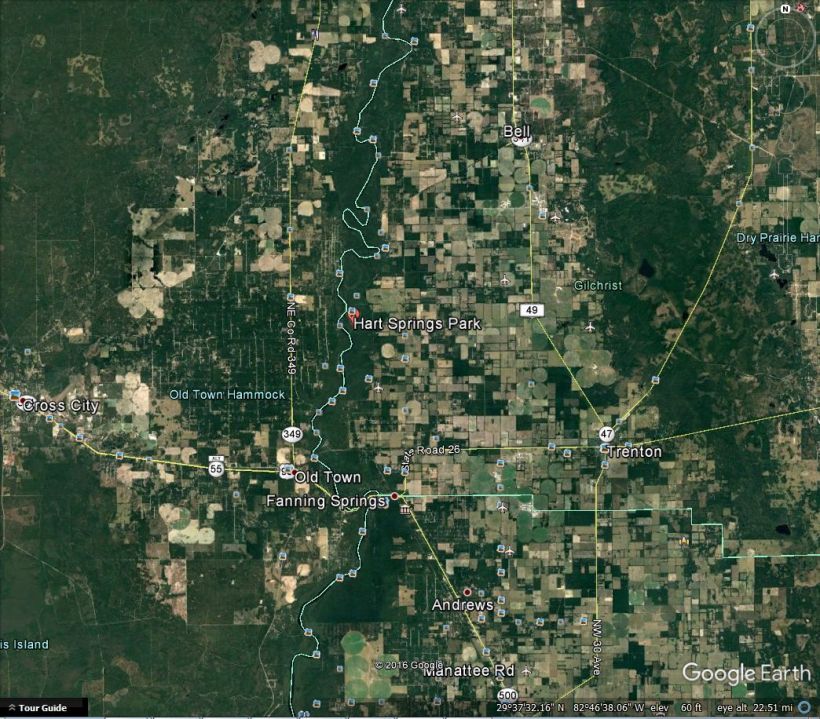
Given that it’s in a similar landscape to Fanning, I had assumed that the nutrient concentrations of Hart would be similar to Fanning, but the nitrate concentration of Hart was quite a bit lower (1.1 mg/L for Hart as opposed to 3.7 mg/L for Fanning according to Scott et al. 2004, “Springs of Florida”), at least in 2004.  The phosphorus concentrations were similar and fairly high (~0.07 mg/L according to Scott et al. 2004).

hart springs aerial

The fish assemblages of Hart and Fanning were somewhat similar, except that Hart did not have many of the larger fish that I observed in Fanning, with the exception of striped mullet (Mugil cephalus), which seem to be in every spring with a connection to a big river.  In both springs, I saw relatively few large fish (except mullet) and a lot of algae.  There were, however, a million turtles in Hart Spring.

Turtles getting startled by my approaching kayak.

And there were a billion snails.  They appeared to be banded mystery snails (Viviparous geogianus), which are the snails found in the Native American middens.

DCIM100GOPRO

Banded mystery snails dotting the sediment near the mouth of Hart Spring.

And, surprisingly, given that I never saw them, there were two manatees!  I was stunned when I downloaded the video.  I had paddled out into the river just a tiny bit so that I could test the water temperature and the dissolved oxygen concentration in the river.  As I was paddling back in, apparently, I also startled the manatees.

Manatees swimming out of Hart Spring and back into the brown Suwannee River water.

I also caught another swamp darter (Etheostoma fusiforme) on video.

The swamp darter swims out of the vegetation in the center of the video and lands on a stick at the bottom of the image.  The other fish swimming around are some kind of shiner (Notropis sp.).